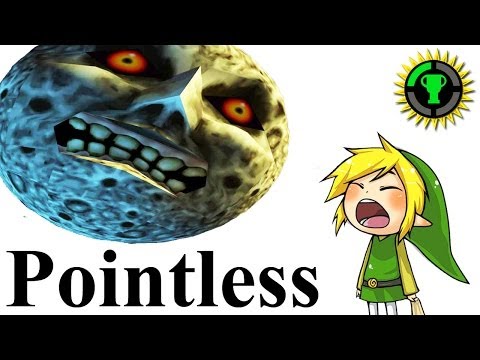
Game Theory: Is Link's Quest in Majora's Mask Pointless?
7 capitulos
- Introduction to the Moon CrisisThe SetupIn Majora's Mask, Link must work against the clock to prevent the moon from crashing into the planet and killing everyone.Central QuestionThe episode examines whether the falling moon would necessarily result in instant death or if Link's efforts to stop it are truly futile.Key PremiseWhile it seems obvious that a giant space rock hurtling toward a planet equals death, the actual threat may be something different entirely.Episode PurposeTo determine if the moon falling is actually as catastrophic as it appears, requiring analysis of size, speed, and energy.
- Calculating the Moon's SizeScale Reference• Ganondorf is 230cm (about 7'6") tall according to Hyrule Historia • Young Link is approximately 4'2" tall • Adult Link is about 1.5m (5') tall at full heightMeasurement Method• Character model comparisons with scenes of Link and Ganondorf together • Verification using Dr. Mizumi's lab diving pool in Ocarina of Time with meter marks and Iron Boots • Photoshop grid analysis comparing the moon to Clock Town's outer wall markingsMoon DimensionsThe moon is approximately 50 times Link's height, making it about 208 feet or 63.5 meters wide.PerspectiveEarth's moon is nearly 55,000 times larger with a diameter of 3,474km, making Majora's moon comparatively tiny.
- Determining the Moon's Mass and DensityVolume CalculationUsing the sphere volume formula (4/3πr³), Majora's moon has a volume of approximately 134,000 cubic meters.Density AssumptionThe moon is assumed to have the same density as Earth's moon, which is 3,346 kilograms per cubic meter.Final MassMajora's moon has a mass of approximately 450 million kilograms, equivalent to about 75 Great Pyramids.Comparative ScaleEarth's moon is 1.6 quadrillion times more massive than Majora's moon, demonstrating the significant size difference.
- Analyzing Fall Speed and Kinetic EnergyMeasuring VelocityBy observing from Termina Field on the final day, the moon falls 27 grid marks during the world's last 5 hours, traveling approximately 1.6 meters per hour.Speed ComparisonThe moon travels at 0.001 miles per hour, which is 30 times slower than a snail.Energy CalculationUsing the kinetic energy formula (KE = 0.5mv²), the falling moon produces only 36 Joules of energy.Energy Context• Your body releases twice that energy as heat in just one second • 1 Joule equals the energy needed to lift an apple 1 meter • The energy is equivalent to lifting 36 apples
- Comparing Impact Energy to Planetary DestructionDestruction ThresholdAccording to research from the University of Leicester, it would take 2.25 × 10³² Joules of energy to destroy a planet like Earth.Moon's InadequacyWith only 36 Joules of energy, the moon's impact would be stopped by Clock Town's clock tower if it could withstand the weight.Ironic RealityDespite its terrifying appearance and the urgency in the game, the moon poses virtually no threat through direct impact.The Real ProblemThe true danger arrives long before the moon reaches the planet.
- Final Conclusion: The Real DangerActual ThreatThe moon's danger is not from direct impact but from the combination of shifting waters, fluctuating gravity, destabilized orbit, altering climate, and intense weather conditions.Survival RealityWith the moon hanging so low in the sky so early in the game, Link would be lucky to survive long enough to see the moon actually touch down.Game vs RealityNo amount of repeating the same 3 days would change the realistic damage caused by a moon approaching this closely to the planet.Theory SummaryThe episode demonstrates that while the game presents the moon as an asteroid-like threat, the real catastrophe would be gravitational and environmental destruction occurring before any impact.