Les différents déchets
Les déchets minéraux représentent presque 70% des déchets produits, suivis des déchets non minéraux non dangereux (28%) et des déchets dangereux (3,5%).
Mineral waste represents almost 70% of waste produced, followed by non-mineral non-hazardous waste (28%) and hazardous waste (3.5%).
3 chapters
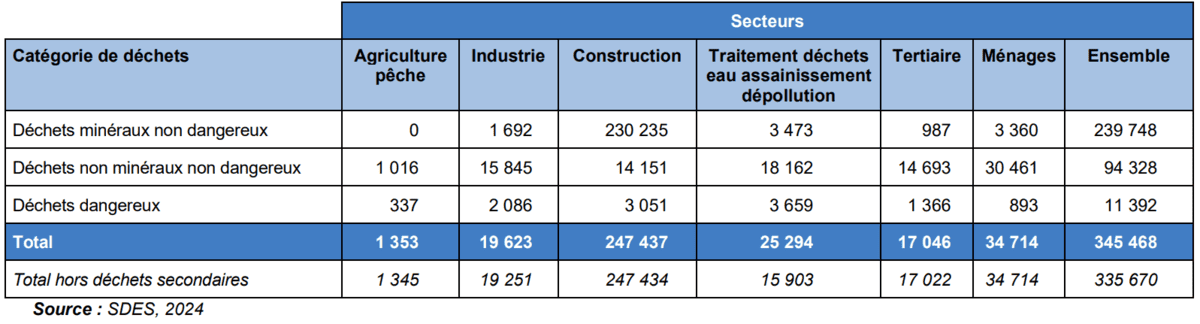
- Waste production in France, 2022 (in thousands of tonnes)General context• In 2022, France produced 345 million tonnes (Mt) of waste, compared to 355 Mt in 2010. • This represents 5.1 tonnes of waste per capita, a level close to the European average. • Data from the SDES study (2024) show a total of 345,468 thousand tonnes of waste produced, of which 335,670 thousand tonnes excluding secondary waste.Waste categories• Mineral and inert waste, totalling 240 Mt, represents 69% of total waste produced. It consists almost entirely of waste from construction, concrete, brick, glass, treated wood, plastics, etc. • Hazardous waste, including asbestos, crop protection products, batteries, solvents, etc., requiring specific treatment facilities and posing a risk to human health and the environment, accounts for 11 Mt, or 3% of total tonnage; • Non-mineral non-hazardous waste, with production reaching 94 Mt, is other waste produced by all sectors of activity, agriculture, industry, services, and households.Breakdown by waste type• Non-hazardous mineral waste: this category is the largest with a total of 239,748 thousand tonnes. It is largely dominated by the construction sector (230,235), well ahead of households (3,360), waste treatment (3,473) and industry (1,692). Agriculture and fishing produce no waste in this category. • Non-hazardous non-mineral waste: this category totals 94,328 thousand tonnes. The main contributors are households with 30,461, followed by the waste treatment, water, sanitation and remediation sector (18,162), industry (15,845), and services (14,693). Construction (14,151) and agriculture and fishing (1,016) also contribute. • Hazardous waste: this category represents the smallest volume, at 11,392 thousand tonnes in total. Waste treatment (3,659) is the leading producer, followed by construction (3,051) and industry (2,086). Services (1,366), households (893) and agriculture and fishing (337) account for the remaining volumes.Breakdown by sector• The construction sector is by far the largest waste producer with 247,437 thousand tonnes (mainly non-hazardous mineral waste). • households: 34,714 thousand tonnes; • waste treatment, water, sanitation and remediation sector: 25,294 thousand tonnes; • industry: 19,623 thousand tonnes; • services: 17,046 thousand tonnes; • agriculture and fishing: 1,353 thousand tonnes. • Source: SDES, 2024
- Production of non-mineral, non-hazardous wasteBy sector• In 2022, 94.3 million tonnes of non-mineral, non-hazardous waste was produced in France, representing 27% of waste. The largest producers are households with 32%, followed by the waste treatment, sanitation and remediation (WDSR) sector with 19% and industry with 16%. • Production of non-mineral, non-hazardous waste declined slightly between 2018 and 2022, falling from 95.6 Mt to 94.3 Mt. Some sectors have reduced their production, such as industry which reduced by 12%, services by 15% and waste treatment, sanitation and pollution by 9%. • These decreases are partly offset by increased waste production from other sectors: household waste increased by 17%, construction sector waste by 8% and agriculture and fishing waste by 3%.By type• Excluding household waste, non-mineral non-hazardous waste comprises 22.4% metal waste, 11.6% mixed materials, 10.1% sorting residues and comparable proportions of wood waste and paper and cardboard. • For industrial waste, wood waste, ferrous metals, thermal operation residues and paper-cardboard represent over 50% of tonnages. • Nearly half of non-mineral non-hazardous waste produced in the services sector is ferrous metals and waste similar to household waste. • More than a third of non-mineral non-hazardous waste produced in the water and waste collection and treatment sector consists of sorting refuse. The remainder is distributed mainly between scrap metal recovery activities and incineration slag production. • The construction sector produces 3.8 million tonnes of packaging, representing nearly 30% of non-mineral non-hazardous waste produced by this sector, as well as 3.0 million tonnes of metal waste, 2.2 million tonnes of dredging sludge and 1.7 million tonnes of wood waste.
- Production of hazardous wasteOverview• Hazardous waste represents 3% of waste produced in France in 2022. Its production shows a slight decline between 2018 and 2022, falling from 12.0 Mt to 11.3 Mt. • They represent a small share of total waste tonnage but their toxic, flammable and explosive nature makes their collection and treatment more difficult and costly than other waste. • More than half of hazardous waste tonnage comes from incineration flue gas treatment residues, treatment sludge, chemical residues, electrical and electronic equipment waste and hydrocarbons.By sector• Over 75% of hazardous waste is produced by four sectors: waste treatment, sanitation and remediation, construction and industry, and services. • The largest producer is the waste treatment and remediation sector, accounting for 3.6 million tonnes of hazardous waste (32%). 3 million tonnes, or 26%, comes from the construction sector. • Another quarter comes from industry with 2 million tonnes. • 1.3 million tonnes come from the services sector. The remainder consists of hazardous waste from households (0.8 million tonnes) and a small share from the agricultural sector (0.3 million tonnes).