Les filières à responsabilité élargie du producteur
En 2021, les 14 filières à responsabilité élargie du producteur françaises ont pris en charge 9,4 millions de tonnes (Mt) de produits, sur un gisement estimé à 16,3 millions de tonnes. Les éco-contributions (cotisations financières) perçues par les éco-organismes agréés pour organiser prévention, collecte et traitement s’élèvent à 1,8 milliard d’euros (Md€) dont 0,8 milliard d’euros est reversé aux collectivités territoriales qui assurent en partie la collecte et le tri.
In 2021, France's 14 extended producer responsibility schemes managed 9.4 million tons (Mt) of products, from an estimated total resource of 16.3 million tons. Eco-contributions (financial fees) collected by approved eco-organizations to organize prevention, collection and treatment totaled €1.8 billion, of which €0.8 billion was returned to territorial authorities responsible for part of the collection and sorting.
5 chapters
- What is an extended producer responsibility scheme?Origins and legal framework• The principle of waste management responsibility by economic actors (manufacturers, distributors, importers, market operators) dates from 1975 and was codified in article L.541-10 of the environmental code. This system, gradually refined and expanded, addresses the need to organize the management of specific waste streams, whether due to their volume like packaging, their specific nature like end-of-life vehicles, or their hazardousness like waste oils. The first scheme was established following the decree of April 1, 1992 on household packaging.The AGEC lawThe anti-waste law for a circular economy, known as the AGEC law, adopted on February 10, 2020 significantly modifies the organization system of schemes. Today, the objective is no longer merely to treat generated waste, but also to prevent it. The obligation now requires acting on the entire product lifecycle, particularly by encouraging eco-design and extending product lifespan, as well as promoting repair and reuse.Organization by eco-organizationsProducers generally choose to organize collectively to fulfill these obligations through non-profit eco-organizations, approved by public authorities. The anti-waste law for a circular economy strengthened the definition of quantified targets to achieve regarding collection, reuse, repair, reuse, recycling, recovery and especially eco-design of products and modified the penalty regime applied to eco-organizations.
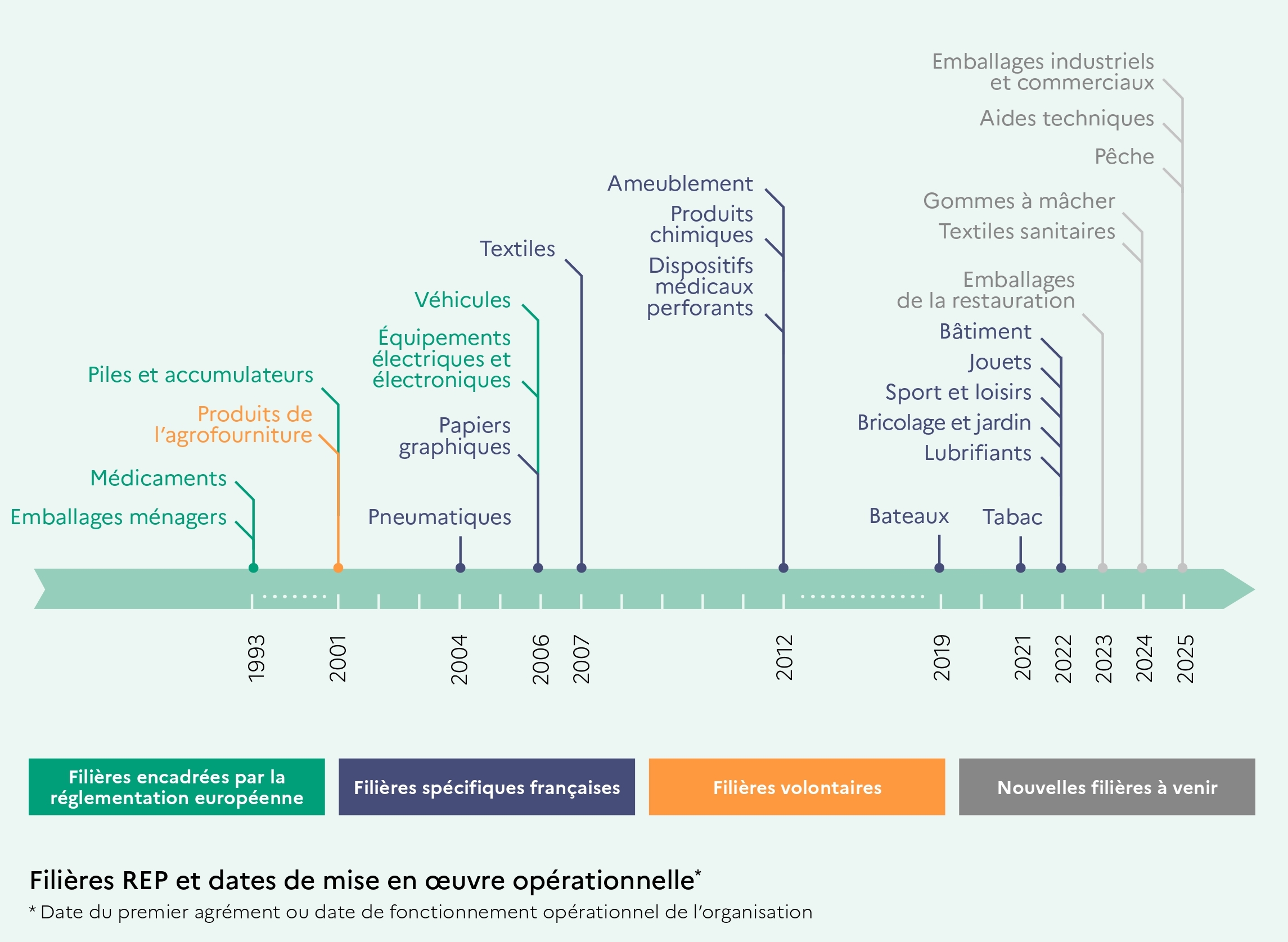
- The 24 extended producer responsibility schemesScheme rolloutFrance has 24 extended producer responsibility schemes that are being implemented progressively: in 2022, 19 schemes covering household or professional products are operational. Five additional schemes are expected to launch by 2025.Construction sector scheme• One of the most recent schemes is for construction products and materials in the building sector, which launched on January 1, 2023. The building sector produces over 40 million tons of waste annually, equivalent to the annual waste quantity produced by households. This scheme will strengthen the network of collection points accessible throughout the territory for building craftspeople and businesses to manage waste closer to construction sites. It will also support local authorities responsible for building waste brought by individuals, and promote reuse and recycling of this waste. One objective is to provide a concrete solution to illegal dumping through a free waste recovery principle financed by approved eco-organizations (Ecomaison, Ecominero, Valdelia and Valobat). The specifications include collection, recovery and recycling targets. The recovery rate for inert waste must increase to reach 88% by 2027, and for all waste (excluding metals) 57%.
- Activity of extended producer responsibility schemesProduction and collection by waste type in 2021In 2021, 9.4 Mt underwent separate collection (from a total resource of 16.3 Mt). Eco-organizations received €2 billion in revenue (of which €1.8 billion in eco-contributions). They returned €830 million to local authorities responsible for much of the collection and sorting. The remainder directly financed operational collection and treatment costs of €738 million and other expenses of €403 million.
- The largest schemes by volumeHousehold packagingEstablished in 1992, the extended producer responsibility scheme for household packaging is France's largest scheme, with an estimated resource of 5.3 Mt and 3.8 Mt recycled. Eco-contributions totaled €834 million in 2021. The scheme's eco-organizations are Citeo, Adelphe and Léko. Overall in 2021, across all materials, the recycling rate is 72.3%. Note that the scheme's specifications set a household packaging recycling target of 75% in 2022.End-of-life vehicles• The system in effect since May 24, 2006 and modified by the decree of February 4, 2011 requires end-of-life vehicle owners to hand them over to approved centers. In 2020, 1,680 centers and 59 shredders approved by prefectures were authorized to process end-of-life vehicles. These centers handled 1.33 million end-of-life vehicles, totaling 1.5 Mt. • On average, an end-of-life vehicle is reused or recycled at 87.6% (85% target) and reused or recovered at 95.7% (95% target).Furniture elementsThe furniture waste scheme became operational at the beginning of 2013. Two eco-organizations are approved to ensure collection and processing: Eco-mobilier and Valdelia. In 2021, eco-contributions totaled €333 million. 3.29 Mt of furniture elements were placed on the market and approximately 1.26 Mt were processed by the scheme. The order of November 27, 2017 specifies the obligations and objectives of eco-organizations for household or professional furniture waste. For 2021, treatment objectives were met: for separately collected tonnages declared, the recycling/reuse rate is 48.5%, versus a minimum of 45% expected, and the recovery rate is 90.7% (87% target).
- The electrical and electronic equipment waste schemeHousehold electrical and electronic waste• This scheme launched in two phases, in August 2005 for professional electrical and electronic equipment waste and in November 2006 for household electrical and electronic equipment waste. • In 2021, the scheme represented a collected tonnage of 874 Mt (+13% compared to 2020) and total eco-contributions of €361 million. Three eco-organizations are approved to ensure collection and processing of electrical and electronic equipment waste: Soren for photovoltaic panels, Ecologic and Ecosystem for other categories. Seven equipment categories are collected—ranging from large equipment to lamps—from local authorities, distributors, and social and solidarity economy actors. With a global collection rate of 53%, the collection target set in the eco-organization approval specifications (65%) is not being met.Professional electrical and electronic wasteProfessional electrical and electronic equipment waste involves lower collected quantities of around 121 Mt, up 55% compared to 2020. The collection rate achieved by eco-organizations (ratio between quantities collected plus quantities exported and the average of the three previous years of quantities placed on the market by members) is 33.5% across all categories, compared to 23% in 2020.
Further reading
- Article L.541-10 du code de l’environnementlegifrance.gouv.fr
- La loi Anti-gaspillage pour une économie circulairelegifrance.gouv.fr
- Filières à responsabilité élargie des producteursnotre-environnement.gouv.fr
Les différentes filières à responsabilité élargie des producteurs sur le site du ministère de la Transition écologique et de (…)
- Les filières à responsabilité élargie des producteursnotre-environnement.gouv.fr
Découvrez les filières à responsabilité élargie des producteurs sur le site de l’Ademe (Agence de la transition écologique)