Acidification des océans
L’acidification des océans constitue un défi majeur, à la fois pour la biodiversité marine et pour la capacité des océans à continuer de fonctionner comme puits de carbone. En effet, en absorbant une part significative des émissions de dioxyde de carbone (CO2) – un quart du CO2 rejeté par les activités humaines depuis la révolution industrielle –, l’océan joue un rôle essentiel dans la régulation du climat. Toutefois, cet excès de CO2 perturbe la chimie de l’océan mondial et a des effets néfastes sur de nombreux organismes marins.
Ocean acidification represents a major challenge for both marine biodiversity and the ocean's capacity to continue functioning as a carbon sink. Indeed, by absorbing a significant share of carbon dioxide (CO2) emissions—one-quarter of the CO2 released by human activities since the industrial revolution—the ocean plays an essential role in climate regulation. However, this excess CO2 disrupts the chemistry of the global ocean and has harmful effects on numerous marine organisms.
2 chapters
- Global IssuesAcidification Mechanism• Ocean acidification is a consequence of increased atmospheric CO2 concentration from human activities. One-quarter of CO2 is absorbed by the ocean in dissolved form or in living organisms (photosynthesis, skeletons) and eventually in marine sediments. Through chemical reaction, CO2 transforms into carbonic acid: the ocean gradually acidifies. The parameters of carbonate chemistry change. This phenomenon poses a major risk for certain plankton, corals, and marine biodiversity. • Indeed, ocean acidification affects the ability of certain phytoplankton to grow and renew themselves. If pH is too low, these species can no longer structure their calcium carbonate skeleton and struggle to develop, even though they form the base of the marine food chain and contribute to oxygen production.Coral and Reef Impacts• Ocean acidification also affects corals. These animals produce a calcium carbonate skeleton that contributes to reef formation. Like plankton, in acidic conditions, corals find it difficult to develop their skeleton. Due to climate warming, increased water temperature also causes their bleaching. Their degradation or disappearance leads to the decline of an entire ecosystem—fish, algae, and crustaceans linked to these reefs, which rank among the most biodiverse ecosystems. • Reefs also provide coastal human communities with numerous services (protection against storms, tourism and underwater recreation, food supply, water purification, etc.) and contribute to local development. Conversely, other environmental impacts from human activities on the coast (overfishing, land pollution, coastal urban development, etc.) compound with ocean acidification and rising sea levels to weaken coral reefs. The disappearance of coral reefs in favor of more mundane algae-dominated ecosystems is a marker of ocean vitality and their capacity to continue functioning as carbon sinks.Planetary Boundary and Aragonite Saturation• Thus, one of the planetary boundaries concerns ocean acidification. It is characterized by the average saturation state of aragonite (Ωarag, a particular form of carbonate) in marine waters. Indeed, for the three types of calcium carbonate (aragonite, calcite, carbonate), the concentration of carbonate ions strongly influences the saturation state of the mineral in seawater. If ocean pH decreases, the concomitant reduction in carbonate ion concentration leads to a decrease in seawater saturation state (in aragonite or calcite). If the saturation state falls below 1, the calcium carbonate produced by marine organisms to make their shells solid becomes soluble. Aragonite undersaturation means the waters will become corrosive to calcium carbonate shells and to most coral systems. • Thus, a threshold for Ωarag was defined (Rockström et al., 2009) at 80% or more of its preindustrial level (Ωarag = 3.44 in 1850). In 2009, it stood at 2.9, or 84% of the preindustrial value. Continuing at the same rate through 2050, Ωarag would reach 2.80, or approximately 80% of the preindustrial level.Outlook to 2100?• The future state of the oceans depends on how much CO2 will be emitted into the atmosphere in the coming decades. The Intergovernmental Panel on Climate Change (IPCC) analyzes projections grouped into four possible CO2 concentration pathways (representative concentration pathways or RCP) based on the emissions profile of greenhouse gases (GHG). • Two pathways are illustrated here: RCP2.6, the most optimistic, projects sharp GHG emission reductions with a peak before 2050 (this pathway is consistent with a maximum 2°C warming by 2100). RCP8.5, the most pessimistic, projects increased emissions at current rates (it leads to probable warming of 4°C in 2100). • In the RCP2.6 case, surface water temperature and pH could increase by 0.71° and 0.07 pH units respectively. In the RCP8.5 case, they would increase by 2.73° and 0.33 pH units (a 170% increase in acidity compared to 1850). • According to the IPCC (2014), under RCP2.6, it is at the moment of doubled atmospheric CO₂ concentration relative to the preindustrial period that the goal of warming no higher than 2°C would be exceeded by 2100. At this tipping point, Ωarag would reach 2.29 (Guinotte and Fabry, 2008), or 67% of the preindustrial level, well beyond the planetary boundary.
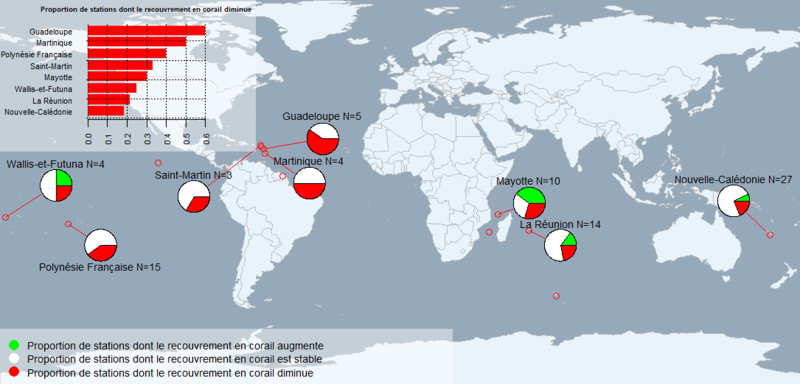
- France's SituationNational Context• France, given its population size and lifestyle, is responsible for 1% of global CO2 emissions that cause ocean acidification. However, its average emissions per capita remain well above the limit needed to prevent warming from exceeding 2°C by 2100 (see "Climate Change") and consequently beyond the limit that would prevent excessive ocean acidification. • Ocean acidification is important for France because the country has more than 11 million km² of exclusive maritime economic zones and represents approximately 20% of the world's atolls and 10% of all reefs across a coastline exceeding 5000 km.Acidification Accelerates in Mediterranean• In France, CNRS-INSU researchers are studying ocean acidification in the Villefranche-sur-Mer harbor in the Mediterranean (Kapsenberg et al., 2017). Their recent work shows extremely rapid changes. Over 2007–2015, surface water temperature increased by 0.7°C. pH decreased by 0.003 units per year, representing nearly a 7% increase in acidity, corresponding to one of the highest acidification rates recorded to date. • Without knowing the preindustrial level of Ωarag in this part of the Mediterranean, it appears that the rate of decrease observed by researchers would lead by 2050 to a level equivalent to approximately 60% of its 2007 value, a decrease clearly exceeding the boundary indicated above.What Are Acidification Impacts in France?• Acidification harms oyster and fish health. The AiAiAi project (Acidification, acclimation and adaptation of bivalve mollusks), led by IFREMER since 2017 in Brittany and French Polynesia, examines acidification effects on bivalve mollusks and their adaptive capacity to this phenomenon. Trials involve two generations of oysters and fish. • Two oyster species are studied: the Pacific oyster in mainland France and the black-lip pearl oyster overseas. Breeding stock and their offspring are exposed to acidification and temperature conditions reflecting current trends and IPCC projections through 2100 (pH decreased by 0.3 units, temperature increased by 3°C). • Results show negative effects on oysters' disease resistance (ANR Gigassat project). For fish, trials begun in 2013 with different pH levels matching IPCC forecasts for 2050 and 2100 show negative consequences on reproduction, which occurs earlier at lower pH. • Acidification also affects many Lophelia pertusa reefs. Lophelia pertusa is a cold-water coral (between 4 and 13°C) found in most oceans but particularly in the Northeast Atlantic. It generally lives at depths below 40 meters. It forms reefs composed of polyp colonies producing an aragonite skeleton, usually white. These reefs provide a highly favorable habitat for numerous species. • Known for centuries, Lophelia pertusa reefs have only recently been studied due to challenges of deep-sea exploration. To address threats to these reefs from human activities including trawling, protection measures have been implemented in recent years, particularly under the OSPAR Convention and Natura 2000 implementation. In 2018, a Natura 2000 site was designated in mainland waters to protect these reefs in the Gulf of Gascony and off the Sea of Iroise. • Live coral coverage decreased at 29% of monitored sites in French overseas territories. One cause: acidification. • France possesses tropical coral reefs in three of the planet's oceans (Atlantic, Pacific, and Indian). It hosts 10% of the world's tropical coral reefs, ranking fourth globally. Covering 55,000 km², reefs are distributed across ten overseas municipalities or departments: Antilles (Guadeloupe, Martinique, Saint-Martin, and Saint-Barthélemy), Mayotte, Réunion, New Caledonia, French Polynesia, Wallis and Futuna, and Scattered Islands in the Indian Ocean. France has global responsibility for conservation and sustainable management of these ecosystems. • Consequences of climate warming, natural phenomena (hurricanes, algal blooms, etc.), and human activities (tourism, pollution, overfishing, etc.) mean 29% of monitored sites in French overseas territories showed decreased live coral coverage in 2017.New Caledonia Strengthens Reef Protection• New Caledonia is home to the world's second-largest barrier reef. According to the Institute of Research for Development, its coral reefs are healthier than in other territories but remain threatened. During the sharp temperature increase recorded in 2016, 90% of fringing reefs, the most resistant, were affected and bleached. Since then, they have managed to regenerate. • Additionally, coral skeletons are weakened by water acidification and a new starfish proliferation. Human activities related to tourism and, recently, green algal blooms also threaten this ecosystem. In 2014, the Coral Sea Marine Park, covering 1.3 million km², was created. It harbors rich biodiversity with over 2000 fish species, 310 coral species, and more than one-third of the planet's "pristine" reefs. In 2018, two new reserves to protect this ecosystem were established within the park: an integral reserve (7,000 km²) and a nature reserve (21,000 km²) covering more than one-third of Caledonian reefs. • To better understand all organism and community responses to ocean acidification long-term, given all relevant factors, a call for proposals was launched in 2015 by the Ministry of Ecological and Inclusive Transition and the Foundation for Biodiversity Research. Eight projects were selected: ACIDREEF, ECOSYSTEME, ICO-BIO, MERCY, COCCACE, ACIDOSCOPE, AiAiAi, PACIO. • This article is an excerpt from the synthesis report of the 2019 edition of the report on France's environment.