
Comment est utilisée l’eau douce en France ?
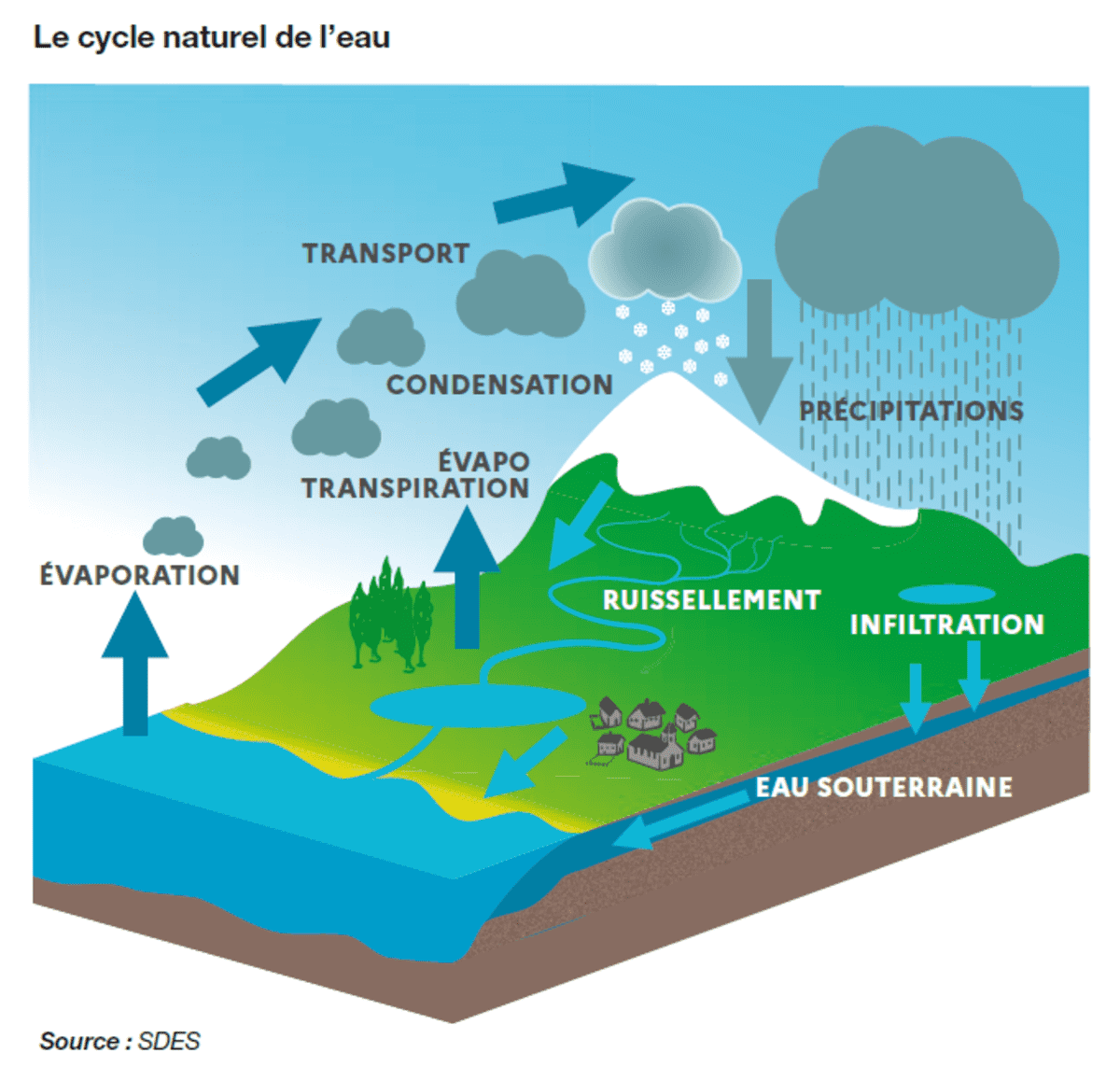
L’eau douce se trouve dans les rivières, lacs, en sous-sol dans les nappes phréatiques, glaciers… En 2022, environ 30 milliards de mètres cubes d’eau douce ont été prélevés en France pour répondre à des besoins quotidiens et économiques. Cela représente près de dix fois le volume d’eau du lac du Bourget, le plus profond de France. Ce chiffre est en baisse depuis une vingtaine d’années, hormis pour l’agriculture qui reste stable en moyenne.
Freshwater is found in rivers, lakes, underground in aquifers, glaciers… In 2022, approximately 30 billion cubic meters of freshwater were withdrawn in France to meet daily and economic needs. This represents nearly ten times the volume of water in Lake Bourget, France's deepest lake. This figure has declined over the past twenty years, except for agriculture which remains stable on average.
- Freshwater essential to human activitiesFreshwater withdrawals use• In 2022, • 45% cooled electrical power plants • 19% produced drinking water for households and services • 17% supplied navigation channels • 12% served agriculture • 7% supported industry and other economic activities Since the mid-2000s, freshwater withdrawal quantities have declined for nearly all uses except agriculture. On average, withdrawals have decreased by 1% per year since 2008 (source: Freshwater withdrawals by use in France in 2022). • Withdrawn water versus consumed water: what's the difference? Withdrawn water is not necessarily 'lost': much of it is returned to nature after use. However, 'consumed' water does not go directly back into the natural environment. It may have evaporated or been absorbed by plants, for example. On average, between 12% and 15% of freshwater withdrawn is actually consumedFreshwater sources• 80% comes from surface waters, rivers, lakes… • 20% comes from groundwater, aquifers… • Surface water is mainly used for power plants and navigation channels. For other uses such as drinking water, agriculture and industry, withdrawals are roughly divided between surface and groundwater. While drinking water is withdrawn throughout France, agricultural water is mainly drawn in the South and industrial water comes primarily from the East and North of the country.
- Different uses of freshwaterPower plants• This is the sector that uses the most freshwater in France. In 2022, 13.3 billion cubic meters were withdrawn to cool thermal power plants, particularly nuclear facilities. This represents nearly half of all withdrawals. • Withdrawals increased from the 1960s with nuclear development, then declined from the 2000s onward. The volume of water withdrawn varies depending on electricity production, weather, and reactor type. • Approximately 95% of withdrawn water is returned to nature, but it is warmer. The temperature of rejected water is regulated for each facility according to season and climate. • In 2022, 83% of cooling water came from three nuclear sites with open circuits, where water is directly exposed to air: Tricastin, Saint-Alban and Bugey, all located along the Rhône. Climate change may complicate power plant cooling. During droughts or extreme heat, less water may be available or rejected water could be too warm for rivers. This could limit electricity production, especially in summer.Drinking water• In 2022, 5.3 billion cubic meters of freshwater were withdrawn to produce drinking water, meaning water for human consumption. This represents less than one-fifth of total volume. • From 1950 to the 2000s, volumes increased greatly: they exceeded 6 billion cubic meters in the early 2000s. Since then, they have declined. In 2022, each resident 'used' an average of 81 cubic meters of drinking water, compared to 100 cubic meters in 2000. • Generally, drinking water comes mainly from groundwater aquifers. But in certain regions (Île-de-France, Brittany, Pays de la Loire, Côte d'Azur, former Midi-Pyrénées region), it is mainly withdrawn from surface waters. • Withdrawn volumes depend on population, water network organization, and presence of tourists who increase consumption during certain periods like summer.Navigation channelsNavigation channels need freshwater to remain navigable and allow circulation. In 2022, 4.8 billion cubic meters were withdrawn for this purpose, approximately one-sixth of the total. Almost all this water comes from rivers and lakes. Sometimes canal water also serves irrigation or other uses. In these cases, it is sometimes returned to nature, but not always at the same location. Withdrawals for channels occur mainly in Eastern France and around the Mediterranean.Agriculture• Agriculture uses freshwater mainly for irrigation, meaning watering crops when rainfall is insufficient. This helps improve yields or manage dry periods, especially between April and September, when rivers often have low flow. • A small amount of water is also used to provide drinking water for animals or clean agricultural facilities. • In 2022, 3.5 billion cubic meters were withdrawn for agriculture, approximately one-eighth of the total. Volumes vary year to year depending on summer rainfall. This was the case for 2022, which was an extremely dry year. To better manage these variations, more and more agricultural land is being equipped for irrigation. • In 2022, 58% of agricultural water came from rivers or lakes and 42% from groundwater aquifers. However, this depends on the region. In the South, surface water is heavily used; in the Center and West, groundwater is primarily used.Industry and other economic activities• In 2022, 2.1 billion cubic meters of freshwater were used for industry, municipalities, public services and other economic activities. This represents less than 10% of the total. • Industry alone accounts for 80% of these uses: 45% for chemicals, 15% for paper and cardboard, 15% for food and beverages. These sectors use water as an ingredient, for washing, heating or cooling. • Since the 1980s, they use progressively less water, thanks to more efficient manufacturing processes and decline in certain activities such as mining, metallurgy, construction and plastics. • Approximately 60% of water withdrawn for these uses comes from rivers and lakes. Main withdrawals occur in the Northeast and along the Rhône, where the chemical industry is very present.
Further reading
- Quelle est la consommation des ménages en eau potable ?notre-environnement.gouv.fr
En France, chaque habitant consomme en moyenne 150 litres d’eau potable par jour. Cette consommation est stable depuis 2014. Elle varie selon les régions, sous l’influence du climat, du tourisme et des habitudes domestiques.
- L’eau sous tension, surtout l’éténotre-environnement.gouv.fr
En France, chaque année la ressource en eau peut devenir problématique, principalement durant l’été. La sécheresse de 2022 a d’ailleurs été exceptionnelle.
- L’eau en France : ressource et utilisationstatistiques.developpement-durable.gouv.fr
Article web - Service des données et études statistiques - Février 2025
- Eau et milieux aquatiques - Les chiffres clés - Édition 2020statistiques.developpement-durable.gouv.fr
Datalab - Service des données et études statistiques - Décembre 2020
- Cartographie interactive des prélèvements d’eau douce par usage sur l’outil GEOIDDgeoidd.developpement-durable.gouv.fr
Base de données GEOIDD - Service des données et études statistiques