
Biomasse : une ressource renouvelable, avec des effets sur l’environnement
La biomasse est une matière organique qui vient des animaux, des cultures, des forêts, etc. Très présente en France, elle peut avoir de nombreuses utilisations (pour l’agriculture, l’énergie, l’industrie, etc.). C’est une ressource renouvelable, mais sa production n’est pas sans conséquence sur l’environnement.
Biomass is organic matter that comes from animals, crops, forests, etc. Very abundant in France, it can have many uses (for agriculture, energy, industry, etc.). It is a renewable resource, but its production has consequences for the environment.
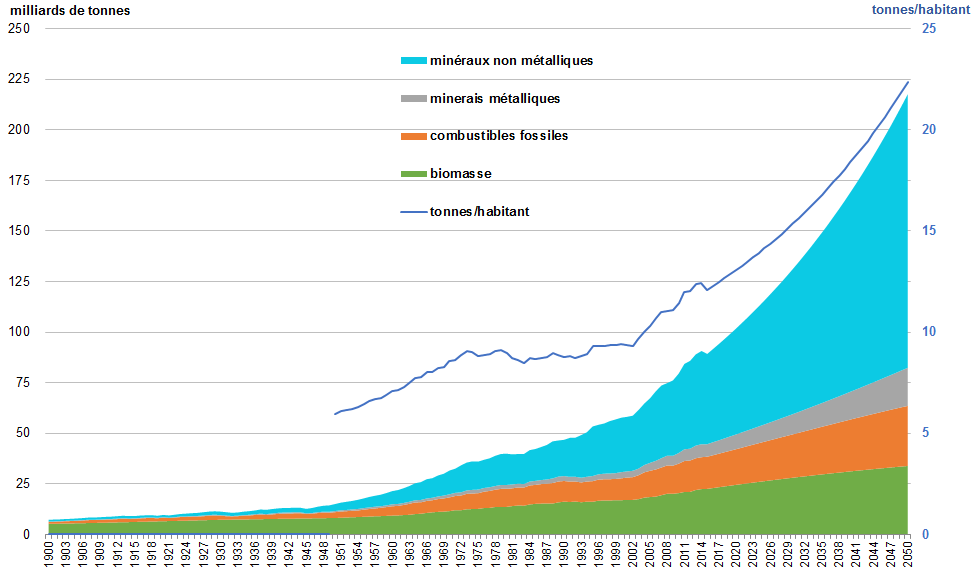
- What is biomass and what is it used for?Definition and extractionBiomass is organic matter that comes from animals and plants. In total, in France in 2022, 222 million tonnes of biomass were extracted. It is therefore the 2nd most extracted material in the country after non-metallic minerals (gravel, sand, etc.) (source: SDES for Eurostat, 2024).Distribution and trends• Here is how it is distributed: • 57% comes from crops (cereals, oilseeds, vegetables, fruits, fibres, etc.), • 26% from fodder and pasture, • 10% from wood, • 7% from fish, plants and aquatic animals, game. • Between 1990 and 2022, biomass production in France declined by 6%. However, this varies from year to year, as climate and rainfall affect crop yields.Surpluses and deficits• Generally, France produces more plant biomass than it consumes. This is called a surplus. But it depends on types of crops: • major crops (cereals, tubers, legumes) have surpluses, • oilseeds, vegetables and fruits are in deficit (we consume more than we produce).Uses of biomass• Biomass is a renewable resource useful for: • food, • construction, • industry (for example, chemicals), • energy production. • It can replace fossil or mineral resources, which are limited.
- What are the environmental effects of biomass?Agricultural land under pressure• Even though biomass is renewable, its production can have negative environmental effects. For example, overly intensive agriculture can damage soil or pollute water with chemicals (pesticides, fertilizers, etc.). Agriculture also requires resources like oil, minerals… and especially land. • But agricultural and forest land is not infinite. Some biomass-based energy sources are developing, such as biofuels, or certain specific plants (hemp, flax, miscanthus) are used for wind turbines or solar panels. These uses also require space. • If we do not carefully balance the different uses of biomass, it could become problematic: less land to produce food, fewer areas to store carbon or preserve biodiversity.Food and energy: finding the right balance• It is therefore important to organize the different uses of biomass, especially between food and energy, and to limit negative environmental impacts. • In France, biomass is the leading renewable energy source. It provides more than 55% of final energy production. It therefore contributes significantly to reducing our fossil fuel consumption. Biofuels account for 6 to 7% of renewable energy, wood 31% (source: SDES 2024). • By 2050, the amount of energy from biomass could reach 430 TWh according to one scenario of the National Low-Carbon Strategy (compared to 170 TWh in 2022). • To make good use of this resource, the National Biomass Mobilization Strategy (2018) established an order of priority: • food (human then animal), • biofertilization (that is, returning crop residues to soil), • manufacturing materials (objects, equipment), • energy production (gas, heat, electricity). • To avoid competing with food production, it is preferable to use so-called 'advanced' biofuels. They use non-edible parts of plants, agricultural residues, specific crops or waste. Algae could also enable production of so-called 'third-generation' biofuels. • Note: using crop residues for energy prevents soil from benefiting from this organic matter. Yet, maintaining healthy soils is essential to continue producing quality biomass. • Zoom: Fishing and aquaculture in France. In 2023, 323,000 tonnes of fish caught at sea were delivered to France, 185,000 tonnes of fish, shellfish, aquatic plants were produced through farming (aquaculture) (Sources: Ifremer and Agreste). Regarding fishing, fish stocks are improving: in 2024, 58% of fish caught came from healthy populations (not overfished). But be aware: the French mainly consume imported seafood, and globally, fish resources remain endangered. According to the United Nations Food and Agriculture Organization, 38% of global fish stocks were overfished in 2021 (compared to only 10% in the 1970s). Aquaculture also poses problems. For example, some farmed fish, like salmon, are carnivorous. To feed them, smaller fish must be caught, which can deplete wild fish stocks.Wood resources: increasing but forests are weakening• Unlike agricultural land, forest area is increasing in France. In 1908, it covered 19% of the territory, compared to 32% today where it spans 17.5 million hectares – roughly 6 times the size of Brittany. • But even as the forest expands, its condition is degrading because of: • climate change, • insects, fungi or diseases that weaken trees. • Result: the forest mortality rate has doubled. It increased from 7.4 million cubic metres per year between 2005 and 2013 to 15.2 million between 2014 and 2022. Conifers like spruce are particularly affected (source: IGN 2024). Forests continue to grow, but more slowly. And as tree growth declines, their ability to store carbon also decreases. • Thus, the forest increased by 0.9 cubic metre per hectare per year between 2014 and 2022, compared to 2.5 between 2005 and 2013. • Zoom: France and deforestation worldwide. France imports more wood than it exports. This represents the equivalent of 540,000 hectares (source: Solagro study 2022). It also uses land abroad to produce certain raw materials (soya, palm oil, cocoa, beef, etc.), often linked to deforestation in tropical zones. This is called imported deforestation. Between 2012 and 2021, on average, France used approximately 3.8 million hectares of land abroad per year for these raw materials. This is almost four times the size of Corsica, and represents 14% of France's agricultural land (Source: SDES, 2023).
Further reading
- Chiffres clés des énergies renouvelables 2024statistiques.developpement-durable.gouv.fr
Publication qui dresse un état des lieux actualisé des énergies renouvelables en France, avec une mise en perspective internationale – Service des données et études statistiques (SDES), collection Datalab.
- Inventaire forestier national – Mémento – Édition 2024ign.fr
Le seul dispositif qui détaille les écosystèmes forestiers et la ressource en bois de l’ensemble des forêts, publiques et privées, sur le territoire hexagonal et la Corse – Institut national de l’information géographique et forestière (IGN).