Minéraux non métalliques : des ressources très locales
La France a près de 3 000 carrières actives sur tout son territoire. Elles permettent d’extraire de nombreux minéraux non métalliques, utilisés dans l’industrie et surtout dans la construction. Mais les importations de ces matériaux augmentent régulièrement. Pour répondre à la demande croissante, le recyclage doit pouvoir s’intensifier. Il serait également possible d’utiliser des matériaux venant des fonds marins. Cela doit cependant se faire avec prudence, pour éviter des impacts négatifs sur l’environnement.
France has nearly 3,000 active quarries across its territory. They allow the extraction of many non-metallic minerals, used in industry and especially in construction. But imports of these materials are increasing regularly. To meet growing demand, recycling must be able to intensify. It would also be possible to use materials from seabeds. However, this must be done with caution to avoid negative environmental impacts.
4 chapters
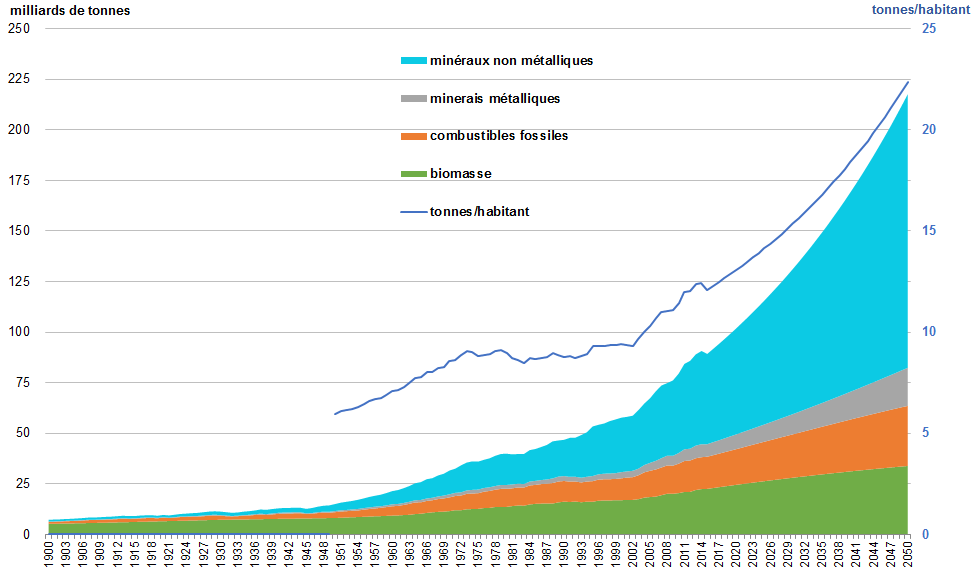
- What are non-metallic minerals used for?Definition and uses• Non-metallic minerals are minerals that include: • those used in industry (andalusite, kaolin, talc, etc.), • those used in construction (gravel, sand, solid rocks or ornamental rocks such as marble, granite, sandstone, etc.),Economic weight• Approximately 90% of these materials are used in the form of sand or gravel, mainly for building homes, public buildings, or infrastructure such as roads and railways. • By themselves, they represent more than half (55%) of the materials used by the French economy.
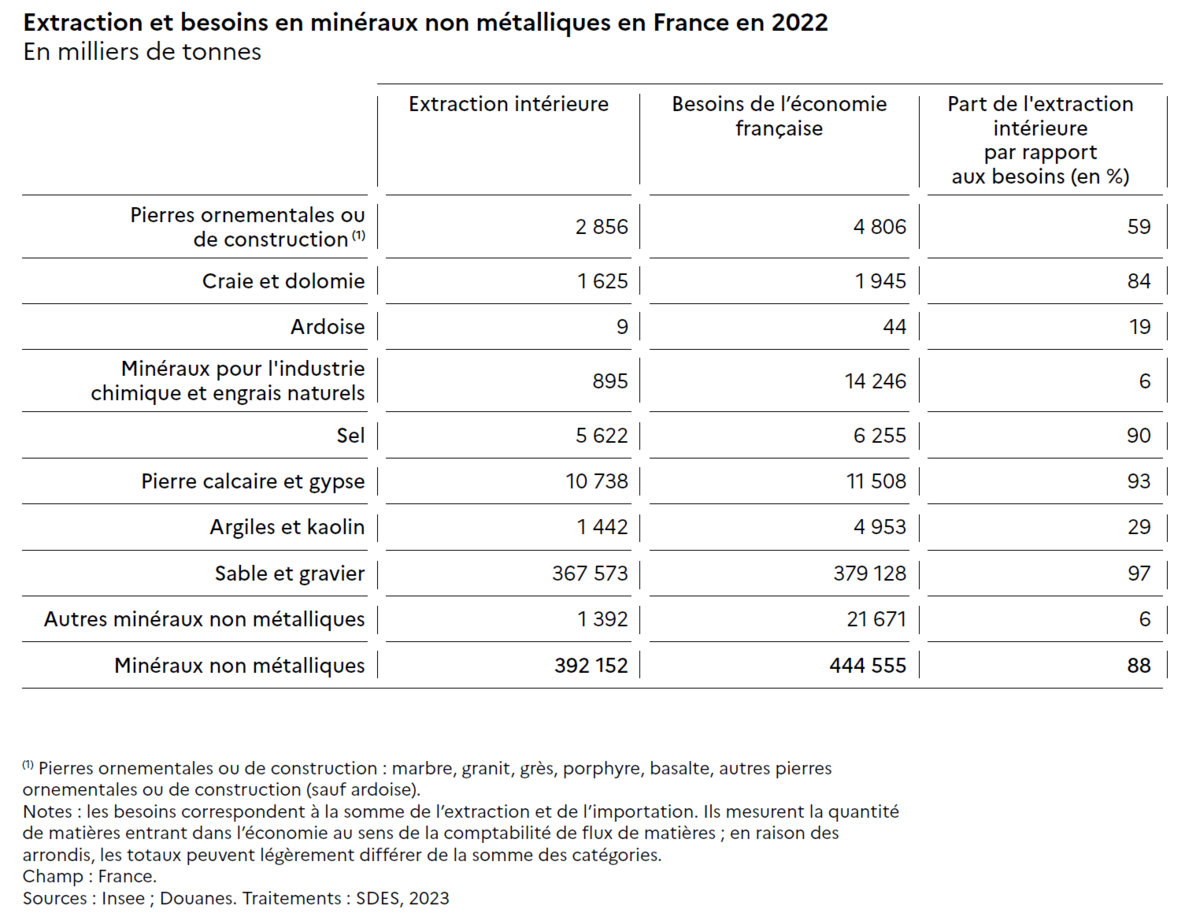
- Mostly local productionVolumes extracted in FranceIn 2022, France extracted 392 million tonnes of non-metallic minerals. (10% less than in 1990). This represents 5.8 tonnes per inhabitant. Thanks to the size of its territory, France is the 3rd largest producer of non-metallic minerals in the European Union. But if we look at the quantity extracted per inhabitant, it ranks only 21st.Meeting needsIn 2022, 88% of non-metallic mineral needs were met by French production, compared to only 0.3% for metallic minerals. This rate varies depending on the type of material. For example, it is 97% for sand and gravel, but only 6% for minerals used in chemistry or natural fertilizers, such as phosphate or potash.Local use of construction materialsConstruction materials: mainly local use Non-metallic minerals used in construction come mainly from quarries near the place of use. In 2022, more than 90% of the flows of these materials remained within regions. This phenomenon is observed in all regions.
- Imports are increasingRising importsIn 2022, France imported nearly 50 million tonnes of non-metallic minerals, or approximately 0.73 tonnes per inhabitant. These imports increased by 32% between 1990 and 2022. Until 1999, France imported as much as it exported. But since 2000, the difference between the two has increased significantly. In 2022, imports were almost twice as high as exports.Decline of French quarriesAlthough France still had nearly 3,000 quarries in 2023, their number has declined significantly since the mid-2000s: -36% between 2007 and 2023. Extracted volumes also fell 11% between 2007 and 2022. This decline is partly explained by the decrease in activity in the building sector after the 2008 crisis.
- Seabeds and recycling: resources for the future?IntroductionAggregates (small pieces of rock such as sand or gravel) are essential for construction. To meet increasingly strong demand, two alternative sources are being considered: marine aggregates and recycled aggregates.Marine aggregatesFrance has substantial marine aggregate resources, estimated at approximately 170 million m3. Their extraction has increased over the past decade, with 4.8 million m3 extracted in 2022. These materials are essential for supplying coastal areas and major waterways, particularly for the construction sector. But their extraction can harm the environment: destruction of marine fauna, seabed modification, impact on waves and currents. To limit these effects, their exploitation is regulated. A research project, called RESISTE and led by the French Research Institute for Seabed Exploitation (Ifremer), studies the regenerative capacity of seabeds.Recycled aggregatesRecycled aggregates meet approximately 25% of aggregate needs in France. 90% of these materials come from road milling. Concrete recycling is more difficult, as it is often mixed with other materials (glass, aluminium, wood, plastic), which complicates sorting. European Directive 2008/98 on waste set a target of 70% valorization of construction waste by 2020. This target is also included in French energy transition law (law no. 2015-992 of 17 August 2015). In 2022, only approximately 50% of construction waste was actually recovered in France.
Further reading
- La consommation de matières premières par l’économie française en 2022statistiques.developpement-durable.gouv.fr
Commissariat général au développement durable (CGDD), 2024.
- Les ressources minérales des fonds marinsmineralinfo.fr
Dossier pour mieux les connaître – Minéral Info, le portail français des ressources minérales non énergétiques