Les métaux face aux besoins de la transition énergétique
Depuis le 20e siècle, nous utilisons de plus en plus de métaux pour faire avancer l’industrie et les technologies. Cette tendance va encore s’accélérer dans les années à venir, surtout pour permettre la transition énergétique. Cela pose de nombreux défis : environnementaux, économiques, sociaux et même géopolitiques, pour la France et pour l’Union européenne.
Since the 20th century, we have used increasingly more metals to advance industry and technology. This trend will accelerate further in the coming years, especially to enable the energy transition. This poses many challenges: environmental, economic, social and even geopolitical, for France and the European Union.
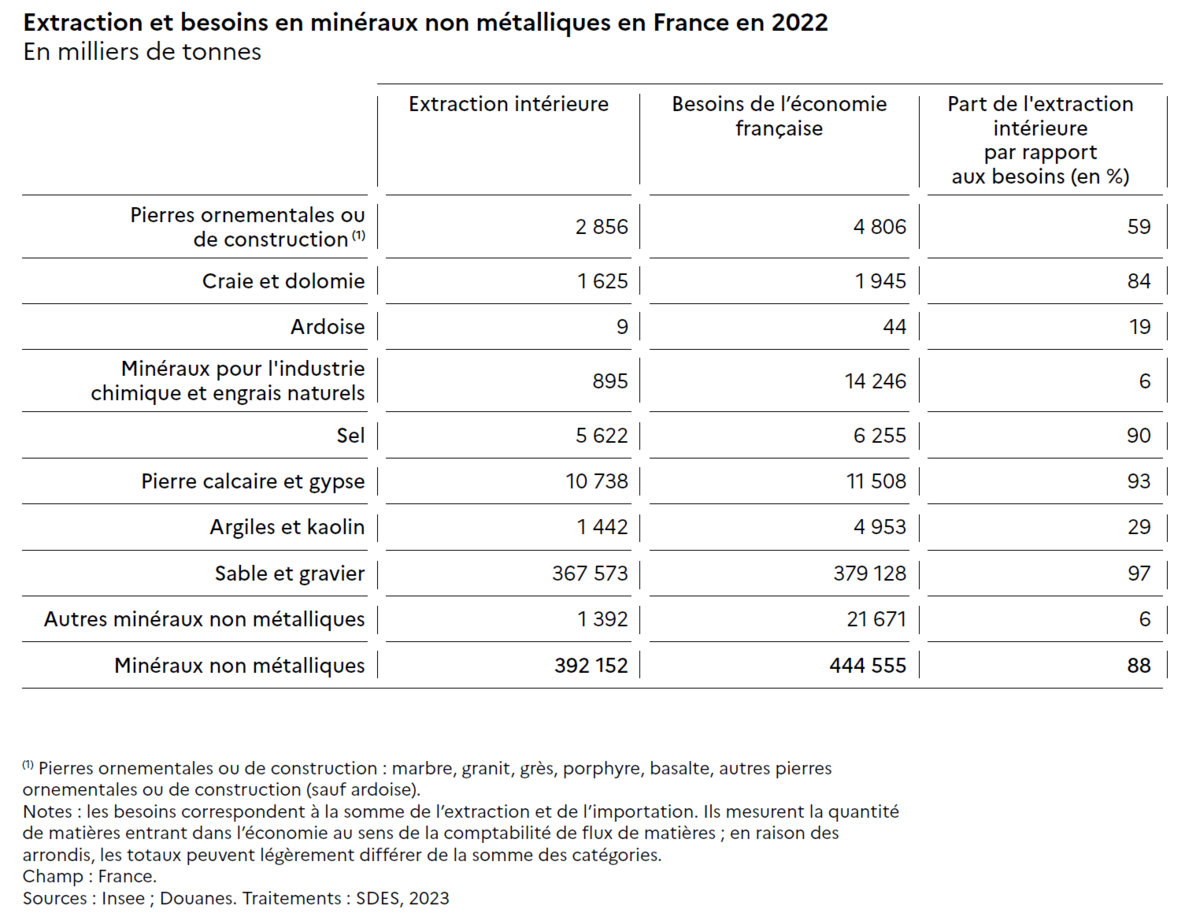
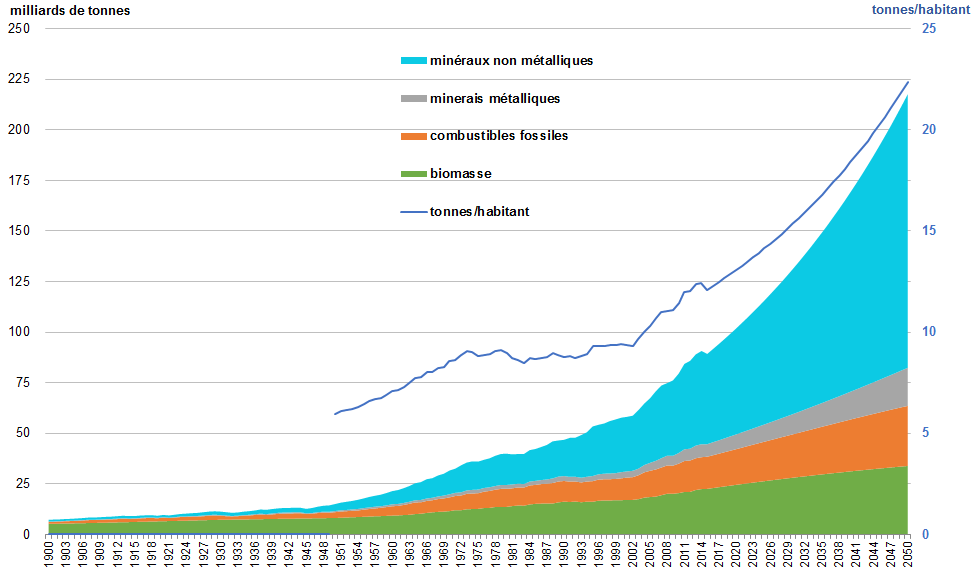
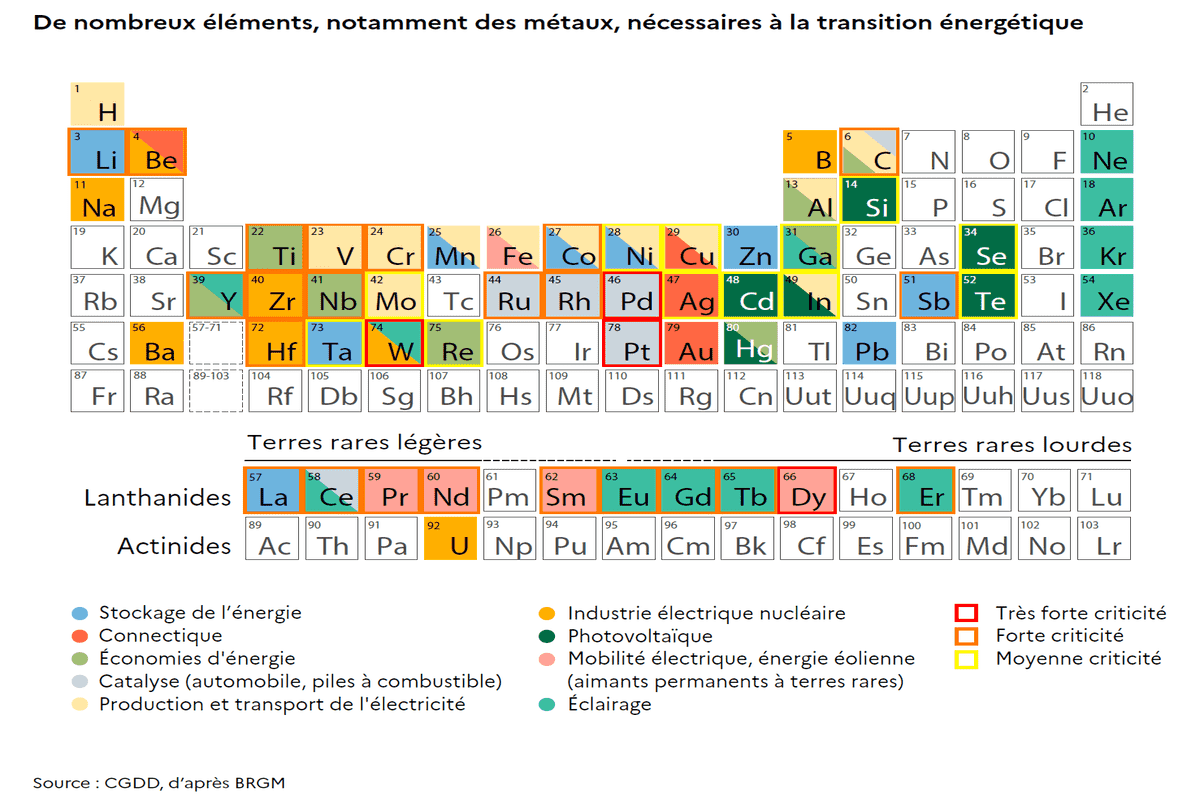
- Ever-growing demand for metalsExpanding uses• Before the 20th century, only a few metals were used: iron, copper, tin, silver, gold, and so on. The Industrial Revolution made it possible to extract more metals and discover new applications, notably through more advanced metallurgical techniques. • As a result, since the 20th century, dozens of metals have been used across many different fields, such as construction, transport, energy, computing (including computers and smartphones), and more. Today, certain metals have also become essential for developing carbon-free energy sources like wind and solar power. They are therefore indispensable for the ecological transition. • Many metals essential to the energy transitionSharp increase in extraction• Growing metal use has driven a sharp increase in their extraction, especially over the last twenty years. Globally, extraction of metal ores more than tripled over the past fifty years. It rose from 2.7 billion tonnes in 1970 to 10.6 billion tonnes today (source: UN Environment Programme). This increase is particularly high for steel production due to strong construction demand in developing countries. • However, not all metals are affected equally: • for "major metals" (copper, iron, etc.): annual extraction is measured in millions of tonnes (Mt); • for "minor metals" (rare earths, etc.), more often used for specific technological applications: annual extraction is measured in thousands of tonnes (kt). However, the relatively low mass of these "minor metals" does not reflect their economic and strategic importance. They are in fact very useful for developing new technologies and the ecological transition. • Metal extraction in France is still very low: 0.2 million tonnes per year (bauxite mainly). This figure should be compared to 392 million tonnes of non-metallic mineral materials extracted in France in 2022 (source: SDES). Most metals consumed in France (17 million tonnes in 2022) are therefore imported, either as metal ores or as products containing metals (automobiles, electrical appliances, etc.). • This situation could change in the coming years. Studies forecast a sharp increase in global metal demand for low-carbon technologies (emitting little or no CO2): for example, rare earths for offshore wind turbines and electric motors, or lithium and nickel for batteries. New extraction, processing and recycling capacities will therefore need to be developed. • > Which metals for nuclear? Nuclear power plants use metals for their construction: nickel, cobalt, titanium, tungsten, tantalum, lead, cadmium, indium, silver, selenium, boron, lithium. For nuclear fuel, we also use: • zirconium, to surround the fuel; • hafnium, which absorbs neutrons well, and especially uranium. Natural uranium is composed almost exclusively of uranium 238 and very little uranium 235, the only one that is fissile (able to produce large amounts of energy by splitting). But because it is rare, natural uranium must be enriched for use in reactors.
- Metals essential to the ecological transition: a real supply challengeCritical metals• Low-carbon technologies, necessary for successful energy transition, use many metals. Some are called "critical" because: • their supply is uncertain (unstable prices, geopolitical tensions, etc.); • they are essential for the economy. • For example: • metals used in electric vehicle batteries (such as nickel-manganese-cobalt or lithium-iron-phosphate); • rare earths, essential for making magnets in wind turbines and electric motors; • copper and aluminium, useful for modernizing electrical grids and manufacturing electrical equipment (cars, transport, etc.). • > Critical and strategic resources The European Union adopted in March 2024 a regulation (the Critical Raw Material Act) that lists 34 materials called "critical". It also defines 17 materials as "strategic", as they are used in technologies that serve simultaneously the ecological transition, digital transition, aerospace and defence.High import dependence• Today, metals used for the energy transition are primarily extracted and processed outside Europe. This makes France and the EU highly dependent on other countries, which becomes problematic as low-carbon technologies are developed. • Regardless of the metal, extraction is concentrated in a few countries. No European country is among the top three producers for these metals. Metal processing is even more centralized, with China playing a dominant role. For example, China produces 68% of rare earths and processes 90% of them. • To reduce this dependence, France and the European Union have implemented several measures. The European regulation on critical raw materials sets three objectives for 2030: • at least 10% of supply must come from extraction in Europe; • 40% must be processed in Europe; • and 25% must come from recycling in Europe. • Several mining projects are underway in Europe, including some in France, such as lithium extraction in Allier or Alsace. • This import dependence also poses problems for producing countries. Metal extraction has environmental consequences: destruction of natural habitats, energy consumption, waste production, etc. Metallurgical plants consume large amounts of energy and release pollutants (dust, contaminated water, sludge). This can also cause social tensions, for example when water used to process ores conflicts with other uses in already arid areas.Future needs ahead• Several studies have attempted to estimate metal needs by 2050 according to different low-carbon technology development scenarios. • For electric vehicle batteries, global demand could be multiplied: • by 9 if current policies are followed; • by 30 in a sustainable development scenario, by 2040. • For rare earths: • demand for electric vehicle motors could increase 18-fold by 2040; • and by 3 for wind turbines, also in a sustainable scenario. • In France, recent studies, including those from Ofremi (French Observatory of Mineral Resources for Industrial Sectors), have also estimated needs for 2035 and 2050. • According to scenarios, annual needs in 2035 would be approximately: • 10,000 to 15,000 tonnes of lithium (in metal form); • 80,000 to 100,000 tonnes of graphite, for batteries using conventional technologies (nickel-manganese-cobalt or lithium-iron-phosphate). • Three main solutions can help reduce these needs: • sobriety, by limiting vehicle and battery size, and encouraging transport modes other than private cars; • diversification of battery types, to limit use of certain critical metals; • recycling, to meet demand in the long term (after 2040), provided collection and processing techniques are improved.
Further reading
- Les ressources minérales critiques pour les énergies bas-carbone. Chaînes de valeur, risques et politiques publiquesecologie.gouv.fr
Rapport de synthèse du groupe d’experts pour la programmation des ressources minérales de la transition bas-carbone. - Commissariat général au développement durable (CGDD) - 2023.
- L’empreinte matières de la France en 2022 : un indicateur de notre consommation effective de matières premièresstatistiques.developpement-durable.gouv.fr
Analyse consacrée à l’empreinte matières, un indicateur qui permet de rendre compte de l’ensemble des matières premières mobilisées pour satisfaire la consommation finale d’un pays. - Commissariat général au développement durable (CGDD) - 2025.
- La mobilité bas-carbone. Choix technologiques, enjeux matières et opportunités industriellesort.bourgogne-franche-comte.developpement-durable.gouv.fr
Rapport identifiant les implications de la mobilité bas-carbone, notamment les besoins en ressources minérales pour les véhicules électriques en 2030 et les opportunités industrielles sur les matières premières. - Commissariat général au développement durable (CGDD) - 2022.
- Comment gagner le pari industriel de la mobilité électrique en France et en Europe ?ifri.org
Analyse des défis industriels, sociétaux, géopolitiques et économiques du déploiement massif de la mobilité électrique en France et en Europe. - Institut français des relations internationales (Ifri) - 2023.