L’eau sous tension, surtout l’été
Entre 2015 et 2022, plus de la moitié des départements en France métropolitaine ont connu des restrictions d’eau chaque été. Ce phénomène devient de plus en plus fréquent, plus sévère et plus étendu. L’année 2022 a particulièrement marqué les esprits à cause de la sécheresse très intense.
Between 2015 and 2022, more than half of the departments in mainland France experienced water restrictions every summer. This phenomenon is becoming increasingly frequent, more severe, and more widespread. The year 2022 particularly captured public attention because of the very intense drought.
2 chapters
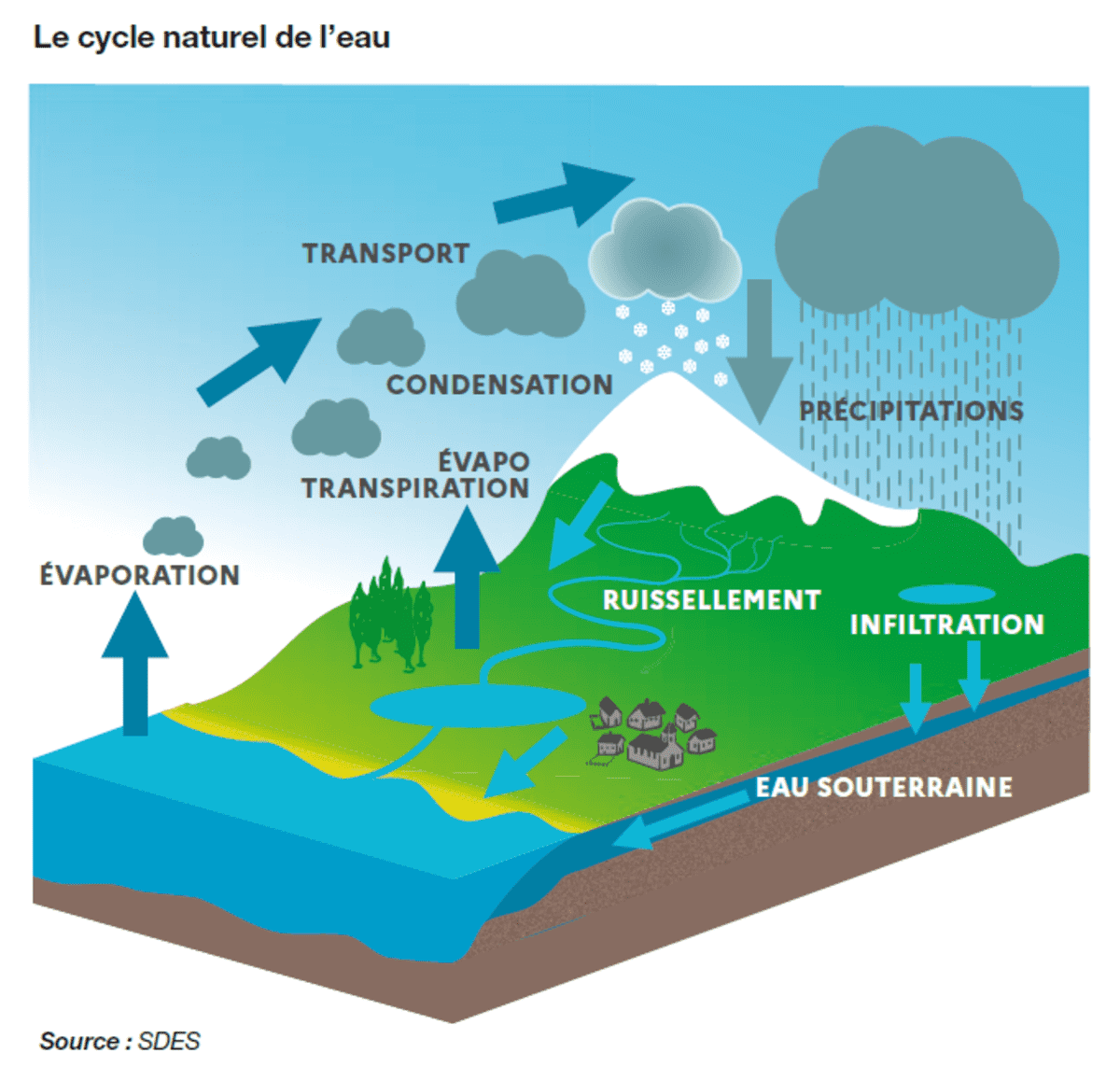
- Freshwater reserves are declining across FranceDecline since 2002• In mainland France, the amount of available freshwater varies considerably by year, season, and region. It depends 94% on rainfall. The remaining 6% comes from neighboring countries. • On average, 62% of rainwater evaporates into the air through a phenomenon called "evapotranspiration." This leaves only 38% of this water as a usable resource. • In recent years, the amount of available water is decreasing, primarily due to rising temperatures, which cause more water to evaporate, declining precipitation (rain and snow in all forms), and increasing droughts. • Between 1990–2001 and 2002–2022, water resources decreased by 14%, especially in southern France. Additionally, soil drought is expanding over time, meaning plants have less naturally available water, including crops. • Volume of water resources in mainland France, shares from precipitation and neighboring countries from 1990 to 2022 — In billions of cubic meters • : Average 1990–2001 : Average 2002–2022 : Change in % • Water resources : 229 : 198 : -14% • Share from precipitation : 217 : 186 : -14% • Share from neighboring countries : 12 : 12 : 0 • (Source: General Commissariat for Sustainable Development)Even more difficult in summer• In summer, water demand is higher. During this season, 60% of water is consumed, mainly for irrigating crops. But at the same time, water flowing through rivers represents only 15% of annual volume on average between 2008 and 2021. Temporary water shortages can therefore occur. • Distribution of renewable freshwater supply by season (average 1990–2020 in mainland France) (in %) • In autumn, September to November, it is 41%. • In winter, December to February, it is 48%. • In spring, March to May, it is 9%. • In summer, June to August, it is 2%. • Scope: Mainland France. Source: Météo-France, Hydroportail. Processing: SDES, 2023 • Water reserves are filled mainly between autumn and winter (September to March), when evaporation is weaker. This is the "recharge season," when rainwater feeds groundwater aquifers. • In contrast, from April to August, it is warmer and evaporation is greater. Rainwater is then largely used by vegetation or evaporates. This is the "low-water season," when river levels are at their lowest. • > In case of shortage: 4 levels of water restrictions. At the national level, there is no chronic water shortage yet. But there can be times when water access is more difficult. This is why local discussions take place to adjust needs. When a shortage is expected, the prefect can decide to limit certain water uses, whether from rivers, lakes, or groundwater aquifers. There are 4 restriction levels, depending on the severity: vigilance, alert, reinforced alert, and crisis. At the "crisis" level, partial or total water use bans are implemented, for example in agriculture, to preserve essential uses like drinking water, health, or civil safety. Populations may be asked to reduce water consumption by up to 50%.
- How water restrictions have evolved over the yearsRestrictions every summerEvery year, limitations are put in place to reduce water use from rivers and bodies of water. Between 2012 and 2022, the years 2017, 2019, 2020, and 2022 were those with the most frequent, broadest, and longest restrictions. For example, in 2019, they affected 30% of the country, and in 2022, 55%. In contrast, 2014 was the least affected year.2022: an unprecedented drought year• Between 2012 and 2022, restrictions were applied to about 30% of the territory over eight different periods. They generally began between May and July, with maximum severity in September. But in 2022, the situation was exceptional: • 97% of mainland France experienced restrictions on surface water use, of which 55% at crisis level; • 27% of the territory faced restrictions on groundwater use, of which 14% at crisis level. • Why? The summer of 2022 began with groundwater aquifers already poorly filled, because the previous months, since autumn 2021, had been warmer and drier than normal. In spring, soils were already very dry, which led to irrigation needs earlier than usual. A rainy June helped delay initial restrictions somewhat. But then, drought, heat waves, and lack of rain caused water demand to spike. Restrictions were therefore triggered from late July and continued even after summer.
Further reading
- VigiEauvigieau.gouv.fr
Un outil pour s’informer en temps réel sur les restrictions d’eau en période de sécheresse.