Forêts et ressources en bois en France métropolitaine
La détermination des stocks et des flux physiques permet de réaliser un bilan annuel environnemental et économique des ressources forestières françaises, ainsi qu’un bilan du stockage de carbone dans la biomasse des arbres. Sur la période 2007-2018, les surfaces et les volumes ont progressé sur le territoire métropolitain.Sur la période 2007-2018, les surfaces et les volumes ont progressé sur le territoire métropolitain.
Determining stocks and physical flows allows for an annual environmental and economic assessment of French forest resources, as well as an assessment of carbon storage in tree biomass. Over the 2007-2018 period, surface areas and volumes increased in metropolitan France.
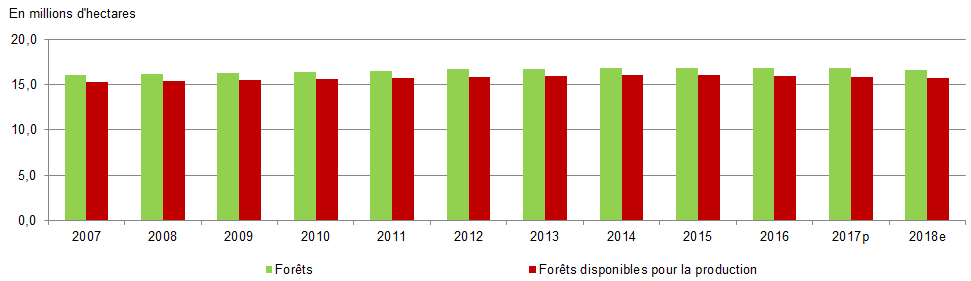
- Forest HeritagePhysical flows• At the start of 2018, France has 16.7 million hectares of forests, of which 15.7 million hectares are available for production. To this must be added 321,000 ha of copses (surface elements smaller than 0.5 ha) that also contribute to the wooded coverage of the territory. The increase in forest area observed over several years (3.8% over the 2007-2018 period) continues overall, though it appears to be slowing.Monetary flows• The average price of forest land reached 1434 euros per hectare at the start of 2018. After stagnation over the 2011-2014 period, the price of forest land appears to be rising again. Forest land is thus valued at 23.9 billion euros in 2018, of which 22.5 billion euros for production forest. • The factors that structurally influence the average price of forest land are the characteristics of the land (reflecting the potential for forest management) and land pressure (related to land uses). Since the 1999 storms, the price of forest land has been strongly correlated with the price of agricultural land. In recent years, the price of timber, reflecting growing demand, and low interest rates have boosted interest in forests, whose promotion as a "green" investment is highlighted, particularly in the recent energy transition and green growth legislation. With surface area changing little, variations in land value are essentially due to fluctuations in unit price.
- Standing timber in production forestPhysical flows• At the start of 2018, France's metropolitan forest contains approximately 3 billion m³ of standing timber available for production (total solid timber volume). The change in standing stock over the 2007-2018 period is estimated at +15.5% per year. • The average volume per hectare in French production forests is increasing over time: it is estimated at 197 m³/ha at the start of 2018, compared to 175 m³/ha at the start of 2007. • Forest capitalization continues in France, as in many other European countries. It originates from two complementary factors: • Agricultural abandonment that began in the 19th century freed up the least productive agricultural land, which progressively became forested and has generated, with a time lag, additional timber volumes. • Rural depopulation which, linked to the emergence of fossil fuels, reduced pressure on firewood, leading to the abandonment of coppice and coppice-with-standards management (TSF) and longer rotation periods: trees in these stands grow larger and their volume increases. • Physical flows consist of net biological production (production minus tree mortality: standing dead trees and regular windthrow) (+ 85.1 Mm³ in 2017) – minus removals (52.7 Mm³) and possible losses from exceptional events such as storms and droughts. Except in 2009 when 46 Mm³ of timber was felled by Storm Klaus, annual volume flows are positive, resulting in timber capitalization in the forest. • Removals thus reached 59% of net biological production in 2017 (51% in 2007). Standing timber stock accumulates, particularly in broadleaves (+ 1.4% per year over the period studied versus + 1.1% per year for conifers). Broadleaf timber stock represents 67% of the total at the end of 2017. The removal structure differs from that of conifers: broadleaves account for only 53% of the harvest (and just 44% in 2010 due to massive conifer windthrow in Aquitaine).Monetary flows• Over the 2007-2018 period, the average price of standing timber increased by 7.1%. It is subject to significant year-to-year variations. It reached 28.5 euros/m³ in 2018. The price of broadleaves, which reflects the fact that a large part of the harvest is used for energy purposes directly by consumers, amounts to 27.2 euros/m³, compared to 30.4 euros/m³ for conifers. • At the start of 2018, the value of timber stocks in French production forests is approximately 87 billion euros.
- Carbon in forestsCarbon stock• Carbon stored in woody biomass (above and below ground wood) in production forests is estimated at 1.3 billion tonnes at the end of 2017. Three-quarters of this carbon stock is stored in broadleaf timber.Change and limits• The quantity stored increases on average by 1.6% per year between the start of 2007 and the end of 2017, representing nearly 16 million tonnes of additional carbon stored each year. Increased storage capacity is linked to growing standing volume. • These estimates do not account for carbon stored in other compartments of the forest ecosystem (foliage, soil, ground vegetation).
Further reading
- Indicateurs de gestion durable de la forêtnotre-environnement.gouv.fr
Les indicateurs de gestion durable donnent un aperçu de l’état des forêts françaises et des activités qui lui sont liées, dont les activités économiques comme les industries du bois. Ils se basent sur des données issues de dispositifs de suivi, comme par exemple l’inventaire forestier national, ou d’enquêtes conduites au niveau national. Leur objectif est de fournir des renseignements fiables et partagés afin de faciliter le débat public et d’éclairer les choix de politique forestière.