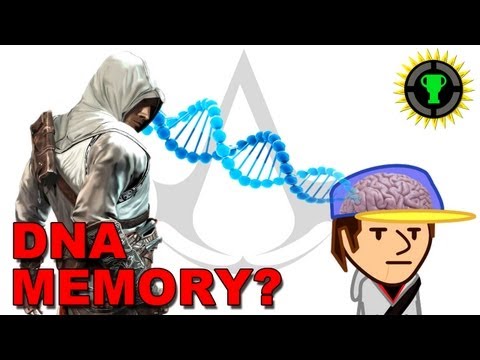
Game Theory: How Assassin's Creed Predicted the Future of Science
7 chapitres
- Introduction and BackgroundSetupMatPat was location scouting for an Assassin's Creed episode after his honeymoon, having traveled to Israel, Jordan, Rome, and Paris.Initial Findings• Discovered Solomon's Temple from the first game in Israel • Found the ancient city of Petra carved into Jordanian Desert cliffs • Realized the findings alone weren't substantial enough for an episodeChallengeInitial ideas like exposing the game's skewed perception of Middle Eastern geography seemed uninspiring as episode topics.BreakthroughViewers asked via Facebook about passing memories through genes, which sparked the actual investigation that made the episode possible.
- Assassin's Creed Lore and Genetic Memory ConceptGame PremiseThe majority of Assassin's Creed games take place inside memories passed down between generations through DNA, not in real time.Character Journey• Desmond quit his secret assassin training at age 16 • Moved to New York and became a bartender • Inherited memories from cooler assassin ancestors through his bloodlineThe AnimusA machine capable of reading genetic memories, allowing Desmond to relive his ancestors' experiences and serving as a cool but suspension-breaking plot device.Scientific QuestionThe game raises an interesting real-world question: can memories be passed down through genetic material and can we see into the minds of our ancestors?
- Jung's Collective Unconscious TheoryTheory OverviewPsychologist Carl Jung proposed that humans share certain memories from the evolution of the brain in what he called the 'Collective Unconscious.'Key Components• Contains Archetypes representing universal behaviors and traits • Anima: feminine impulses in males • Animus: masculine impulses in femalesLinguistic ConnectionAnimus is a Latin word translating to 'memory' in English, which is why Ubisoft named their memory-reading machine the Animus.Pop Culture ReferencesFinal Fantasy X also references Jung's theory with the Anima summon, named because it represents the spirit of the villain's mother.
- Instincts vs. Memories: The Scientific RealityJung's ExplanationJung's theory attempted to explain why all humans share basic instincts like yawning, blushing, and post-micturition convulsion (the post-pee shiver).The ProblemInstincts are not the result of memory or learning but rather Fixed Action Patterns (FAPS) - brain shortcuts for responding to certain stimuli.How It Works• Seeing someone yawn prompts you to yawn automatically • This reflex provides evolutionary advantage and gets hardwired into the brain • Works as a compulsion with no conscious controlGenetic LimitationGenes dictate the brain's structure and chemistry but acquiring new memories doesn't affect DNA, so memories cannot be passed to future generations through conventional biology.
- DNA Data Storage BreakthroughRevolutionary DiscoveryIn January 2013, the journal Nature reported on researchers creating flashdrives made out of DNA, making memory storage through genetic material theoretically possible.Technical Method• DNA is made of 4 interlocking bases: Adenine, Guanine, Thymine, Cytosine • Scientists created code using these bases to represent computer binary code (zeros and ones) • DNA bases form binary code that computers can translate to documents, images, and sound filesSuccessful Encodings• All 154 of Shakespeare's sonnets • 26 second audio clip from Martin Luther King's 'I Have a Dream' speech • File explaining the data conversion processStorage Capacity41 grams of DNA can fit 1 million gigabytes of data, and unlike obsolete formats like LaserDiscs and VHS tapes, DNA will never become obsolete - usable DNA from a 60,000 year old mammoth has been found.
- Cost Analysis and FeasibilityEncoding CostsIt costs $12,400 per megabyte to turn data into a corresponding strand of DNA, making the process extremely expensive.Game Disc Calculation• Xbox 360 dual-layered disc maximum: 8 GB • Actual usable capacity due to DVD burning limitations: 6.8 GB • Cost to encode one game disc: 6,800 MB × $12,400 = $84,320,000Decoding ExpensesDecoding memories from DNA back into usable form costs $220 per megabyte, adding another $1.5 million to retrieve the memories.Total Price TagThe total cost to encode and decode an entire Assassin's Creed game through DNA memory is approximately $86 million - enough to buy over 1,433,000 new games at $60 each.
- Conclusion and Call to ActionAchievementUbisoft successfully predicted in 2007 the next use of genetic research 6 years before these studies had any public attention.Practical RealityGenetic memory storage is not cost-effective yet but would logically be the first choice format for the next PlayStation console due to its extreme expense.HumorIf only Ubisoft were as good at predicting genetic research as predicting game release dates like for Rayman Legends.Viewer Engagement• Only 1 in 6 of Matthew's viewers are subscribers • Encouraged viewers to subscribe as it's the easiest way to stay informed of uploads • Expressed friendly competition with Game Grumps, needing 800,000 more subscribers