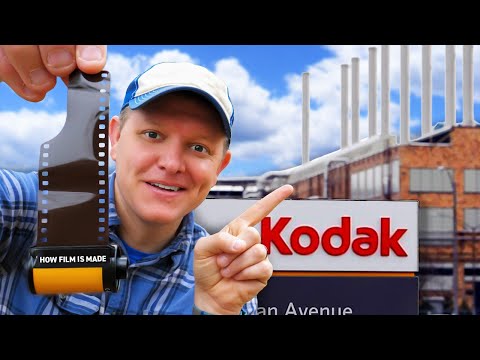
How Does Kodak Make Film? (Kodak Factory Tour Part 1 of 3) - Smarter Every Day 271
I love analog film photography. There's something to me about being able to capture a memory in a physical object with light and physics and chemistry.
12 chapters
- Introduction to Film Photography and KodakWhy Film MattersFilm photography captures memories in physical objects through light, physics, and chemistry, creating something beautiful and tangible.Analog ComebackAnalog photography is experiencing a massive resurgence in popularity, with used film cameras becoming increasingly expensive due to high demand.Manufacturing QuestionAs analog film demand grows, the key question is whether manufacturers like Kodak are producing new film or just selling old stockpiles to meet consumer needs.Series Structure• Three videos covering the complete film manufacturing process • Part 1: Film support (base material) production • Part 2: Light-sensitive emulsion coating • Part 3: Packaging in total darkness
- Kodak Plant Tour WelcomeRochester FacilityThe Kodak plant is located in Rochester, New York, with operations spanning a massive campus that originated in 1891 with Building One at Kodak Park.Tour GuideMatt Stauffer, an IT manager and third-generation Kodak employee, leads the tour with family ties to the company through his father, grandfather, and extended family.Facility ScaleThe plant features a steam generation facility for power needs and extensive infrastructure, though photographic film represents only a small percentage of Kodak's total business.Generational Culture• Experienced employees mentor younger workers, gradually sharing decades of knowledge • Younger engineers bring tech-savvy skills and ownership mentality to the work • Older generation actively encourages younger employees, fostering partnership and pride in legacy
- ESTAR Film Base Material IntroductionMaterial CompositionESTAR is Kodak's trade name for polyethylene terephthalate (PET), a polyester polymer used as the base for most photographic film products.Key Properties• Very strong and tough due to continuous biaxial orientation stretching • Greater stability and longevity compared to acetate • Recyclable material • Higher tensile strength than acetateTechnical AdvantagesESTAR's high tensile strength makes it ideal for projector film that undergoes hundreds of passes through theaters without wearing out.Material Choice ConsiderationsMotion picture origination film still uses acetate rather than ESTAR because the film needs to fail before the camera to provide mechanical strain relief and protect equipment.
- Pellet Grinding and Powder PreparationRaw Material DeliveryPolyethylene terephthalate pellets arrive by railway cars that have dedicated tracks on the Kodak campus, with one railcar supplying material for two days of production.Grinding Process• Two 50 horsepower motors grind pellets into fine powder • Production rate reaches 10,000 pounds per hour maximum • Pneumatic conveyor system transports powder 100 feet upward • Material stored in 300,000-pound rooftop storage tankPowder AdvantagesConverting pellets to powder increases surface area, which is critical for better stabilizer mixing, cleaner production, and fewer defects in the final optical film.Quality ControlPowder form prevents inclusions and defects that would occur with pellets, and the larger surface area allows even distribution of stabilizers that remove catalyst residue.
- Polymer Reactor and Drying ProcessReactor ControlFive fluidized polymer reactors (FPRs) are controlled from a central pneumatic panel, with newer automated systems supplementing original pneumatic equipment from the facility's early days.Drying Operation• Polymer powder is dried to five parts per million moisture content by weight • Moisture measured using intrinsic viscosity (IV) testing with Tinius Olsen instruments • IV correlates with water content in the polymer • Batches of 10,000 pounds are processed through heating coilsReactor DesignFluidized bed reactors use dry nitrogen flowing through a distribution plate with tiny holes to keep powder moving like waves and ripples, operating under about seven PSI pressure.Material Conservation• Closed-loop nitrogen recirculation system saves expensive gas • Glycol scrubbers clean nitrogen to remove organics and aldehydes • All equipment is stainless steel—no aluminum allowed to prevent inclusions • Conveyor systems are completely closed loop
- Extrusion Screw and Melting SystemMotor and DriveA 200-horsepower motor drives a gearbox connected to an Archimedes-style screw that melts polymer powder through friction heat alone, operating at approximately 30-42 rpm.Screw Design• Approximately 40 feet long with varying flight depths • Deep flights early in screw build pressure on material • Shallow flights reduce diameter and relieve pressure • Hollow center pipe pulls vacuum to extract volatile gasesProcessing ConditionsMolten polymer reaches 540-548 degrees Fahrenheit and exits the screw under 1,200 psi pressure, with jacketed piping controlling uniform temperature throughout the melt process.Two-Screw System• Primary screw downstairs does heavy lifting and pressurization • Secondary metering screw upstairs provides fine adjustment of thickness • Metering screw dampens pressure fluctuations before material reaches casting • Speed adjustment on metering screw controls final film thickness
- Filtration and Die CastingPrecision Filtration• Molten polymer pumped through ten or five micron filter sticks • Stainless steel mesh filters are cleaned and reused, not discarded • Filters break down and go to dedicated cleaning room • Process ensures optical clarity by removing all contaminantsDie AssemblyMolten plastic is extruded onto a polished wheel from a precisely designed die positioned at 12:00 o'clock, with vacuum applied behind the material to ensure even adherence.Cooling ControlMaterial cools from 540 degrees at extrusion to 135 degrees as it travels around the rotating wheel, with controlled cooling preventing hazy crystalline structures for optical clarity.Material Handling• Film emerges very thick, approximately one-eighth inch like a board • Driven rollers and pinch rollers convey material through process • Cooling sections further reduce temperature • Coating stations apply various treatments during production
- Drafting and Tentering Stretching ProcessStretching NecessityLong polymer molecules are not oriented when cast from the die, so stretching in two dimensions gives them molecular orientation, dramatically increasing material toughness.Drafting Process• Stretches material in direction of travel (machine direction) • No drive rollers in stretch zone—material is pulled by edge rollers • Rollers grip thick ribs on material edges • Thickness reduces from 0.107 to 0.050 inches with speed doubling or triplingTentering Process• Stretches material widthwise using clip-chain system with nearly 1,000 clips • Width increases from 16.5 inches to 60 inches full width • Heat applied uniformly to prevent uneven stretching • Controlled tension prevents necking (narrowing) like heated taffyHeat Setting• After stretching, temperature increased to heat set and lock molecular structure • Molecules line up lengthwise and widthwise creating strong, intertwined structure • Material cools and contracts slightly due to thermal properties • Tension released carefully to prevent tearing and chip formation
- Edge Trimming and Quality ScanningRib RemovalAfter stretching, thick ribs on both edges are cut off and recycled back into the manufacturing process as ground reuse material.Thickness MonitoringNon-contact nuclear device measures film thickness in real-time and sends feedback all the way back to the die to adjust molten material application for uniform thickness.Defect Detection• Scanner uses laser and CCTV cameras to identify small defects • Scanner creates real-time map showing widthwise location of defects • Limits exist on acceptable number of defects per roll • Defect data scrolls continuously as material moves throughFeedback LoopMinutes after material is cut and stretched, thickness data travels back to the beginning of production line, enabling heaters at the die to adjust output in real-time for consistency.
- Accumulator System and Roll WindingAccumulator PurposeClever arrangement of pulleys that allows production line to maintain constant speed while stopping the takeup spool for roll changes, buying precious seconds to change out full rolls.Balancing EquationProduction line velocity must equal accumulator velocity plus takeup spool velocity, with the accumulator spreading open to absorb extra material when production continues but spooling stops.Operation Technique• Constant velocity maintained at production line entrance • Good tension maintained throughout system • Accumulator spreads open to stop spool while keeping production moving • Accumulator collapses back down as spool accelerates to production speedOperator SkillOperator Steve monitors accumulator percentage (target around 45%) and uses a knife to cut film at precise moment when speed is zero, taking pride in minimizing waste and safety margin.
- Quality Sampling and Final PackagingSample Collection• Quality sample taken from first cut to measure dimensions and properties • Keeping sample stored upstairs for reference in case of customer complaints • Samples used to verify product meets specifications and identify issuesOperator ExperienceSteve has worked in the building for about 21-22 years and uses one of his fifth or sixth knife blades total during that time, showing the precision and longevity of the equipment.Safety SystemsLight curtain sensor stops the winding machine if operator crosses the beam, preventing injuries during the high-speed film winding process.Final Handling• Finished rolls manually placed onto operator shoulder for transport • Each cart is sized for specific core diameter • Spindle released via button to lower roll into cradle • Rolls sent to roll room for wooden casket packaging and shipment
- Conclusion and Next StepsManufactured SupportPart 1 complete shows the entire film support (base material) manufacturing process from powder to finished rolled film ready for further processing.Remaining Processes• Part 2 covers applying light-sensitive emulsion coating to the film base • Part 3 covers packaging film in complete darkness to prevent light exposure • Both processes require specialized equipment and techniquesEncouragementViewers encouraged to find old film cameras from drawers, thrift stores, or yard sales, revive them with new film, and explore creative photography for personal enjoyment rather than internet sharing.GratitudeHost expresses appreciation for viewer time and attention, acknowledging Patreon supporters and thanking audience for choosing to watch content of personal interest rather than other internet options.
![How Does Film ACTUALLY Work? (It's MAGIC) [Photos and Development] - Smarter Every Day 258](https://img.youtube.com/vi/TCxoZlFqzwA/mqdefault.jpg)