How the Germans Measured Milliseconds MECHANICALLY - Smarter Every Day 283
10 chapters
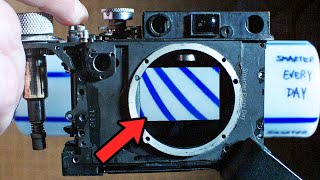
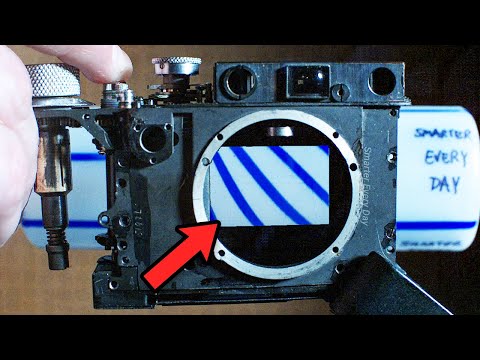
- Introduction to the Mechanical StroboscopeDevice DiscoveryA mechanical stroboscope device from the 1930s is demonstrated, featuring a rotating drum with a light bulb inside that has specific grooves and must rotate at a precise speed to achieve accurate measurements.Operating PrincipleThe device works by using rolling shutter technology, where viewers observe through an image port and use persistence of vision to measure shutter speeds with their eyes.Visual Observation• Viewers see diagonal grooves and curves through the image port • The rolling shutter effect creates specific patterns based on rotation speed • The brain interprets these patterns to determine exposure durationInitial AmazementDestin experiences excitement discovering that mechanical measurement relies on the same rolling shutter principle used in digital cameras, but achieved entirely through analog means.
- Leica Camera Problem and Historical ContextManufacturer BackgroundIn the early 1900s, Leica cameras were the undisputed best cameras in the world, but engineers faced a critical challenge with shutter speed accuracy.The Shutter Challenge• A dial on the camera controls shutter speed settings • Incorrect exposure duration causes either blurred images (too long) or dark images (too short) • Precise millisecond timing is essential for proper image exposure • Testing shutter accuracy was a major engineering problemMeasurement NeedEngineers needed a reliable method to verify that camera shutters operate at exact millisecond speeds, such as 1/1000th of a second.Solution PurposeThe mechanical stroboscope was designed specifically to allow technicians to quickly and visually assess whether camera shutters are functioning at their intended speeds.
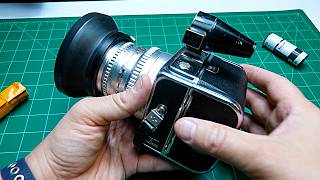
- Location and Kamerastore DiscoveryPersonal ConnectionDestin connected with Juho on Instagram, discovering they shared interests despite Juho's unique background of driving a van from Finland to Kathmandu, Nepal.Business Operations• Juho founded Kamerastore in Finland to restore and sell old film and digital cameras • The company operates the camera rescue project, acquiring old cameras from storage • Technicians service cameras and restore them to pristine working condition • Passionate people from around the world work on this restoration projectFacility VisitDestin traveled to Tampere, Finland, spending two days at the Kamerastore workshop learning about camera restoration and mechanical preservation techniques.Team IntroductionJuho introduced Destin to Ari and the Leica repair team, who then provided access to the mechanical testing device and demonstrated its operation.
- Testing Device and Service ManualTechnical DocumentationA German service manual from the camera manufacturer contains the exact patterns and specifications needed to properly test and verify camera shutter speeds.Pattern Analysis• The manual shows specific groove patterns that correspond to different shutter speeds • Pattern ratios determine whether shutter speeds are within proper tolerances • Curved grooves appear differently depending on the exposure duration • Visual comparison to the manual confirms shutter speed accuracyCalibration StandardsThe service manual provides reference patterns that camera technicians use to determine if measured shutter speeds fall within acceptable tolerances for the camera model.Language BarrierDespite the manual being in German, the visual patterns make linguistic translation unnecessary for understanding the technical requirements.
- High-Speed Camera Demonstration SetupEquipment Assembly• A Phantom high-speed camera capable of 20,000 frames per second • A NANLUX flicker-free light providing consistent illumination • A Leica camera from Finland with a curtain-type rolling shutter • A marked rotating object to visualize shutter movementRolling Shutter MechanicsThe Leica's two curtains create a rolling shutter effect, with one curtain opening while the second curtain follows behind, moving left to right across the film frame.Visual Capture MethodThe high-speed camera captures the shutter curtain movement at 20,000 frames per second to visualize exactly how quickly the shutter opens and closes.Rotating Object TechniqueA rotating marked object is used to demonstrate the rolling shutter effect, similar to previous experiments with propellers and fidget spinners showing aliasing principles.
- Rolling Shutter Aliasing PrincipleAliasing ConceptAliasing occurs when a strobing light and rotating object match up in frequency, creating an optical illusion where motion appears stopped or reversed.Record Player Analogy• Record players have dots on the perimeter synchronized with a strobing light • When rotation speed matches the strobe frequency, dots appear stationary • Too slow rotation makes dots appear to move backward • Too fast rotation makes dots appear to move forwardSpeed CalibrationThe rotating object's speed is adjusted using belts until it reaches the correct velocity where the aliasing effect shows no apparent motion.Measurement ApplicationOnce the correct rotational speed is calibrated using aliasing, rolling shutter creates observable patterns that persist in vision, enabling precise millisecond-level time measurement.
- Comparing Mechanical and Electronic ShuttersShutter Mechanics• The Leica shutter is driven by a spring that must accelerate and then decelerate • Electronic shutters operate linearly without acceleration phases • This difference affects the shape of patterns produced by the rolling shutter effectPattern DifferencesThe spring-driven Leica produces curved patterns that show acceleration and deceleration, while electronic shutters produce straight, linear patterns as exposure time changes.Speed Settings TestTesting at 1/250th, 1/500th, and 1/1000th shutter speeds shows progressively wider patterns, demonstrating how exposure duration relates to the visual groove patterns.Observable EffectsThe curved shutter pattern is visible when using the mechanical spring-driven system, contrasting with the linear pattern expected from constant-velocity electronic shutters.
- Testing Serviced and Unserviced CamerasTest SetupTwo cameras are tested: one that has been professionally serviced with known good shutter function, and another unserviced camera recently acquired from storage.Serviced Camera Results• At 1/250th setting: produces good pattern matching the reference manual • At 1/500th setting: pattern is accurate • At 1/1000th setting: pattern matches the expected measurement • Overall results match the service manual reference patternsUnserviced Camera IssuesThe unserviced camera shows progressively narrower patterns at higher speeds, indicating the shutter is closing faster than intended, particularly at the 1/1000th setting.Problem DiagnosisThe unserviced camera is firing faster than the 1/1000th of a second setting, revealing a shutter timing problem that requires service adjustment.
- Electronic Verification and Accuracy ConfirmationDigital MeasurementAn electronic measuring device confirms the manual analog method, showing that the unserviced camera's 1/1000th setting actually fires at 0.6 milliseconds instead of 1 millisecond.Multi-Speed Analysis• 1/1000th speed is too fast at 0.6 milliseconds • 1/500th speed is approximately correct within acceptable range • 1/250th speed is slightly slow but still acceptable for useMethod ValidationThe analog visual method using rolling shutter and persistence of vision produces accurate discrete readings that match electronic measurements, proving the 1930s technique's effectiveness.Historical SignificanceEngineers in the 1930s achieved sub-millisecond measurement accuracy using purely mechanical and optical principles, demonstrating remarkable engineering insight and ingenuity.
- Conclusion and Kamerastore RecognitionVideo SponsorshipThe video is funded by Smarter Every Day patrons rather than external sponsors, allowing independent presentation of the restoration technique and Kamerastore's work.Business Appreciation• Kamerastore takes damaged or old cameras and restores them to pristine working condition • Technicians are trained in all different camera models • The company combines camera restoration expertise with genuine passion for preservation • Founder Juho and his team are committed to keeping mechanical marvels aliveSpecial OfferFree shipping is available for orders through kamerastore.com/smarter, providing viewers access to restored cameras without additional delivery costs.Gratitude StatementDestin thanks Patreon supporters whose contributions funded the Finland trip and equipment needed to document this mechanical measurement technique and camera restoration process.
![How Does Film ACTUALLY Work? (It's MAGIC) [Photos and Development] - Smarter Every Day 258](https://img.youtube.com/vi/TCxoZlFqzwA/mqdefault.jpg)