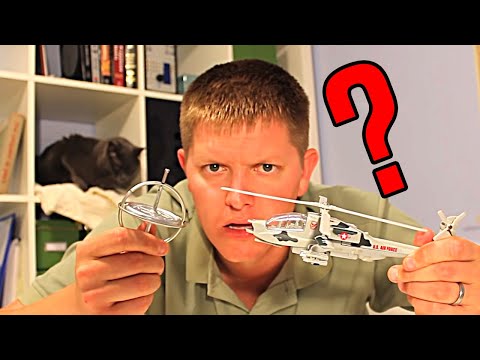
Are Helicopters Gyroscopes? - Smarter Every Day 48
4 capitulos
- Introduction and Series ContextOpening SetupDestin uses tinker toys with his children to explain complex helicopter concepts, establishing that helicopters are very complicated machines.Series BackgroundThis video is part of a series on how helicopters work, building on previous explanations about cyclic pitch and rotor disc dynamics.The Core QuestionHow do pilots change the pitch in the rotor disc to tilt a helicopter forward, especially when the intuitive approach doesn't work?Counterintuitive DiscoveryThe logical approach of increasing lift on the back of the rotor disc to tilt forward is incorrect; instead, more lift must be applied to the side.
- Gyroscopic Precession PrincipleThe ConnectionHelicopter rotors are a big mass spinning very fast, similar to a gyroscope, which explains the counterintuitive behavior in rotor control.Key Concept• Gyroscopic precession causes any force applied to a spinning disc to take effect 90 degrees out of phase • A force applied to roll the helicopter forward actually causes it to roll sideways • Pilots must apply pitch changes 90 degrees ahead of where they want the effect to occurExpert ExplanationCarl explains that when a blade pulls up and another pushes down, the effect takes place 90 degrees later when the blades are parallel with the machine.Initial DifficultyEven Destin struggles to understand the concept initially, and an ex-pilot explanation at the Smithsonian doesn't fully clarify it until he conducts his own experiment.
- Hands-On Bicycle Wheel ExperimentExperimental SetupDestin and Carl use bicycle wheels, a force application device (metal strip), and a camera to demonstrate gyroscopic precession, similar to methods used by the Wright brothers.Stationary TestWhen the bicycle wheel is not spinning, applying an upward force on the metal strip causes the tire to rotate in the same plane as the applied force.Spinning TestWhen the bicycle wheel is spinning with angular momentum applied, the same upward force causes the wheel to rotate 90 degrees from where the force is applied.Principle DemonstrationThe experiment visually confirms that gyroscopic precession causes forces applied orthogonal to the plane of rotation to act 90 degrees out of phase with the applied force.
- Conclusion and PreviewKey TakeawayHelicopter blades operate 90 degrees out of phase due to gyroscopic precession, which explains why counterintuitive control inputs are necessary.Video ComplexityDestin acknowledges this is one of the more complicated videos and invites viewer feedback to improve future explanations.Engagement CallViewers are encouraged to leave comments with their understanding and to subscribe for future content.Next EpisodeThe next video will explore the helicopter speed limit, which is determined by physics rather than FAA regulations.