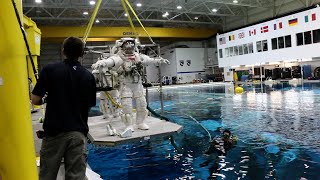
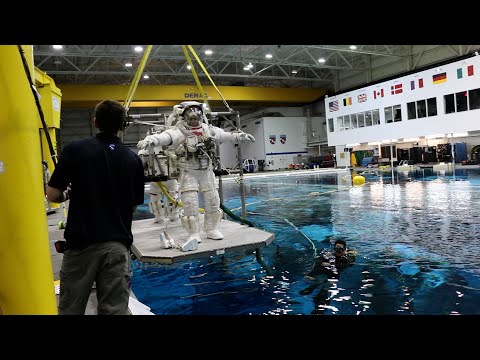
Astronaut Vic Glover at NASA's Neutral Buoyancy Laboratory
4 capitulos
- Introduction to NASA's Neutral Buoyancy LabFacility OverviewThe video is filmed at NASA's Neutral Buoyancy Lab where astronauts train for spacewalks by practicing in a swimming pool.Training PurposeAn astronaut is about to be suited up and will perform underwater training exercises to prepare for actual spacewalk operations.Suit PressurizationWhen the spacesuit is pressurized, it becomes much stiffer, making movements more difficult - comparable to wearing oven mitts or ski gloves all day for six and a half hours.Equipment Setup• Tool belt with folding tools that lay flat against the astronaut • Mock-up drill and pistol grip tools for equipment handling • Dive cards on the forearm containing procedural information • Helmet-mounted lights and cameras for ground monitoring
- Suit Checks and Tool PreparationPre-Dive ProtocolThe astronaut checks out all tools and clips in each one he will use during the training dive.Equipment PressurizationTools are pressurized before the astronaut puts on the suit to prevent loss if they become detached during the dive.Daily Training ScheduleThe astronaut dives approximately six hours per day during training.Safety Observation• Two divers observe and assist the astronaut throughout the training • Additional personnel film and document the training activities • First few minutes of each dive are dedicated to comprehensive gear checks
- Initial Safety Checks and Leak InspectionGear VerificationSupport divers inspect the suit and equipment for any leaks and ensure all systems are functioning properly before descent.Visual IdentificationThe suit has red stripes on each side to provide contrast, making it easier for divers to identify and track the astronaut underwater.Buoyancy AssessmentDivers check whether the astronaut is neutrally buoyant - meaning he doesn't have to fight against gravity or be pulled down.Initial PositioningSupport divers rotate and assess the astronaut's position to ensure proper alignment before bringing him to the training line and descending to 40 feet.
- Fine-Tuning Buoyancy and Emergency EquipmentWeight Adjustment• Divers add and remove weights to achieve perfect neutral buoyancy • If the astronaut lists to one side, weights are swapped to the opposite side • More weight is added to the back if the astronaut tends to go belly down • Foam padding is sometimes used for additional buoyancy controlPressure ConstantsThe spacesuit maintains a constant air pressure of approximately 18.7 psi with a four pound delta, which remains fixed throughout the dive.Emergency PropulsionAn SAFER (Simplified Aid for EVA Rescue) unit, which functions as a small jet pack, is attached to provide emergency propulsion and control if the tether becomes disconnected.Control CapabilitiesThe SAFER allows the astronaut to control movement in all directions - left, right, forward, and backward - and provides the astronaut with experience using the equipment in realistic conditions.