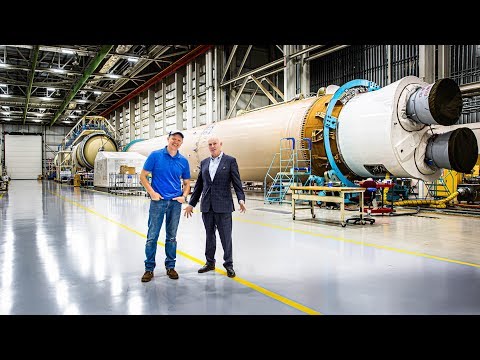
Tory Bruno talks about Rocket Engines and ULA's Business philosophy - Smarter Every Day
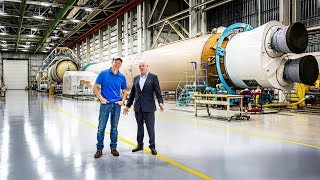
The leftover footage from the United Launch Alliance rocket factory tour at the Decatur facility where they create Atlas Rockets, Delta Rockets, and the new Vulcan rocket
4 capitulos
- Guidance and Control SystemsSystem OverviewGuidance, Navigation, and Control (GNC) is integrated on the back end of the Centaur upper stage with a flight controls computer, inertial measurement sensors, and rate sensors.Adaptive Wind Handling• ULA launches balloons during countdown to measure actual wind conditions • They reprogram trajectory parameters on the fly less than 60 seconds before ignition • The rocket runs the updated parameters through a simulation lab in Colorado to recertify the trajectoryAutonomous CapabilitiesOnce flying, the rocket can autonomously reprogram its own parameters and adjust its trajectory to commit unused propellant reserves to the mission if performance is better than expected.Mission OptimizationThis system enabled Parker Solar Probe to achieve a steeper inclination and higher altitude than originally planned, extending the mission's life.
- Rocket Engine Technology and StrategyFuel-Rich vs Oxygen-Rich• American engines traditionally use fuel-rich cycles for more stable combustion and cooler operation • Russian oxygen-rich engines deliver higher performance and Isp but require complex internal coatings to resist corrosionRD-180 Engine LegacyAt the end of the Cold War, the U.S. government asked ULA to use the Russian RD-180 engine on Atlas rockets as part of diplomacy with the former Soviet Union. ULA has ordered their last RD-180s but Russians are still delivering them.American InnovationFor Vulcan, ULA is retiring the RD-180 and replacing it with an American-made oxygen-rich stage combustion cycle engine using better modern manufacturing technology.Engine Selection RationaleThe RD-180 was the highest performance engine of its class available at the time. Using it was a strategic decision based on performance and diplomatic considerations, not a lack of American technology.
- Competitive Partnerships and Market StrategyCompeti-Mates PhilosophyThe space industry uses the term 'competi-mate' because it is not unusual to have competitors in the supply chain or buying missions from competitors.Blue Origin Partnership• Blue Origin developed the BE-4 engine over years before partnering with ULA on Vulcan • ULA shortened development cycle by several years through this partnership • Blue Origin brings engines back to Earth; ULA initially operates as expendable • Together they produce enough engines to make them affordable for both rocket programsSolid Rocket Booster StrategyNorthrop Grumman (which owns ATK) manufactures ULA's solid rocket boosters and is also a competitor in the launch market. They bring investment to the SRB program, and together they have enough production rate to make it affordable.Business LogicThe engine and SRB pricing on a recurring basis would be very high without partnerships. Combined production rates make the rockets more affordable for both companies.
- Market Positioning and Future VisionMarket Domains• Commercial marketplace: satellite operators like Dish TV, DirectTV, and broadband internet providers at geostationary orbit • National security space market: closer to NASA exploration needs with different capabilities and higher performance requirementsStrategic FocusULA has deliberately centered on national security and exploration markets because they are more stable and allow for higher performance rockets and exquisite payloads.Dominance in National SecurityULA has launched nearly every GPS satellite in orbit except one. They have decades of expertise in national security space constellations.Space as War Domain• Space is now contested and considered a war-fighting domain like land, air, and sea • Having a broader industrial base is important for national security • ULA is investing in post-Vulcan capabilities not discussed in the interview to address this challenge