Hovering a Helicopter is Hilariously Hard - Smarter Every Day 145
Knowledge is not understanding
7 capitulos
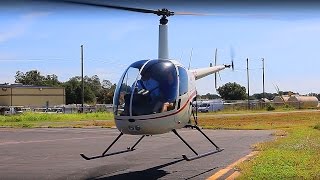
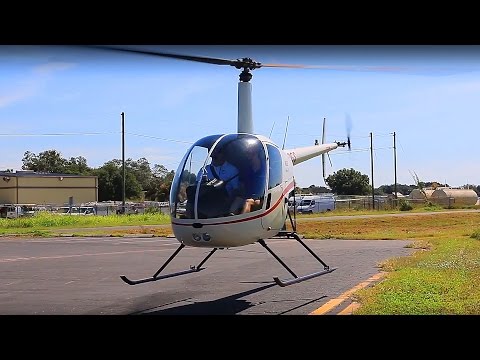
- Introduction and Challenge SetupLearning PhilosophyKnowledge from previous helicopter physics videos didn't translate to actual understanding, which is why hands-on experience is necessary to truly comprehend how helicopters work.The ChallengeDestin attempts to hover a Robinson R22 helicopter, which is considered the hardest thing to do in helicopter piloting because it has no augmentation systems.Why It MattersUnderstanding what goes into hovering a helicopter and how a pilot's brain manages the complex task reveals the incredible cognitive demands of this skill.Expert PerspectiveHelicopter instructor pilots are either complete idiots or incredibly brave, as they must hand over controls to students they've never met and trust them not to crash.
- First Flight with Brandon: Control Connections and Initial StrugglesControl System IntroductionThe helicopter controls are physically connected together, which means if the student makes an error, the instructor must wrestle the controls away or trust the student will release them.Early Attempts• Destin's first attempts at holding the cyclic in position are unsuccessful and require Brandon to repeatedly take over • The student struggles with basic directional control and maintaining altitude • Brandon guides with simple instructions like 'pedal to your heading'Learning TimelineBrandon estimates it typically takes 6-8 hours for students to have a breakthrough moment, but predicts it will take Destin 6-8 months.Instructor ObservationsBrandon's hands move closer to the controls when Destin attempts something difficult and dangerous, and relax when flying straight and level.
- Second Flight with Tommy: The Rodeo and Control CoordinationLearning TechniqueTommy teaches by first showing delicate control operation, then demonstrating how two controls interact with each other to achieve one simple maneuver.Pilot Induced OscillationDestin's main problem is over-controlling and freaking out, which causes the aircraft to wobble. The solution is to chill out and apply more subtle control inputs.Breakthrough Moments• After using only the left pedal to point at a tree, Destin realizes it's an instinctive process rather than conscious thought • When combining collective and pedals to point at the stop sign while maintaining altitude, another breakthrough occurs • These moments confirm Tommy can see when understanding clicks in the student's brainThe Core PrincipleHovering a helicopter requires simultaneously managing multiple coupled controls, similar to how a Rubik's cube solver instantly understands all the interconnected changes needed to solve the puzzle.
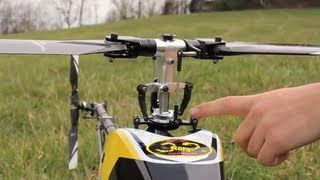
- Control Systems Explained: The Three Main ControlsCollective ControlControls the power applied to the rotor system by moving the swash-plate to change the rotor blade pitch, which increases or decreases the bite out of the air.Pedal ControlCompensates for torque applied to the helicopter body by providing counter-torque. This counteracts both the torque from collective changes and the side-pushing force from the tail-rotor.Cyclic ControlSimilar to collective in moving the swash-plate but operates independently on individual rotor blades to create directional control and counteract the tail-rotor's sideways push.Systemic ComplexityAll three controls must work together in perfect coordination, happening multiple times per second, requiring the pilot to instantly develop the most efficient and effective solution to maintain hover.
- Third Flight with Michelle: Hands-Off Instruction and Rapid ProgressTeaching StrategyMichelle takes a hands-off approach, meaning if Destin enters a pilot induced oscillation, she makes him recover himself rather than intervening, removing his safety net to force improvement.Critical MomentDestin's first takeoff is terrible, but Michelle's willingness to let him struggle forces him to straighten up and improves his performance dramatically.Demonstrated Skills• Successfully executes the first takeoff with Michelle's guidance • Achieves hovering for the first time, though poorly executed • Attempts a landing at a chosen location and successfully puts the helicopter downConfidence BuildingMichelle's encouragement and belief in Destin's ability helps him overcome self-doubt and perform better than expected.
- Final Test with Brandon: Precision Landing ChallengeProgress AssessmentBy the final flight, Destin can take off, navigate to designated locations, shoot an approach, and land the helicopter.The Solo TestBrandon's challenge is to land the helicopter with its skids precisely on a stick lying on the ground. Success on this test qualifies Destin to fly solo.Execution Results• First attempt lands directly on the stick • Second attempt also touches the stick perfectly • Brandon confirms this achievement represents genuinely good precision flyingKey InsightThe stick landing exercise teaches precision and demonstrates that hovering requires understanding a complex coupled control system rather than simple up-down, left-right thinking.
- Conclusion and SponsorshipMain TakeawayHovering a helicopter is hilariously hard because it requires rewiring the brain to manage a complex coupled control system, not a simple linear input-output relationship.Brain RewiringThe skill involves getting complex muscle memory that allows instant, efficient solutions to maintain stable hover while simultaneously managing multiple interdependent controls.Experience Context• Destin completed this training in St. Petersburg and Clearwater, Florida • His children were playing on the beach below while he learned to hover • The experience combined aviation training with tourism and family timeRegional RecommendationsThe Clearwater area offers attractions including the Chihuly glass art museum, Salvador Dali museum with melting clocks and burning giraffes, MC Escher traveling exhibit, and Clearwater Marine Aquarium with Winter the Dolphin.