
How Does The James Webb Space Telescope Work? - Smarter Every Day 262
The James Webb Space Telescope is about to launch, and this is a really big deal that people from all over the science community had been waiting on for years.
12 capitulos
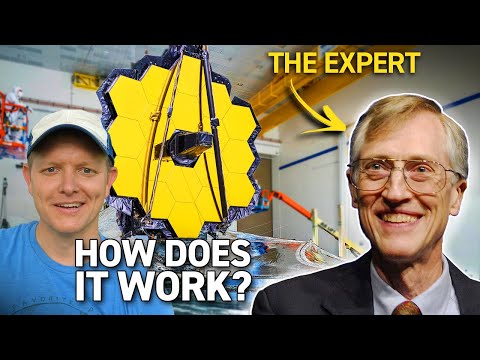
- Introduction to James Webb Space TelescopeProject OverviewThe James Webb Space Telescope (JWST) is a major astronomical project that requires deployment into space. Its unprecedented complexity involves folding mechanisms similar to origami that must unfold precisely after launch, making it one of the most complex things humans have ever built.Featured ExpertDr. John Mather is the senior project scientist for JWST. He is a Nobel Prize-winning astrophysicist and cosmologist who won the Nobel Prize in Physics with George Smoot for work on the Cosmic Background Explorer satellite.Special ConnectionDestin's father worked on the sun shield component of the James Webb Space Telescope, making this interview particularly meaningful from both a scientific and personal perspective.Video PurposeThis video explores how the James Webb Space Telescope works through an interview with Dr. Mather, covering its design, components, and the scientific goals of the mission.
- Telescope Design and Optical SystemUnique ConfigurationThe James Webb Space Telescope has a distinctive design unlike the Hubble Space Telescope or Galileo's telescope. It features a large hexagonal mirror made of 18 smaller hexagons that collect starlight and galaxy light from distant objects.Optical Path• Light collects on the large primary mirror and bounces to a small convex secondary mirror • Light then reflects to a tertiary mirror and finally to a fine steering mirror • The three-mirror anastigmat design provides good image quality over a large area of sky • Fine steering mirror compensates for spacecraft movement like image stabilizationMirror MaterialsThe 18 hexagonal mirror segments are made of beryllium, which is very light and very stiff while holding its shape when cold. Each hexagon is so thin it can be lifted by hand, yet must be extremely precise.Technical ChallengeThe most difficult engineering challenge was building the giant mirror made of 18 pieces, which must all be adjusted to the correct position after deployment in space.
- Instruments and Detection SystemsInstrument PackageThe James Webb Space Telescope contains cameras and spectrometers in the instrument package located behind the mirror. These instruments detect wavelengths from 0.6 microns (visible red light) to 28 microns (infrared light).Detector Technology• Two types of detectors: mercury cadmium telluride and arsenic doped silicon • Combined detectors provide sensitivity across the entire wavelength range needed for observations • Detectors were improved beyond existing technology to provide the required sensitivity and size • Specialized instruments invented specifically for this missionSpectroscopy CapabilitySpectrometers spread starlight into rainbow colors to determine what objects are made of. Spectrum lines from different chemical elements and molecules help identify composition, similar to how different colors appear in fireworks.Detection ChallengesIdentifying elements requires detecting multiple spectrum lines to be certain of composition. Objects moving toward or away from Earth cause wavelength shifts that must be accounted for in analysis.
- Red Shift and Infrared ImportanceRed Shift ConceptAs distant objects move away from Earth due to universal expansion, their light wavelengths increase. This shift is called red shift and can multiply wavelengths by large factors, with the farthest observed objects showing a red shift of 11.Wavelength ExtensionThe Lyman alpha hydrogen line at 0.12 microns appears at 1.44 microns with a red shift of 11. The telescope is designed to potentially detect objects with red shifts of 20 or 30, which have never been observed before.Doppler EffectThe red shift works similarly to the Doppler effect with sound. As objects move away, their light frequencies drop and shift from visible spectrum into infrared, just as a siren's pitch drops as it moves away.Infrared NecessityAn infrared telescope is essential for studying distant universe objects where expansion has stretched ultraviolet light into infrared wavelengths. Without infrared capability, much of the light from distant objects would be undetectable.
- Sun Shield and Thermal DesignShield StructureThe sun shield is made of five layers of thin plastic coated with metal, made from Kapton material. Sunshine reflects away from the shield's outer side while allowing only minimal heat through to the instrument side.Temperature ManagementThe sun shield keeps the telescope cold and thermally stable without requiring complex thermal management systems. One side of the telescope is always in darkness while the other faces light, similar to Earth's nighttime.Orbital ConfigurationThe James Webb Space Telescope orbits around the Lagrange Point Two (L2) of the Earth-Sun system. This location provides continuous shadow from the sun while maintaining communication with Earth.Power SupplySolar panels hidden on the sun side of the sun shield provide power for the observatory. The telescope requires several kilowatts of electricity, which is relatively small for such a giant observatory.
- Folding Mechanism and Launch ConfigurationDeployment DesignThe James Webb Space Telescope must be folded to fit into a rocket payload fairing. After launch, it unfolds like origami in precisely choreographed engineering sequences that must work despite the violent vibrations of rocket launch.Mechanical StructureThe telescope has a giant tripod framework with three legs and multiple hinge points. The legs fold sideways and around behind the observatory to achieve a compact configuration for launch.Unfolding RequirementEverything that is folded for launch must unfold and function correctly in space. This is described as one of many things that must work perfectly for mission success.Critical Design FeatureThe folding mechanism and successful deployment are essential to the mission. Each component must survive both the folding process and the violent launch environment.
- Reliability and Testing ApproachRisk MitigationAlthough nothing can be guaranteed to work, NASA ensures reliability through redundancy and rigorous testing. Key strategies include having two of everything when possible, rehearsing all procedures repeatedly, and seeking peer review criticism.Quality Assurance• Review panels provide peer reviews from senior engineers with related experience • Engineers with good instincts about similar projects provide alternative approaches • Critical feedback on incorrect procedures is essential despite discomfort • Thorough testing is more important than theoretical analysis aloneTest ArticlesNASA created several test articles including a pathfinder telescope with carbon fiber framework. Test articles had two or three actual mirrors installed to enable realistic testing.Testing PhilosophyAnalyzing design is insufficient without physical testing. There is no such thing as analyzing something so well that certainty is guaranteed without actual tests.
- NASA Testing Facilities and MethodsThermal Vacuum ChamberA huge thermal vacuum chamber at NASA's Goddard Space Flight Center was built in the 1960s to simulate space conditions. The chamber uses liquid nitrogen to create extreme cold and vacuum similar to the space environment.Component Testing• Large components are tested in the main thermal vacuum chamber before assembly • Smaller thermal vacuum chambers test component-level assemblies • Everything is tested from large systems down to individual nuts and bolts • Testing occurs at both assembly and component levelsVibration TestingA shaker table at Goddard Space Center simulates the G-forces and vibrations the telescope experiences during rocket launch. The telescope is mounted and shaken violently to ensure nothing breaks or falls apart.Acoustic TestingA sound chamber with the largest subwoofer in the country simulates rocket noise exceeding 140 decibels. Microphones at different points measure sound variations from reflections and echoes to ensure the telescope survives acoustic loading.
- Clean Room Procedures and MovementContamination ControlThe James Webb Space Telescope is transported using a portable clean room tent. This protective environment prevents contamination during movement and handling.Air Bearing TransportThe portable clean room moves on air bearings using compressed air pumped to tent feet. The combination of air bearings and a flat floor surface allows the entire structure to be moved by hand without friction.Handling InnovationThe telescope is moved within the portable cleaning room on a cushion of air. This remarkable capability allows a massive space telescope to be repositioned smoothly and safely by personnel.Facility LocationThese procedures occur at NASA's Goddard Space Flight Center in Greenbelt, Maryland, where the Hubble Space Telescope has been controlled for several decades.
- Lagrange Points and Orbital MechanicsLagrange Point BasicsLagrange points are special locations in space where two orbital bodies interact in a way that creates balance points. Objects placed at these spots experience balanced gravitational forces from both bodies.L2 SelectionThe James Webb Space Telescope orbits around Lagrange Point Two (L2) of the Earth-Sun system. L2 is the only location where a single-sided sun shield can protect the observatory from sunshine, Earth shine, and moonshine simultaneously.Orbital DistanceThe L2 Lagrange point is approximately four times as far from Earth as the Moon. The telescope orbits around rather than at the L2 point itself, which provides practical advantages for positioning and fuel efficiency.Communication and PowerThe L2 location allows continuous communication with Earth while maintaining solar power generation. The sun provides necessary electricity for the observatory while the Earth blocks direct sunlight from reaching the instruments.
- Scientific Goals and Infrared AdvantagesPrimary Objectives• Observe the first stars and galaxies in the universe • Study the first black holes and their formation • Understand how galaxies grow and evolve • Observe star and planet formation happening today • Study exoplanets and the outer solar systemVisual CapabilitiesThe James Webb Space Telescope will produce beautiful pictures using infrared light rather than visible light. The images will look different from optical observations but reveal hidden features invisible to regular telescopes.Dust PenetrationInfrared light can penetrate dust and gas clouds that block visible light. Longer wavelength infrared bounces less off dust grains, allowing the telescope to see stars being born inside clouds that are otherwise obscured.Image ProcessingInfrared images will be false-colored to create visible representations that people can see. This processing maintains the scientific data while making observations accessible to the public.
- Launch Day Perspective and WisdomDr. Mather's ApproachDr. Mather does not experience anxiety about the launch despite the project's complexity and stakes. His confidence comes from knowing that the team has made the best possible plan and executed it thoroughly.Planning PhilosophyRather than worrying about potential problems, the team identifies concerns, creates plans to address them, and implements solutions. This systematic problem-solving replaces anxiety with actionable preparation.Release and TrustAfter completing the best possible plan and doing their best work, the team releases the project to its fate. This emotional acceptance of what cannot be controlled demonstrates mature engineering perspective.Life LessonThe wisdom shared is applicable beyond engineering: create the best possible plan, do your best work, then emotionally release attachment to outcomes. This approach reduces anxiety and enables peace with uncertainties beyond personal control.