EXTENDED CUT: 2024 Solar Eclipse Preparation - Smarter Every Day 295B
A total solar eclipse is happening on April 8th, 2024
13 chapitres
- Setting Up Temperature Monitoring EquipmentEquipment OverviewGordon has built a comprehensive temperature tower system to monitor ambient conditions during the eclipse at three different heights.Orientation Method• Baskets protecting temperature sensors must face north to avoid direct sunlight • North is opposite to the direction of maximum eclipse which occurs at 180 degrees south • Proper orientation ensures only convective heating is measured, not radiative energySensor PlacementSensors are positioned at ground level, 6 inches, 10 feet, and 20 feet to track temperature changes across different atmospheric layers.Measurement GoalsThe setup will document how solar radiation decreases during the eclipse and how temperature lags at different heights as thermal energy dissipates.
- Shadow Effects and Pinhole ProjectionSharp Shadow TrackingGordon has motorized a stand that will automatically track the sun, keeping shadow projection surfaces perpendicular to solar rays throughout the eclipse for clean, undistorted images.Pinhole Projection Basics• Light rays from the sun travel in straight lines through a pinhole, creating an inverted image • During crescent phases, the projected image will also be crescent-shaped but reversed left-to-right • A simple shoebox with foil and a pinhole allows safe observation of the eclipseDIY InstructionsCut a square in the shoebox top, tape tinfoil over it, poke a hole with a pin, tape white paper inside the back, and create a viewing port on the side.Optimization TipsHolding projection surfaces at 90 degrees to the sun prevents angle distortion and produces clearer images compared to flat surfaces on the ground.
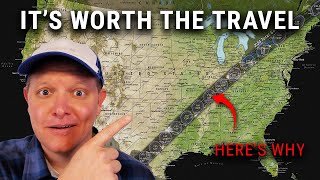
- Understanding Eclipse Contact TimesContact Definitions• C1: Moon's edge first touches the sun's edge • C2: Total eclipse begins, moon completely covers the sun • C3: Total eclipse ends, moon starts to exit the sun • C4: Moon completely separates from the sunPath of TotalityThe umbra path extends from Mexico through Texas to Canada, approximately 120 miles wide for the 2024 eclipse, making it bigger than the 2017 eclipse which was 71 miles wide.Duration and TimingThe 2024 eclipse will last over four minutes in Texas where Gordon and Destin will observe, with the point of greatest eclipse occurring in Mexico at over four minutes total.Planning Recommendations• Position yourself as close to the center line as possible to maximize totality duration • Being 99% in the path is not enough; you must be within the totality zone to experience the full eclipse • Within 10 miles of the center line is acceptable and loses only a few seconds of totality
- Why Solar Eclipses MatterAstronomical ImportanceAn eclipse allows you to physically watch the clockwork of the solar system in action as the moon moves from west to east across the sun while Earth's rotation carries everything westward.Personal ImpactThe experience is overwhelming and emotional; people must witness a total eclipse themselves to understand why it matters, as words cannot convey the sensation.Rarity FactorThe next total solar eclipse crossing the continental United States after April 2024 will not occur until 2045, making this eclipse a rare opportunity not to be missed.Scientific Phenomena• Darkness falls in the afternoon • The sun's corona becomes visible • Multiple sensory and visual effects occur • Temperature and lighting conditions change dramatically
- Partial Phase Temperature PhenomenaHistorical Data• 2002 eclipse: 9 degrees Fahrenheit temperature drop • 2017 eclipse: Data logger with too much thermal mass failed to capture changes • 2019 eclipse: 26 degrees Fahrenheit drop with proper equipment in calm conditionsMeasurement StrategyMonitor ground-level temperature where solar energy is absorbed, plus 6-inch, 10-foot, and 20-foot sensors to capture thermal inversions and time lags in different atmospheric layers.Expected ResultsTemperature will decrease as the moon blocks sunlight, reach minimum during totality with additional lag cooling, then reheat after totality as solar loading increases again.Observer ExperienceViewers will notice temperature dropping significantly, with Gordon's app providing three reminders during partial phases to observe temperature changes, as many people miss this effect without prompting.
- Light and Color Changes During EclipseAmbient Light MonitoringA light sensor measures lux decrease in white light from C1 to C2, with mounting higher to avoid interference from people walking in front of it.Color Spectrum Shift• The sun's edge becomes increasingly red due to limb dimming • Center of sun is approximately 6000 Kelvin, edge is 5500 Kelvin • During last five minutes before totality, only red-shifted limb light reaches Earth • RGB sensor shows red light increasing while blue-green decreasesEerie Lighting EffectThe combination of red-shifted light and reduced brightness creates an unusual, otherworldly appearance that contributes to the eclipse's distinctive atmosphere.Data CollectionGordon will have two color sensors operating: one monitoring the observing area and another mounted on a tracking camera pointed at the sun throughout the eclipse.
- Wind and Atmospheric ChangesEclipse Breeze TheoryAs distant hills cool faster than your location, dense cooled air rolls downhill as a subtle breeze moving toward your observing site from the direction the moon's shadow approaches.Conditions Required• Calm conditions at the observing site • Mountains or hills relatively close by • Topography in the direction of umbral approach • Clear visibility of temperature gradientsObservation MethodPosition a data logger wind sensor pointing toward nearby hills and east-south direction to capture subtle wind direction changes during the eclipse.Important CaveatThe eclipse breeze is subtle and not a strong wind; awareness of unexpected wind direction is necessary as it may approach from a direction different from where you're looking at the eclipse.
- Convective Cloud DissipationCloud Formation MechanismOn clear days, the ground warms from sunlight, creating moisture that rises in eddies and condenses into fluffy white convective clouds when it reaches the boundary layer.Eclipse Impact• Convective clouds depend on continuous solar energy and moisture supply • As the eclipse blocks sunlight, this energy supply diminishes • Fluffy convective clouds can dissipate 10-15 minutes before totality • This effect can significantly clear the skyCloud Type DistinctionBig thick gray rain clouds are weather-related and won't dissipate during an eclipse, requiring you to have a backup observing location plan to move away from weather fronts.Weather PlanningCheck weather forecasts the day before, aim for high pressure bubbles, and have a location 20-50 miles away as backup to move toward if clouds threaten your primary site.
- Animal Behavior During EclipseDarkness ResponseAnimals don't understand that an eclipse is occurring; they interpret decreasing light as nighttime approaching and begin their nighttime behaviors even though the sun is still partially visible.Observable Behaviors• Crickets become extremely active 10-15 minutes before totality • Birds fly toward their nighttime resting locations in organized groups • Bees attempt to return to their hive as darkness approaches • Farm chickens exhibit remarkable behavioral changesResearch OpportunitiesSet up video cameras at beehives or flower bushes to document decreased insect activity as totality approaches, or monitor chicken behavior which shows dramatic changes before and after totality.Sensory AwarenessAnimals are sensitive to light level changes earlier than humans notice them; watch for organized bird movement in a specific direction rather than random activity, as this indicates behavioral response to eclipse.
- Purkinje Effect and Color VisionVision Science Basics• Cones provide daytime color vision and require high photon energy to fire • Rods provide nighttime vision and only absorb blue-green wavelengths • Mesopic zone occurs when both cone and rod vision operate simultaneously • Eclipse transition into mesopic zone is unique due to pure light decreasePurkinje Effect DefinitionAs light diminishes during an eclipse, cones struggle to fire while rods take over, causing red colors to appear bland while green colors appear relatively brighter in the mesopic zone.Color Requirements• You must have colored targets to observe the Purkinje effect • Bright colors like red, green, yellow, and blue create contrast changes • Wearing bright clothing helps you see color shift in surrounding people and objects • Bland environments with gray tones prevent observation of the effectOptimal ConditionsSummer eclipses with green vegetation show the Purkinje effect best, while winter eclipses in areas with gray landscapes and bland trees show minimal effect, as demonstrated by comparing 2017 Tennessee eclipse to 2019 Argentina eclipse.
- Shadow Bands and Final PhenomenaShadow Band Theory• When the sun becomes a thin slit 90-120 seconds before totality, atmospheric layers refract and perturb the light rays • Some theories suggest refraction from warm and cold air layers • Other theories propose wave front interactions similar to stellar scintillation • Gordon believes they result from atmospheric seeing treating the slit like a planetVisual Characteristics• Very low contrast gray shadows appearing on light-colored surfaces • Shadows organized in rows forming rectangles representing the thin slit shape • Shadows move left to right with leapfrogging motion creating a snake-like appearance • Effect resembles boiling water but with distinct linear patternObservation Tips• Must watch the ground, not the sky, as shadows appear on surfaces • Appear 120 seconds before C2 and reappear dramatically after C3 due to dark adaptation • More visible after totality when you're dark adapted, creating more dramatic effect • Impossible to capture well with cameras due to sensor dynamic range limitationsPositioning StrategyPlace a white sheet in front of your group to observe shadow bands; use the solar eclipse timer app which provides reminders at 90, 60, and 30 seconds before C2 to force yourself to look down at the critical moment.
- Solar Eclipse Timer App and Final RecommendationsApp Features• Uses GPS location to calculate precise contact times for your specific position • Converts universal time calculations to local time automatically • Provides voice guidance at critical moments throughout the eclipse • Reminds observers when to look for specific phenomena at exact timesKey Guidance MomentsApp reminds users to observe temperature changes three times during partial phases, look for shadow bands at 90, 60, and 30 seconds before totality, observe the horizon for color changes, and experience the corona during totality.Essential Phenomena• Pinhole projection with name cards to safely observe eclipse crescent • Sharp and fuzzy shadow effects by rotating surfaces relative to sun • Purkinje effect by wearing colored clothing to see color shift • Shadow bands by watching white surfaces just before totalityFinal PhilosophyYou don't need to do all the science that Gordon does, but learning high points enhances enjoyment; doing a little portion helps you enjoy the eclipse more; during the hour and a half of partial phases, balance documentation with actual experience; then focus completely on totality.