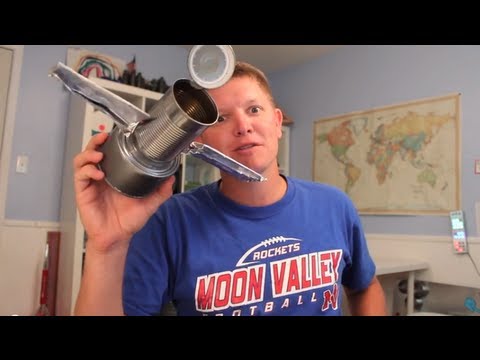
Space Telescopes Maneuver like CATS - Smarter Every Day 59
The awesome science that goes into making space telescopes work
7 chapitres
- Introduction to Space Telescope EngineeringOpening ContextSpace telescopes produce awesome science, but the engineering behind making them work is equally impressive.Sun Shield Innovation• The James Webb Space Telescope uses a sun shield to maintain stable operating environment • The instrument operates at about 45 degrees Kelvin with intense heat from the sun on the other side • A 3D laser scanner ensures the sun shield is perfect for precise instrument operationCore ChallengeUnderstanding how space telescopes point at and observe specific stars and nebulae.Solution OverviewTwo main methods exist to apply external force on satellites to make them turn and maneuver.
- Traditional Rocket Propulsion MethodBasic MechanismRockets can point space telescopes at desired stars and celestial objects in orbit.Limitations• Rockets use fuel which clouds up the area around the satellite • Fuel is a finite resource and can run out, ending the mission • This method is not sustainable for long-term space telescope operationsProblem StatementScientists need alternative methods that don't rely on rocket fuel.Next SolutionA more elegant approach using electromagnetic principles and torque rods is needed.
- Electromagnetic Torque Rod MethodOperating Principle• A compass needle interacts with Earth's magnetic field • Scaling this up creates a torque rod with a coil of wire • Applying voltage to the wire generates an electromagnetic field • The electromagnetic field interacts with Earth's magnetic field to create rotationImplementation DesignScientists use three torque rods positioned in three different axes on spacecraft, applying or removing voltage as needed to rotate based on Earth's magnetic field position.Key AdvantageThis is an elegant solution with no moving parts.Critical Limitation• Only works in places with an external magnetic field like Earth • Doesn't work in deep space or on Mars where magnetic fields are very weak • Alternative methods needed for distant space missions
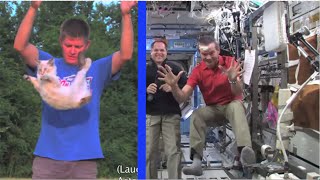
- Nonholonomic Systems and Cat PhysicsConcept FoundationSpace telescopes in deep space use the same physics principles as a cat flipping 180 degrees from rest by rotating against itself.Conservation Principle• Cats and space telescopes change their rotation state without violating conservation of angular momentum • This ability has been studied extensively by applied mathematicians, neuroscientists, robot builders, and astrophysicistsPath Determines State• A ping pong ball in a block returns to initial state when the block returns to its starting position via the same path • If the block returns along a different path, the system doesn't return to the initial state • The path taken determines the final state of the systemSystem ClassificationSystems where angular momentum never changes but final rotation can be altered are called Nonholonomic systems, which enable cats to flip and space telescopes to maneuver.
- Reaction Wheels and Momentum ControlDevice OverviewReaction wheels are devices that keep space telescopes pointed at particular stars.Operating Mechanism• Multiple reaction wheels spin inside the spacecraft • Engineers calculate which wheel should be sped up or slowed down at specific times • This precise control achieves rotation in the needed axisPractical ApplicationMomentum management is used on the space station and any system flying in space to point and focus at nebulae or stars for telescope observations.Momentum BrokersEngineers are essentially brokers of momentum, managing the amount of momentum in the system to enable precise pointing and focusing.
- Advanced Control Moment GyroscopesEnhanced DesignControl Moment Gyros (CMGs) are more advanced than reaction wheels, featuring the ability to rotate their axis itself.Dual-Axis RotationCMGs have two axes of rotation, allowing more complex control than single-axis reaction wheels.Mathematical Complexity• The added capability of rotating the CMG's axis creates significantly more complex mathematics • Specialized engineers calculate precise satellite pointing trajectories from one point to another • Advanced mathematics ensures smooth transitions along specific pathsOperational Constraints• CMGs can reach singularity points where rotation becomes blocked and no further movement is possible • When singularity occurs, external energy inputs like magnetic torquers or propulsion jets are needed to escape the blocked position
- NASA Testing and Hardware ConstraintsComponent VerificationNASA's attitude control components lab tests spacecraft control systems to ensure they will function properly in orbit.Chandra X-Ray Telescope Testing• The Chandra X-Ray Telescope reaction wheel undergoes life testing to determine longevity • Life tests assess how long components will last in space • Failed components can be analyzed and replaced if issues are discoveredLegacy Hardware Limitation• Chandra was built in the early 1990s and uses hardware from that era • Test equipment must match the actual hardware flying on the telescope • Components cannot be updated or modernized after launchTime Lock ProblemOnce a spacecraft is launched, it is locked in time with the components built at that moment, requiring continued use of identical hardware for testing and operation, similar to the space station and shuttle programs.