How Neil Armstrong Trained to Land on the Moon - Smarter Every Day 250
8 chapitres
- Introduction to Lunar Landing ChallengeSeries OverviewThis is the first video in a series about returning to the moon through NASA's Artemis program, exploring the technical solutions required for safe lunar landings.Core ProblemLunar descent requires achieving zero velocity at touchdown, but the moon's gravity is one-sixth of Earth's (1.625 m/s² vs 9.8 m/s²), making spacecraft behave differently than on Earth.Training ParadoxThe challenge is practicing lunar landings on Earth with vehicles that experience full Earth gravity, requiring innovative simulation methods.Historical SourceThe foundation for this exploration comes from a 2007 lecture by Neil Armstrong himself to the Society of Experimental Test Pilots about lunar lander development.
- Early Simulation Attempts: Helicopter and X-14Helicopter ConceptIn the 1960s, NASA considered using helicopters as lunar descent simulators because they hover and descend vertically like a lunar lander would.Gravity Problem• A helicopter on Earth requires six times less tilt angle to achieve the same horizontal acceleration as the same mass would on the moon • Due to the moon's lower gravity, spacecraft would need to tilt much more dramatically to move laterally, creating control challenges not present in helicopter flightAlternative: X-14NASA tested the X-14, a vertical takeoff and landing experimental aircraft from the 1950s-60s with variable reaction control that could replicate lunar control characteristics, though it could not simulate reduced gravity.Limitations• Helicopters created dead man's curve risk during hovering descents near the ground • Neither helicopter nor X-14 could accurately replicate lunar gravity effects, limiting their usefulness for training
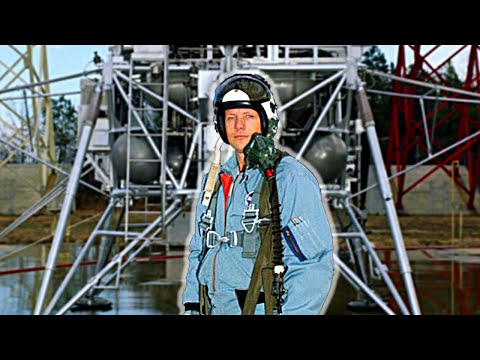
- The Lunar Landing Research Facility (LLRF)Innovative SolutionNASA Langley Research Center developed the LLRF, a large hangar structure that suspended vehicles from a traveling bridge crane to reduce their apparent weight to lunar equivalents.Technical Design• A vertical cable attached to a traveling bridge crane lifted vehicles with an upward force equal to 5/6 of the vehicle weight • A complex electro-hydraulic system kept the crane platform directly overhead and cables vertical • Innovative compensation networks managed cable stretch and pendulous frequenciesFlight EnvironmentThe flying volume was 180 feet high, 360 feet long, and 42 feet wide, providing adequate space to give pilots a substantive introduction to lunar flight characteristics.LimitationsWhile effective for first-order approximation training, the LLRF's safety mechanisms (emergency stops that locked everything up) did not replicate true free-flight conditions pilots would experience on the moon.
- The Lunar Landing Training Vehicle (LLTV)Design InnovationNASA's Flight Research Center at Edwards Air Force Base developed the LLTV, which used a gimbal-mounted jet engine providing constant upward thrust, with additional throttleable rockets for control, achieving realistic free-flight simulation.Technical Features• Partially enclosed cockpit with limited visibility • 3-axis side stick controls • Lift rocket throttle replacing collective control • Rate command attitude hold system approximating lunar module performancePilot AssessmentNeil Armstrong praised the LLTV as an excellent simulator capturing the handling characteristics of the lunar module landing maneuver, noting it was significantly different from any other aircraft he had flown.Safety Risks• Three LLTV vehicles were lost during training • NASA management worried constantly about reliability and safety • Pilots insisted the vehicles were vital to lunar landing preparation and their views prevailed
- Neil Armstrong's LLTV ExperiencePre-Mission TrainingArmstrong flew the LLTV exactly one month prior to the Apollo 11 launch, with NASA management viewing it as an overall risk reduction technique despite the vehicle's dangerous nature.Simulation QualityThe LLTV accurately simulated the need to tilt the spacecraft much more than on Earth, and provided the experience of looking out the window at the lunar surface—though simulations of the flight computer weren't fully integrated until actual lunar orbit.Training EffectivenessBen Feist, creator of Apollo in Real Time, confirms Armstrong was adequately trained and that the LLTV was an excellent simulator for the moon descent challenges, noting Armstrong as a test pilot helped develop the training protocols himself.Psychological Value• The danger of flying the LLTV was itself a component of training—it "put their hides on the line" as pilots said • Real physical risk elevated the simulation's realism, creating psychological preparation for actual lunar landing danger
- The Emergency Ejection IncidentWhat HappenedDuring an LLTV flight, Neil Armstrong lost control and ejected from the vehicle, with the wreckage later recovered partially burned and with a snake that had been sheltering underneath.Root Cause• A ground controller was too timid in directing Armstrong to reduce lift rocket thrust • An engineer behind the controller allowed Armstrong to deplete the peroxide fuel reserve • Armstrong lost all pressure needed for attitude control, causing him to pitch up uncontrollablyDesign IntentWayne Ottinger, LLTV program engineer, had designed the fuel tank to always reserve 20 pounds of peroxide for attitude rocket system, separate from the lift system, preventing this exact scenario.Pilot ResponseArmstrong, recognizing he had lost attitude control (which some initially thought was pilot-induced oscillation), made the correct decision to eject from the doomed vehicle.
- Engineering Evolution and Future TrainingGenerational ProgressWayne Ottinger noted that engineers of the 1950s-60s had their unique place in history, and modern engineers can build on their shoulders, learning from past innovations while adapting to new technology.Necessity of TrainingOttinger emphasized that astronauts will not go to the moon without a free-flight trainer, making it essential for future Artemis missions.Knowledge vs UnderstandingWhile NASA has the technical knowledge to build an LLTV today, the challenge is reclaiming the understanding of why decisions were made in specific ways during the original program.Future RequirementsWhen the craft approaches the flat ridge near Shackleton Crater for the future moon landing, the pilot must have simulation experience at least as good as the LLTV provided to Apollo crews a half century earlier.
- Conclusion and Sponsor MessageSeries ContinuationThe episode concludes by noting more content about lunar landers may follow depending on opportunities and collaborations with NASA contractors and managers.Book RecommendationHost recommends 'Carrying the Fire' by Michael Collins, the Apollo 11 astronaut who orbited the moon, praised for Collins' humility, poise, and wisdom.Audible PartnershipEpisode sponsored by Audible, which offers monthly credits for any audiobook and access to the Audible Plus catalog with thousands of included titles.Viewer AppreciationHost thanks viewers for watching and invites subscription, emphasizing it is a precious choice, and closing with the signature 'you're getting smarter every day.'