International Space Station Tour on Earth (1g) - Smarter Every Day 141
I want to be an astronaut so I love taking tours of the International Space Station online.
9 chapitres
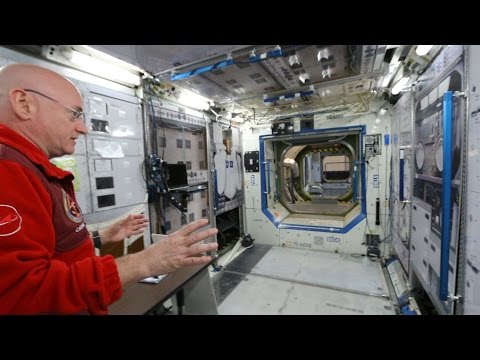
- Introduction and Tour SetupProblem IdentifiedDestin struggles to maintain spatial orientation during online ISS tours due to lack of gravity as a reference frame.Solution PresentedScott Kelly provides an in-person tour of the ISS mockup at Houston to help establish spatial understanding.Learning Enhancement• Video includes a video game-style radar showing position and orientation • Annotation links allow viewers to see corresponding orbiting footage • Tour follows the exact path Scott Kelly walked with DestinTour RouteStarting from Scott Kelly's Soyuz docking point and proceeding through to the Japanese module.
- Russian Segment and Docking SystemsDocking AreaMRM2 module at the top of the space station serves as the docking point for Soyuz spacecraft.Key Modules• Service module houses primary equipment • FGB is a Russian-built module owned by the United States, primarily used for cargo stowage • Carpeted velcro surface designed for secure equipment and item storageTransit PointWalking from the aft toward the forward section of the Russian segment leads to the US segment entry point.ConfigurationMultiple Soyuz spacecraft dock to different parts of the Russian segment for crew rotation and emergency evacuation capability.
- Node 1 and Node 3 - Common AreasCrew FunctionsNode 1 serves as the primary dining and social area for US segment crew members, with Russians occasionally joining.Galley Equipment• Drink bag filling stations • Small refrigerators • Food warming devicesNode 3 FeaturesContains the Cupola, the primary window for Earth observation and photography.Proximity LayoutThe Cupola, exercise equipment, toilet, and treadmill are all located within a few feet of each other at different orientations.
- Exercise and Life Support SystemsExercise Equipment• ARED (resistive exercise device) for strength training • Treadmill for cardiovascular exercise • Equipment positioned at various orientations relative to modulesLife Support Systems• Oxygen generation system that converts water into oxygen • Processor that converts urine into water • Carbon dioxide removal assemblies to filter CO2 from air • Lithium hydroxide canisters as backup systemsEnvironmental ChallengesRussian Vozdukh system cannot support six crew members, requiring backup lithium hydroxide canisters if primary systems fail.Photography ContextBeautiful Earth photographs are taken near the Cupola, which is located close to the toilet facility.
- US Laboratory Module - Science HubModule PurposeThe US laboratory module is the main science hub of the ISS, analogous to the bridge of a ship.Science Facilities• Multiple science racks for conducting experiments • Glove box for controlled sample handling • Three minus-eighty degree laboratory freezers for storing human and science samples • Robonaut (robotic assistant)Operations• Robotic arm can be controlled from this module or from the Cupola • Majority of US science research conducted hereLayoutThe mockup is less spacious than the actual orbiting module, which contains significantly more hardware.
- Node 2 and Crew Sleeping QuartersDocking Hub• Primary docking location for visiting vehicles including Space Shuttle, HTV, Cygnus, and Space X Dragon • Designated docking ports for future US crewed vehiclesSleeping Arrangement• Four US segment crew members sleep in this module • Three additional sleeping berths available in other modules • Crew members jokingly refer to the berths as coffins due to their appearance when occupiedPersonal QuartersEach bunk includes sound dampening, ethernet connectivity for internet access and power, a CSL laptop for intermittent internet, and personal workspace for email and applications.Comfort FeaturesPersonal sleeping bags attached to walls, adequate headspace, and cozy design make microgravity sleeping feasible.
- Columbus Module - European ScienceScientific RoleColumbus is the ESA science module hosting extensive human research and experimentation.Research Facilities• Multiple science racks on walls and ceilings utilizing all available space • Blood sample collection and processing area • Ultrasound equipment for medical research • Centrifuge for blood preparation before freezing • Gas analyzers providing specific gas compositions for experimentsOrientation SystemLighting and label orientation provide crew members with spatial reference, though some modules like PMM are oriented differently requiring crew readjustment.StorageModule includes dedicated storage space for scientific equipment and supplies.
- Japanese Module and External FacilitiesJapanese Module RoleJPM (Japanese Pressurized Module) serves as a secondary science module with various research racks.External Facilities• Japanese robotic arm with exposed external facility for moving science payloads • Side porch area for external payload manipulation • Airlock allowing hardware movement without exposing crew to vacuumTrainingCrew members receive science training using fully functional mockups of actual science racks rather than in the ISS mockup itself.Payload Management• Modular science racks can be replaced and rotated • Hardware brought up via HTV and other cargo vehicles • Big overhead storage area for equipment storage
- Conclusion and Technical DiscussionLearning OutcomeViewers should now understand spatial relationships between ISS modules and their functions during orbit observations.Production Thanks• Patreon supporters funded the flight and the complex motion-tracking radar overlay • Every second of video required motion tracking the camera position relative to ISS wireframe • Technical complexity made solo production impossibleSupport InformationPatreon supporters enable production of complex educational content like this comprehensive ISS tour.Bonus DiscussionPost-credits conversation with Scott Kelly about control moment gyros versus reaction wheels and their engineering applications.