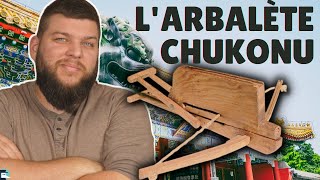

Comment est né l'Empire de Chine ? Entretien avec Arnaud Bertrand, archéologue et Sinologue
Interview with Arnaud Bertrand, Archaeologist and Sinologist
16 chapters
- Introduction and Arnaud Bertrand's BackgroundGuest IntroductionArnaud Bertrand is an archaeologist, sinologist, associate researcher and lecturer in the history of art and Chinese archaeology at the Catholic University of Paris. He is director of the French association of friends of the Orient and scientific adviser for the Silk Road exhibition at the Arab World Institute in 2022.Personal Journey• First contact with China through kung-fu practiced competitively for 12 years. • Initial interest in art history and the 15th-century Renaissance. • Passion for hydraulic pumps and the Roman Empire. • Gradual redirection toward ancient China and Central Asia.Academic PathStudy of Pergamon and the Greek Orient before discovering aspirators in China. Work on Chinese frontiers and Central Asia, eventually dedicating himself to northwestern China for about 12 years.Current CollaborationCollaboration with Nota Bonus for several months on a Chinese history series comprising nearly 10 episodes. Arnaud writes at least half the scripts and has connected other specialists for the other half.
- Definition and Geography of Ancient ChinaTime PeriodAncient China spans from the Neolithic to the fall of the Eastern Han Empire around 220 CE. This period covers the Neolithic, Bronze Age, and unlike the West, China has no distinct Iron Age.Absence of Cultural Unity• Virtually no Chinese cultural coherence until the end of the first millennium BCE. • Complete diversity between the north of the Yellow River and the south of the Yangtze River. • Differences in bronze-working techniques, religious institutions, and funeral practices. • Regional varieties even within funeral rituals.Appropriate TerminologyBefore unification in 221 BCE, one should speak of the 'Chinese world' rather than 'China' to be precise. This better reflects the reality of a vast space ten times the size of France, fragmented into multiple kingdoms and cultures.Comparison with EuropeContrary to appearances, ancient Europe had no more cultural coherence than China. The three European spaces (central, eastern, western) were equally fragmented under multipolar domination.
- The Qin Dynasty and Administrative UnificationQin PositionThe Qin are established in the northwest with the steppe, in a space of constant exchange with steppe peoples. They adopt legalism early, a very strict administrative philosophy based on law and meritocracy, unlike other kingdoms dominated by Confucian thought.Legalism and Application• Legalism governs the entire administration by law rather than religion or other forms. • Example of strictness: if you fail to report your neighbor's theft, you receive capital punishment too. • A rigid but effective system for imposing order and territorial expansion. • Contrast with administrative systems based on ritual and religion.Qin-Chu RivalryThe Qin in the north and the Chu in the south represent two completely different worlds. The Chu dominate southern rice paddies with strong maritime and commercial presence. This rivalry is profound, administrative, and cultural.Role of the PreceptorA key figure, preceptor of the future first emperor, uses meritocracy and legalism from around 250 BCE for approximately 20 years. He employs diplomacy and soft power to gradually expand Qin territory before the first emperor's rise.
- Ying Zheng and the Foundation of EmpireOrigins of the Future EmperorYing Zheng arrives around 250 BCE and is absolutely not predestined to rule. His preceptor is the true architect of his rise to power, similar to Mazarin's role for Louis XIV or Richelieu's for Louis XIII.Unification Process• Standardization of numerous weights, measures, and currencies to facilitate commerce. • Relocation of the capital from Xianyang to a more central position. • Creation of imperial commanderies corresponding to Roman provinces. • Organization into districts and cantons with strict hierarchical reporting.Institutional ReformsHarmonization of writing from seal script to clerical script to accelerate administration. Standardization of chariot axles to match newly built roads. Melting down weapons of the conquered into currency to constitute the imperial treasury.Duration and Limits of UnificationThe unification process begins before 221 but takes time. Ying Zheng dies in 210, only 11 years after taking the imperial title. This is a very short timeframe to unify such vast territory, but achieved through conscripts and organized political opposition.
- Qin Succession and the Beginning of CrisisSuccession ProblemAt Ying Zheng's death in 210, the main problem stems from magistrates and local governors who are the regime's primary political opponents. These figures had been severely controlled and sometimes executed. Their local cultures had been suppressed or heavily regulated.Successor's ReactionThe first Han emperor venerates the first Qin emperor but quickly eliminates local governors and magistrates as opponents. This resembles a political series where the main opponents are those in direct contact with power.Return to TraditionsAfter 209, there is a return to Spring and Autumn traditions with recurring revolts. The Qin regime is highly centralized and rigid, creating problems during power transitions.Gradual ImplementationEven without total territorial integration, the Qin manage to impose their administrative structure. The problem arises especially during power successions when local revolts easily resurface.
- The Rise of Liu Bang and the Han DynastyHumble OriginsLiu Bang comes from peasant stock in the Chu territory in the south, dominated by the Qin. He has no particular interest in reading and learning. He is an ordinary person, a typical success story of the era.Political Ascent• Creates clientelist and diplomatic ties within local prefecture circles. • Obtains military posts and leads a garrison for several years. • Capitalizes on the death of the first Qin emperor in 209 to position himself. • Joins revolt movements and gradually accumulates power.Consolidation of PowerLiu Bang officially becomes emperor in 206, after a 4-year period of revolts. In 202, he establishes himself as the first emperor of the new Han dynasty, changing his title and insignia. He must then face a complex situation with powerful political opponents.Reorganization DilemmaLiu Bang must reward his sworn brothers and family who helped him seize power. He creates a mixed system with commanderies in the center-west and kingdoms governed by family members in the east, creating an unbalanced structure.
- Han Stabilization and the Xiongnu ThreatGeopolitical ContextIn Liu Bang's time, the Xiongnu (steppe peoples) form a unified confederation under Mao Dun. Unlike fragmented China, the steppe represents a unified power, culturally and linguistically homogeneous, far more threatening.Diplomatic Marriage System• The Han do not wish to militarily occupy northern territories. • From 198 onward, a system of marriages between the imperial court and the Xiongnu is used. • Imperial women are sent in marriage to avoid direct war. • This system resembles the Disney Mulan system but is used as an appeasement policy.Transition Under SuccessorsUnder regent Empress Lü Hou for 25 years after Liu Bang's death, the system functions through diplomacy and marriage. The Han Empire consolidates control of the center while the Xiongnu accept this relatively peaceful system.Later ExpansionFrom 176 BCE onward, the Xiongnu claim to have occupied all the city-states of the Taklamakan oases (former Xinjiang). The Han seek to restart the diplomatic system after a period of northwestern occupation.
- Military Expansion and Frontier ConquestExpansion StrategyEmperor Wu of the Han (141–87 BCE) decides to directly confront the Xiongnu after constant raids on northern commanderies. He sends conquering generals who successfully deploy forces well beyond the Great Wall.Military Campaigns• Generals like Wei Qing and Huo Qubing launch raids between 121 and 119 BCE. • First decisive victory in 119 where the Xiongnu are truly defeated militarily. • Colonization of new territories with Han migrations and Han settlers. • Control of essential trade routes for the economy.Occupation ProcessOccupation follows a precise order: first secure trade routes, then establish garrisons and forts. Next come military conscripts, slaves, and prisoners of war to cultivate fields and expand arable lands.Role of the Great WallContrary to popular belief, the Great Wall is built last after occupation. It serves as a defensive line and monitoring point after trade routes and frontier forts are already established.
- Diplomacy and Frontier AdministrationHan Diplomatic ApproachThe Han are not expansionist but highly diplomatic. They do not wish to occupy territories because it is extremely costly militarily and administratively. The risk of enemies destroying everything is very high.Clientelist Strategy• Encourage local peoples to change allegiance through soft power. • Offer land, families, and buffer zones to Xiongnu defectors. • Use gifts and trade rather than pure force. • Create buffer zones between hostile Xiongnu and Han territory.Administrative OrdersDocuments found at frontiers show concrete orders: if you see a surrendering Xiongnu, give him millet, land, and family to integrate into the buffer zone. This is a policy of gradual integration.Favorable EnvironmentThe northwest was not a sterile desert 2,000 years ago but lush with rivers, deltas, and resources. This fertile territory allowed agricultural production necessary for clientelism and stable population settlement.
- Economic Debate and Succession ProblemsCosts of ExpansionAn important text called 'The Debate on Salt and Iron' dates to Emperor Wu's death. It opposes those at court who think frontier investment must stop because it is too expensive against those who want to continue.Han Golden Age• Golden age between the interregnum of Emperor Gu (76–75 BCE) and Emperor Xuan (15–20 BCE). • Frontiers profitable through trade route revenues. • Numerous frontier tribe revolts but relatively peaceful phase. • Better commercial connections due to northwestern occupation.Beginning of DeclineFrom the beginning of our era, major famines caused by significant Yellow River flooding. These natural disasters create political crises and reduce capacity to manage frontiers.Succession ProblemsSeries of rapid emperor changes with little time to rule. Resembles the late Roman Empire with many emperors in very little time. The Wang family gradually emerges by placing her son Wang Mang at court.
- End of Qin, Rise and Fall of the Former HanSystem TransformationWang Mang, first emperor of the Xin (9–23 CE), tries to return to the great age of Confucius's Spring and Autumn period. He abandons frontier policies and returns to a system more based on ritual and celestial forces.Religious and Symbolic Reforms• Return to the idea that the emperor is the Son of Heaven receiving a celestial mandate. • Construction of a great square hall with circular dwelling at center representing earth and heaven. • Use of feng shui and cosmological ritual in governance. • Creation of 5–6 different currencies with changing shapes (knives, etc.).Failed TransitionWang Mang's reforms fail after 20 years. The Eastern Han regain power thanks to the Red Eyebrows, a very important agricultural force. Wang Mang did not maintain necessary military and administrative capacities.Period ConclusionFrom 221 BCE to 9 CE unfolds a history of unification, expansion, and consolidation. Then begins the Eastern Han period marked by major political changes and the beginning of central power's decline.
- Archaeology in China and Research WorkExcavation ZonesArnaud Bertrand has conducted archaeological surveys for nearly 10 years around the present-day city of Dunhuang, famous for the Mogao Caves. This region of current Gansu contains approximately 500 fortified sites, less than 6% of which have been excavated.Research Topics• Study of fortifications and ancient frontier cities of the Han. • Analysis of communication towers and defensive lines. • Work on documents discovered at postal relays. • Combination of material and documentary data to understand administration.Sino-French CollaborationConstant work with researchers from the region's academy of sciences. Hundreds of kilometers traveled by four-wheel drive to identify and map sites. Mutual respect and genuine exchange of knowledge between French and Chinese researchers.Administrative ChallengesExcavations in China are extremely regulated and rare. Current projects might begin digging only in 5 years. Necessity to follow strict protocols with embassies and justify French contribution as purely intellectual, not financial.
- Heritage Protection and Political StakesChinese Legislation• Certain Chinese works must not leave the territory, classified as national treasures. • Construction of museums near major excavation sites to preserve pieces. • Substantial budget for restoration and conservation of remains. • Excavation reports now excellent with plans, images, and detailed texts.Publication DelayApproximately 10 to 15 years between excavation end and major publication of remains. During this period, objects are protected and contextualized. Example of restoration of Xi'an capital walls damaged during the Cultural Revolution.Looting ProblemLess than 10% of Chinese burial sites remain unlooted. The rest fall victim to looting and the international black market. Looters use sophisticated techniques resembling Mission Impossible to retrieve and sell remains.Genghis Khan AffairChinese authorities contested an exhibition on Genghis Khan in France, demanding removal of the term 'Mongol emperor'. China refuses 90% of artifact loans when its demands are not met, showing stakes in national historical narrative.
- Historiography and Interpretive DebatesFirst Emperor RepresentationClassical Chinese historians present him as a tyrant, but this is largely exaggerated. The first caricature dates about 90 years after his death, equivalent to judging Adolphe Thiers today without precise documents and without portraits.Continuity of Influence• No rupture between Ying Zheng and the Han dynasty. • The first major rupture comes with Wang Mang's death. • Ying Zheng is the first emperor of the Chinese program generally. • Veneration of the first emperor initiated by the first Han emperor.Pictorial RepresentationsFrom about 100 years before our era, bricks become a medium for pictorial narrative. Images of the first emperor appear in chronicles and tombs, showing assassination attempts and searches for the great cauldron for legitimation.Place in HistoryThe first emperor was fierce and terrifying, but also respected and fully part of Chinese history. He appears in funerary contexts, a sign of his importance in collective memory without rupture with subsequent periods.
- Demography and Complexity of Cultural IntegrationPopulation FiguresIn the Former Han and Qin era, approximately 60–68 million people live in the empire. In years 2–3 CE, the population reaches about 56–57 million inhabitants, representing a gigantic administrative entity.Forced Displacement• Approximately 7 million people deported to frontiers. • Represents 10% of total population relocated to frontiers. • Chang'an, the capital, is 7–8 times larger than Rome. • Disproportionate demographic concentration for the era.Integration ChallengesUnderstanding and integrating ancient Chinese culture is complicated even for specialists dedicating years to it. Administrative richness, multiple terms for the same concept, and bureaucratic details make study very demanding.Knowledge AcquisitionArnaud Bertrand, despite 13–14 years of intensive study, continues discovering new things translating documents. Study of ancient China is an endless process of deepening where one remains always somewhat 'lost' in its complexity.
- Bibliographic Resources and Future WorksReference Works• The Chinese World by Jacques Gernet (3 volumes, 2007 paperback edition). • The True History of the First Emperor by Damien Chaussende. • General History of China edited by Damien Chaussende (10 illustrated volumes). • The Debate on Salt and Iron translated by Jean Davy.Academic Publications• Online articles from the Collège de France with Anne Cheng. • Courses on Central Asia by France Grenet. • Bilingual versions with Chinese and French for specialists. • Works by Alain Dote, Olivier Aventur on epigraphy and Shang-Zhou periods.Upcoming EpisodesComing in May: episode on the Forbidden City with focus on architectural symbolism. Then in June–July: introduction to the Three Kingdoms centered on historiography rather than historical details. Three Kingdoms historiography will be a specialized topic.Arnaud's Current WorkWriting a biography and history of northwestern expansion currently underway. Work done in the evening after midnight once children are asleep. Publication planned with articles on northwestern discoveries to come.