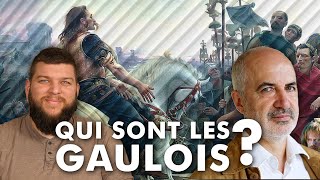
Comment mieux connaître les Gaulois ?
11 chapters
- Introduction and specialist presentationSeries contextThird episode in a short series on Gallic equipment and combat, with links to the first two episodes available in the description.Expert introductionGuillaume Reich is a doctor of protohistoric archaeology, specialist in the cultures of the second Iron Age, a period spanning from 475 BCE to 25 BCE.Research fields• Material cultures produced by the Celts • Gallic armament and equipment • Gallic combat techniquesPedagogical approachThe episode focuses not only on research findings but also on methodology and research itself.
- La Tène site: an exceptional archaeological siteLocation and discoverySwiss site discovered in 1857, namesake of the second Iron Age with thousands of objects in exceptional preservation.Preservation conditions• Exceptional anaerobic phenomenon (oxygen deprivation) • Ordinarily perishable materials preserved nearly intact: wood, wickerwork, leather, fabric fragments • State of preservation close to the moment of abandonmentTypes of objects found• Weapons: spears, shields, swords, scabbards and suspension systems • Jewelry: torcs, fibulae, belt elements • Tableware: ceramics, wooden containers, metal vessels (cauldrons) • Equestrian equipment: harnesses, chariot elements • Craft and agricultural tools • Human remains: 50 to 100 skeletons • Equine remains: approximately 30 horsesScientific importanceMajor reference site enabling research for over 150 years on Celtic material cultures.
- Hypotheses on La Tène site's functionEarlier hypotheses• Military arsenal • Swiss customs post • Lacustrine settlementsRitual sacrifice hypothesisFrom the 1950s onwards, German scholars considered it an 'Opferplatz' (sacrifice site) due to the enormous quantity of material discovered.Regional comparisonsSimilar discoveries in northern France, notably the sanctuaries of Rythème and Gournay-sur-Aronde, leading to the view of La Tène as a sanctuary or military trophy.Current dominant hypothesisLa Tène site is probably a military trophy, a concept specific to the Celtic world linked to war rituals and offerings to deities.
- Celtic military trophies and the religious dimension of warTrophy conceptAncient practice specific to the Celtic world: before battle, belligerents negotiate with deities to request victory.Offering mechanism• Negotiation with the gods: 'you give to me, I give back to you' • In case of victory, consecration to the deity of part of war spoils • Spoils could include: tableware, livestock, horses, humans reduced to slaverySpiritual dimensionWar in the Celtic world is a religious act par excellence, with rites before (gathering of initiates, oracle consultation), during, and after (ritual offerings).Important clarificationsSpirituality surrounds war practices but does not justify them; these are not religious wars in the strict sense.
- Research methodology: from traces to gesturesInnovative approachSystematic study of damage affecting weapons to determine whether it results from religious rituals or combat use.Methodological challenges• Distinguishing between intentional ritual destruction and accidental combat damage • Risk of interpreting everything anomalous as ritual • Need to establish precise questions for archaeological materialsDisciplines mobilized• Traceology (study of traces) • Forensic sciences and scientific police methods • Applied mathematics • Archaeological experimentationResearch interestBeyond classical typological identification, this approach allows insight into human gesture and determination of the site's actual function.
- Trace identification: manufacturing, restoration and taphonomySorting tracesNeed to distinguish authentic destruction traces from manufacturing marks, restoration, and post-depositional alterations.Modification factors• Taphonomy: chemical and mechanical agents acting during 2200 years of burial • Corrosion due to metal oxidation • Alterations from object discoveryVocabulary establishmentCreation of precise terminology distinguishing creases, flexions, torsions, notches, cuts, rather than treating them as synonymous.Terminological rigorEliminate traces of non-anthropic origin and categorize authentic traces using standardized vocabulary for systematic comparison.
- Archaeological experimentation: replicas and test protocolsEthical approachImpossible to damage 1200-year-old original objects; use of faithful replicas of archaeological weapons for experimental testing.Replica criteria• Respect of weapon's internal structure • Similar chemical composition • Appropriate morphology • Limitation of prohibitive costs of exact replicationExperimental relevanceMinor composition variations (e.g., 0.2% or 0.3% carbon) do not affect results; only major variations (0.2% vs 2% carbon) are relevant.Established protocolArchaeological experimentation is not improvised testing but a process answering precise questions with defined protocol and clear issues.
- Practical training and gesture creationParticipant trainingTraining of several dozen people in weapon replica handling, in partnership with equestrian instructors for mounted combat training.Equestrian training• Complete training of horses for mounted combat simulation • Requires significant time, energy and patience • Rewarding results and gradual horse learningReconstruction elements• Biomechanics: body movements constant since the Iron Age • Weapon morphology guiding usage • Traceology on weapons indicating contact points • Applied mathematics and physical indicatorsSafety and rigorSeveral hundred combat sessions without serious injuries (one scratch only), conducted with effective protection and strict adherence to methodological protocol.
- Sources for reconstructing war gesturesTextual and iconographic sources• Ancient Greco-Roman texts • Iconography produced by Celts and their contemporariesComparative approachesEthnography of contemporary societies still using swords and spears: observation of usage techniques and traces produced on weapons.Forensic medicineApplication of forensic principles to interpret wounds and impact traces on weapons.Methodological synthesisMobilization of maximum converging elements to redraw the outline of a complete and coherent Gallic martial art.
- Results: debunking myths about Celtic weaponsCommon traces found• Slight sword flexions: easily obtained in combat from blade impacts when supple • Swords embedded in shields bending at 90 degrees: frequent combat accident • Blade straightening during subsequent strikes: remarkable capacity for ductilitySpectacular deformation cases• Scabbards wrapped around legs during falls: simple rider accident • Scabbards bent against horse croup: accidental contact at trotChallenging stereotypesRefutation of the ancient Greco-Roman myth of the 'barbaric Celt producing poor-quality weapons': Celtic swords are ingenious and exceptionally functional.Celtic technical qualities• Malleability and ductility allowing shock absorption • Exceptional mechanical resistance • Ability to absorb impacts without catastrophic fracture
- Conclusion and perspectivesThanks and summaryGratitude to Guillaume Reich for illuminating scientific methodology and debunking several stereotypes about the Gallic Iron Age.Importance of the workMany researchers work quietly to improve understanding of ancient periods, especially the Iron Age.Additional resourcesGuillaume Reich's works and bibliography available in the description and on Nota Bonus channel's social media.Support appealMention that archaeologists have limited financial resources, with implicit appeal to passionate supporters.