Francs-maçons, Stargate, Beyoncé… pourquoi l'Égypte ancienne est partout ?
13 chapters
- Introduction and context of the exhibitionCentral themeThe video explores how ancient Egypt is fantasized and represented in our minds, rather than the actual history of this civilization.Featured exhibitionThe exhibition "Egypt, Eternal Passion" at the Royal Domain and Museum of Mariemont in Belgium, from September 24 to April 16, traces 2,000 years of passion for ancient Egypt through about a hundred objects of Egyptian inspiration.Collection originsThe museum's Egyptian collection comes from Raoul Warocqué, a philanthropist heir of a wealthy industrial dynasty who amassed antiquities since the 19th century.Current relevanceThis exhibition speaks to us and our contemporary relationship with Egypt, proving that this attachment has been part of our lives for a very long time.
- Raoul Warocqué's collection and its treasuresVisionary collectorRaoul Warocqué, heir of a wealthy industrial dynasty, established himself as a philanthropist and passionate collector in the final decades of the 19th century.Major acquisitions• In 1888, acquired a copy of the "Description of Egypt," a monumental work in 23 volumes resulting from Bonaparte's Egyptian Expedition • Collected bronzes, alabaster vessels, vases, scarabs, statues of deities and faience figures • Collection included a uraeus (serpent from pharaohs' crowns) and a statue of Horus the childLegacy and continuationAfter Warocqué's death in 1917, the Belgian state continued acquisitions, adding mirrors, reliefs, stelae and papyrus fragments, making Mariemont the largest collection in Wallonia and the second in Belgium.Museum specialtyThe museum built a specialty by creating bridges between antiquity and the contemporary world, with exhibitions such as "Memories of the Orient" (2010), "From the Nile to Alexandria" (2013), and "Egyptian Gods in Geek Culture" (2016).
- Favorites: five treasures from the permanent collectionPtolemaic bustA monumental bust of a Ptolemaic queen once accompanied by a man, whose identity remains mysterious: could be Cleopatra VII, Cleopatra II, III, or even the goddess Isis.Divine artifacts• The aegis of Hathor decorated with a head topped with horns enclosing the solar disk, with the triad Osiris, Isis and Horus • Multicolored reliquary chest with great falcon and scenes of Osiris and Anubis, including the 4 children of Horus protecting the deceased's organsPredynastic jarA simple jar decorated with wavy lines and spirals dating from the predynastic period, before Egypt's unification, about 5,500 years old.Temporal contrastAn Egyptian flabellum from the 13th century (Middle Ages) adorning a Virgin and Child, creating an interesting anachronism amid ancient pharaohs.
- Silver sphinx and mysteries of EgyptologyQuestionable authenticityA silver sphinx purchased in the early 20th century actually dates from the 19th century, possibly a copy of an authentic object whose location no one knows.Reasons for fantasySome objects refuse to reveal their secrets, fueling fantasies about Egypt for centuries.Contemporary appropriationsThe exhibition shows that our appropriations of the Egyptian past are sometimes displaced or frankly funny, but ancient Egypt is omnipresent: tattoos, travels, collections of trinkets, company logos, manga heroes.Living museumThe museum remains a living space that confronts past and present, giving a place to all types of Egyptian objects from yesterday and today.
- Five eras of Egyptian passion: from antiquity to todayAge of the GodsFrom antiquity until 30 BCE, Roman Gaul already experienced strong Egyptian influences with statues presenting oriental figures like Harpocrates (Horus the child with finger to mouth) and Isis whose cults spread widely throughout the Roman Empire.Christian influenceEgyptian fashion lasted until the Middle Ages and influenced Christianity, notably the shift from representations of adult Christ to that of the child Jesus in his mother's arms, inspired by statues of Isis lactans (Isis nursing young Horus).Medieval connectionThe Middle Ages maintained its connection to Egypt through numerous pilgrimages, as the Bible considered Egypt the land that welcomed the Holy Family fleeing persecution in Bethlehem.Continuity and mysteryContrary to expectations, interest in Egypt did not disappear with modernity, but rather intensified at the end of the Middle Ages.
- Age of scholars: scientific EgyptomaniaMajor eventBonaparte's famous Egyptian campaign in 1798 triggers an explosion of Egyptomania, with dozens of travel accounts occupying a special place in the scholarly world.Intellectual transitionInterest shifts from mystical charm to scientific interest, with researchers addressing not only the ancient period but also the specificities and issues of contemporary Egypt.Hieroglyph enigma• Since the Middle Ages, hieroglyphics remain at the heart of Egyptian passion with attempts at decipherment • In 1822, Champollion makes the decisive discovery that transforms the understanding of hieroglyphics • From the Rosetta Stone to modern Egyptological dictionaries, hieroglyphics become the symbol of this passionVisual implicationsFake hieroglyphics, imitations and neo-hieroglyphics appear everywhere on period furniture, revealing boundless enthusiasm.
- Age of passions: tourism and cultural creationTourism explosionIn the 19th century, tourism explodes with Thomas Cook cruises, visits by celebrities to Egypt and advances in photography fueling a new generation of travel journals.Artistic productions• Verdi's opera Aïda, premiered in Cairo in 1871, commissioned by Ismail Pasha, Egypt's viceroy, with scenario and set design advice from Auguste Mariette, one of the greatest Egyptologists of the era • "The Mummy's Romance" by Théophile Gautier telling the story of Tahoser, a young woman whose mummy was perfectly preservedInternational collaborationsA crazy mix of science, art and history uniting Italy, Egypt and France around Egyptophile creations.Explosive private collectionsPrivate collections multiply thanks to travelers bringing souvenirs from Egypt for their fireplaces, with Warocqué representing one collector among thousands of enthusiasts.
- Age of collections: museums and freemasonryMuseum formationLarge assortments are sold to various governments to stock state museums being created, notably the Charles X Museum collection preserved by Champollion, at the origin of the Louvre's Egyptian department.Masonic symbolism• Freemasons adopted many Egyptian motifs in their rituals • A frieze from the Antwerp lodge filled with Egyptian elements • A medal celebrating the centenary of the Grand Orient of Belgium • Masonic lodges attached themselves to Egyptian antiquity, nurturing many fantasiesContemporary continuityEven today, masonic lodges maintain their connection to Egyptian antiquity.Historical anecdoteThe Charles X Museum collection preserved by Champollion became the origin of the current Egyptian department of the Louvre.
- Contemporary Egyptian iconsMythified CleopatraCleopatra becomes a femme fatale embodied by Liz Taylor and Monica Bellucci, plasticized like a Barbie doll, rather than respected for her true history.Iconic Nefertiti• It is not Nefertiti's history that makes her famous, but her bust preserved in Berlin • Her great blue crown becomes an icon reproduced and diverted a thousand times • Rihanna, Daisy Duck and Beyoncé's coat of arms wear Nefertiti's style • She becomes an African icon, symbol of pride for Black communitiesMediatized TutankhamunTutankhamun is famous solely because of the spectacular and widely publicized discovery of his tomb in 1922, especially for his famous golden mask.Questions of identityThe question arises: who is really the icon? Tutankhamun himself or only his name, his mask, his tomb or his media coverage?
- The mummy: object of horror and fascinationVaried representations• Object of horror and fear • Erotic figure as in "The Mummy's Romance" • Sympathetic and clumsy character as in "Hotel Transylvania"Emotional contextsWe can be afraid, fantasize or laugh around the figure of the mummy, as the exhibition shows very well.Human realityA mummy first represents human remains of a person who truly lived and who believed in eternal life.Respectability requiredWe must recognize the dignity and humanity behind these artifacts, beyond contemporary fantasies.
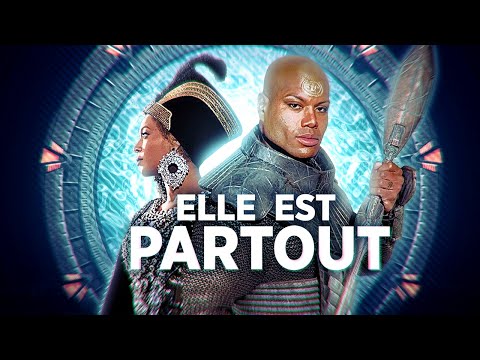
- What makes it "Egyptian": recurring symbols and motifsUnveiled IsisThe motif of Isis "unveiled" symbolizes the end of obscurantism and revealed wisdom, becoming an appreciated image in esoteric and occult circles.Neglected Anubis• For a very long time, Anubis was completely snubbed, nicknamed "the barker" by Christians because of his dog head • Champollion does not even mention him in his "Egyptian Pantheon" • He is one of the major deities, but only in the 20th century did his original look make him a superstarPower of imageryVisualizing "a man with a dog's head" immediately triggers the association "Egyptian," when we could have completely missed it.Universal hieroglyphicsHieroglyphics, true or false, copies or fantasies, work every time regardless of context: Stargate, Asterix and Cleopatra, Indiana Jones, street art.
- Pyramids, sphinx and Egyptian presence everywhereUniversal symbolsPyramids and the Great Sphinx appear everywhere: comics, graphic novels, cinema, music, company logos, movie sets.Khufu's mystery• A pyramid like Khufu possesses remarkable geometry • It symbolizes the mystery of its construction • It embodies beliefs linked to extraterrestrials and Masonry • These elements are found in hundreds of contemporary logos and setsVirtual reconstructionThe game Assassins Creed Origins reaches new heights in its reconstruction of monuments, adopting many motifs present in the Mariemont exhibition.Popular cultureYu-gi-Oh cards, papyri with names, pyramids and DVDs of "The Mummy" lie around in homes, proving that Egypt has entered our daily lives.
- Conclusion: Egypt everywhere and Mariemont as a bridgeEgyptian omnipresenceAncient Egypt has deeply settled into contemporary culture through the arts, music, video games, logos and daily life.Invitation to visitThe exhibition "Egypt: Eternal Passion" at the Royal Domain and Museum of Mariemont offers in-depth exploration with a wild collection and free permanent collections all year.Bridge between worldsMariemont connects the worlds: you travel alongside Cleopatra, Nefertiti, Champollion, Bonaparte, Isis and Beyoncé.Call to engagement• Share your exhibition experiences in comments • Describe how Egypt influenced your personal life • Subscribe to "Le Phare à On," Simon Thuault's channel dedicated to ancient Egypt