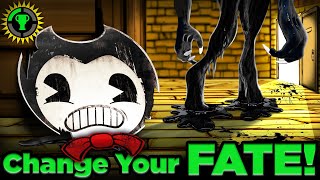

Game Theory: How Bendy EXPOSES Disney's Cartoon CONSPIRACY (Bendy and the Ink Machine)
11 chapters
- Introduction and Historical ContextShow OpeningMatPat introduces Game Theory and welcomes viewers to a special episode focusing on the 1920-1940 era.Historical Period• The era between 1920 and 1940 was marked by the Great Depression • Hitler rose to power overseas, sparking the beginnings of World War II • Despite dark times, animation exploded onto the scene as a form of entertainmentGolden Age of AnimationAnimation had existed since 1900, but the 1920s-1940s marked what's known as the Golden Age of Animation when the medium truly flourished.Game IntroductionBendy and the Ink Machine is a small indie title told in five parts, where you play as Henry, a retired cartoonist invited back to Joey Drew Studios after 30 years.
- Game Plot and Lore OverviewSetting and DiscoveryHenry finds the studio abandoned and discovers through audio logs that Joey Drew was experimenting with ways to bring his cartoon creations to life, and the experiments were successful.Living Cartoons• Bendy, the company's signature character, is now alive and very dangerous • Boris the Wolf also walks around the studio • Alice Angel appears to play a bigger role in later chaptersCult ActivitySome employees, like Sammy Lawrence (music department director), worship these living cartoons as gods, forming what appears to be a cult.Main QuestionMatPat proposes to reveal the true identity and inspiration behind Joey Drew, the main character's driving force.
- Max Fleischer: The Forgotten PioneerThe TheoryJoey Drew is inspired by Max Fleischer, a real animator whose name has been almost completely forgotten by history despite being a single most important pioneer of animated entertainment.Disney's Marketing• Walt Disney is commonly credited as the pioneer of animation, but he purposely planted these thoughts through masterful marketing • Disney took credit for ideas that weren't originally his • Disney used media to sell his story to audiences unaware of the truthFleischer's Real ImpactMax Fleischer, with his brother Dave, operated the Fleischer Studios in New York and were the true masterminds responsible for shaping early animation.Animation RivalryThis began the animation feud between the Disney studio on the west coast in Hollywood and the Fleischer brothers in the east in New York, a rivalry that lasted two decades.
- Fleischer's Innovations and FirstsRotoscoping TechniqueIn 1914, Max Fleischer invented rotoscoping, which allowed artists to trace over live-action footage to create more realistic-looking animated movements, representing a huge advancement in animation quality and speed.Out of the InkwellThe Fleischer brothers created this famous series in which live-action footage of Max was combined with animated characters that literally came to life off the page to interact with the real world.Sound InnovationMax created Song Car-Tunes in 1924, four years before Steamboat Willie, featuring the famous follow-the-bouncing-ball sing-alongs. This was the first to combine sound and animation, but Disney later claimed credit.Disney's SuppressionWhen Steamboat Willie launched, Walt Disney actively discouraged reporters from mentioning these past Fleischer sound videos, allowing Disney to claim credit for being the first to use these techniques.
- Fleischer vs Disney: The Business WarStudio StatusAt their prime, the Fleischer studio was a premiere producer of animated cartoons for theaters with Walt Disney Productions as their chief competition.Disney's VictoryDisney won the competition due to superior marketing and their location in California amongst the growing movie industry, which ultimately buried Fleischer's business and erased his name from animation history.Game ConnectionThe abandoned studio in Bendy and the Ink Machine reflects Max Fleischer's eventual bankruptcy and loss of his business to Walt Disney. The game wouldn't feature an abandoned studio if it paralleled successful Disney animation.Revenge ThemeIf the game paralleled Disney's success, why would characters be out for revenge? Fleischer, left with a crumbling business and name lost to obscurity, would have a chip on his shoulder and motivation for revenge.
- Character Parallels: Bendy and BimboVisual SimilaritiesBendy (small character with big white gloves) appears to be inspired by Mickey Mouse, but Max Fleischer had his own version: Bimbo, a tubby black-and-white cartoon dog with big white hands.Personality Differences• Mickey in early cartoons was typically the good guy fighting back against bullies • Bimbo was actively a troublemaker and mischief-maker • Bimbo's behavior is a stronger match for what you'd expect from a little devil like BendyBimbo's DarknessIn the 1930 cartoon Swing You Sinners, undead spirits punish Bimbo for his misdeeds. Bimbo constantly chases women and pulls pranks, fitting the mischievous devil character better than Mickey Mouse.ConclusionThe parallels between Bendy and Bimbo are far stronger than between Bendy and Mickey Mouse, suggesting Max Fleischer's character is the true inspiration.
- Alice Angel and Betty Boop ConnectionAlice Angel Overview• Alice appears to be a female devil creature like Bendy who somehow became an angel • She is drawn to be beautiful with a tight black halter top dress that would be considered scandalous in the era • Sammy Lawrence expects her popularity to surpass Bendy'sBetty Boop ParallelAlice Angel matches exactly with Betty Boop, one of the Fleischer Studio's most famous creations: a singer who was Bimbo's love interest and surpassed him in popularity while being considered an attractive, sexy character.Visual Matching• Both wear black halter top dresses (red in later Betty Boop cartoons, but black and white in early cartoons) • Betty Boop was considered so attractive that her design had to be toned down in 1934 when the government cracked down on sexual content in filmsSpecies ConnectionBetty Boop actually started as a French Poodle, with her long dog ears becoming her hoop earrings. Like Alice and Bendy, both are the same species, matching their love interest dynamic.
- Animation Styles: Disney vs FleischerDisney's West Coast Style• Family-friendly approach with characters behaving realistically • Brighter and cheerier settings • Tightly bound to the rules of realityFleischer's New York Style• Much grittier and twisted aesthetic • Aimed at more mature audiences • Character bodies contort like rubber bands with looser animation style • Felt like improv where characters aren't bound to reality rulesVisual Environment• Grungier settings taking place in cities, sewers, and buildings rather than outdoors • Racier topics and scarier cartoons with darker, sometimes hellish imagery • Joey's animation studio in Bendy features industrial pipes, dripping ink, dark and shadowy spaces—literally a hell on earthModern ComparisonThe Fleischer style was like YouTube animations from channels like GonzoSSM, PsychicPebbles, OneyNG, and EgoRaptor—looser and more experimental than Disney's controlled approach.
- Cult Imagery and Fleischer CartoonsBendy's CultThe big reveal at the end of Chapter 2 is that Sammy is trying to sacrifice the player to their ink god, Bendy. He's clearly in a cult worshiping these living cartoon characters.Fleischer's Hidden Cult Themes• In Betty Boop - Is my Palm Read, Bimbo and Koko the Clown worship a shadowy witch figure that's never explained, just bowing to it • In Betty Boop Red Hot Momma, a fireplace suddenly transforms into the literal mouth of Hell with no explanation • Unexplained recurring theme of cult activity throughout Fleischer studio cartoonsBimbo's Initiation DetailsIn this cartoon, Bimbo is locked in a sewer by Mickey Mouse (showing Max's grudge against Disney) and confronted by cultists asking him to join. When he refuses, he's tortured with horrific punishments including a knife cutting through a spinning room to stab him repeatedly.Cult RevelationAfter being asked repeatedly if he wants to join, Bimbo finally says yes. The cult is revealed to be made up entirely of Betty Boops, creating a bizarre and creepy dynamic about clones or self-worship.
- Theory Synthesis and PredictionsTheory Summary• Max Fleischer is the real-life inspiration for Joey Drew • Between the gritty setting, failing company, desire to bring cartoons to life, white-gloved mascots with matching female partners, and a boss with a chip on his shoulder, the parallels are undeniable • Recurring cult imagery connects Fleischer's work to Bendy's narrativeExpected Story Arc• Alice will take center stage as the game progresses, with her popularity skyrocketing and surpassing Bendy's • Bendy likely won't be happy about this, creating in-fighting between characters • The player will be stuck in the middle of this conflictFuture Cult ElementsThe game hasn't seen the last of the cult. Like Bimbo's Initiation showed, characters could be using the ink machine to replicate themselves, building a cult of hundreds of horrifying Bendy and Alice clones.Joey Drew's FateIt wouldn't be surprising if Joey Drew is the real identity behind the first Bendy, fused together with his creation by the cursed ink machine. He'd be literally consumed with his desire to bring cartoons to life, mirroring Max Fleischer's eventual consumption by his desire for revenge on Disney.
- Conclusion and Closing RemarksTheory ConclusionThe game will eventually reveal more about Joey Drew's true identity and the fate of the studio as Chapter 3 arrives.Subscribe CallMatPat invites viewers to subscribe and join the Theorist cult, making a playful reference to the cult themes of the video.AdvertisementMatPat promotes VRV, a free streaming app that offers anime from Crunchyroll, shows from RoosterTeeth like RWBY, and content from the Tested channel with Adam Savage from MythBusters.Final Thoughts• MatPat apologizes if the episode ruined Disney for anyone, noting that while he still loves Disney, learning about Walt's manipulation was disappointing • He jokes about Space Mountain still being fun and Star Wars land coming to Disney parks • He ends with an apology to Max Fleischer for Disney's historical erasure