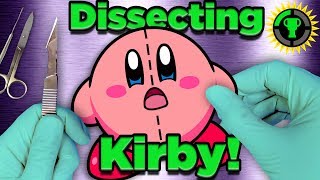

Game Theory: What is a Kirby? The SCIENTIFIC PROOF!
6 chapters
- Introduction to KirbySeries OverviewKirby franchise started in 1992 with Kirby's Dream Land and has launched over two dozen games, selling over 35 million copies—more than double Metroid sales and triple Star Fox.The MysteryWhile characters like Sonic, Crash, and Mario have clear identities, Kirby's exact biological nature remains unexplained. Even creator Masahiro Sakurai claims to not know what Kirby actually is.Personal Connection• Kirby Super Star was a favorite childhood birthday present • Two-player Epic Yarn was played with Steph around Christmas when engagedCore QuestionThe episode sets out to definitively answer: What exactly is Kirby biologically?
- Physical Properties AnalysisBody Elasticity• Kirby's body shifts to the side of impact when hitting the ground, then bounces back to normal like a water balloon • Wind force deforms his body while running • No solid internal structural system—body is filled with fluidSkeletal EvidenceIn the original Super Smash Brothers, only three characters show no skeleton when electrocuted by Pikachu: Kirby, Jigglypuff, and Samus (hidden in suit). Kirby has absolutely no bones.Arm Characteristics• Kirby never sprouts fingers from his stretchy nubblies • Objects stick to him when held, suggesting selective adhesion • Arms can form anywhere on his body—above, behind, or even on his faceMovement PatternsIn Return to Dream Land, nubblies slide around on his body surface rather than being fixed at shoulders. Swimming animation shows arms forming on his face and sliding down his sides while body maintains spherical shape.
- Amoeba Theory IntroductionWhat Are Amoebas• Single-celled organisms made up of one cell • Eukaryotic with a nucleus that controls cellular function • Spend life moving and searching for foodCytoplasm RoleAmoebas are filled with cytoplasm, a fluid that allows them to maintain structure while remaining elastic and able to change shape.Pseudopods FunctionAmoebas move and grab objects using stretchy appendages called pseudopods (false feet) that can form anywhere on their bodies by pushing cytoplasm against the cell membrane.Connection to KirbyKirby's fluid-filled body, elastic deformations, and mobile nubblies align perfectly with amoeba characteristics, explaining how he can form appendages without skeletal or muscular systems.
- Defensive and Divisional AbilitiesGuard MechanismKirby's guard ability is explained by amoebas forming cysts—thick protective layers of skin that harden during extreme situations, allowing his nubblies to defend without breaking.Cellular DivisionIn Kirby Mass Attack, Kirby splits into pieces with each piece functioning as separate individuals, similar to how amoebas divide.Multi-Nucleus SolutionWhile typical eukaryotic cells have one nucleus, xenophyophores (giant deep-sea amoebas) can have thousands of nuclei, allowing them to divide into multiple viable pieces without issue.Size ConfirmationXenophyophores grow up to 20cm (8 inches) in diameter. Nintendo officially states Kirby is 8 inches tall, matching the size of these giant amoebas exactly.
- Copy Ability and EndosymbiosisEndosymbiosis Explained• Endo (inside) + symbiosis (close interaction) = interaction formed on the inside • Simple cells ingested one another and shared abilities because it was evolutionarily beneficial • Example: mitochondria has its own DNA, suggesting it was once a separate organismBiological ProcessOne cell ingests another, obtains that cell's abilities through genetic reading and writing, filters what is needed for survival, and can expel unwanted material.Kirby's Copy MechanismKirby ingests living enemies and takes only abilities that help him survive. He doesn't gain redundant traits like extra eyes from Waddle Doo because he already has eyes.Ability ReleaseWhen Kirby no longer needs a copied ability, it exits his body as a star, representing the DNA being expelled from his cellular structure.
- Conclusion and Final EvidenceComplete TheoryEvery aspect of Kirby—physical attributes, movement, holding objects, defense, cellular division, and copy ability—can be explained by him being a pink, eight-inch sentient amoeba.Scientific Proof• Kirby's copy ability is identical to endosymbiosis, a real evolutionary process • His size matches xenophyophores exactly at 8 inches • His body structure and flexibility match amoeba biologyDefinitional MatchKirby exhibits all defining characteristics of giant amoebas: single-cell structure, fluid-filled body, pseudopods, selectively permeable membrane, ability to form cysts, and multi-nucleated cellular division.Mystery SolvedThe episode answers one of the biggest mysteries in video games: Kirby is scientifically proven to be an amoeba, and his copy ability represents the real biological process of endosymbiosis.