
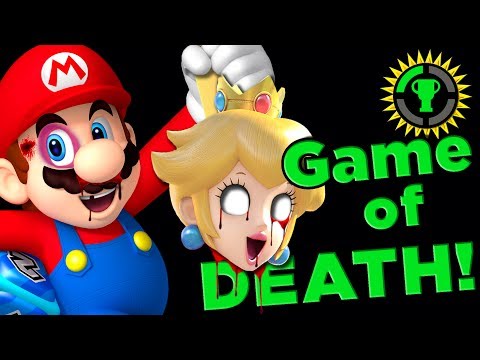
Game Theory: How DEADLY is Mario Kart 8?
Where we analyze cartoon physics, with a seriousness usually reserved for overworked, mechanical engineering undergrads
9 chapters
- Introduction and Series OverviewShow PremiseGame Theory analyzes cartoon physics with the seriousness usually reserved for mechanical engineering undergrads.Notable OversightIn 182 episodes of the series, Mario Kart had never been covered despite being a franchise the host played extensively while growing up.Current CatalystThe release of Mario Kart 8 Deluxe prompts the analysis.Main ThesisMario Kart 8 is arguably the single most horrific Mario game out there, containing death machines disguised as fun racing karts.
- Safety Violations and Legal IssuesEquipment Deficits• Karts have no helmets, no seatbelts, and no sides • Characters ride completely unprotected at high speedsProduct Placement ProblemThe Mercedes GLA, an unlockable kart in the game, violates vehicle advertising laws by not showing characters wearing seatbelts.Legal RequirementsVehicle advertising must show proper driving etiquette including seatbelt usage, brake usage, and lane indication.ConclusionNintendo and Mercedes are breaking the law with their GLA promotion in Mario Kart 8, making the entire game an illegal sponsored video.
- Measuring In-Game SpeedsReference StandardMario's official height is 155cm (5'11"), established through direct measurement of an official Nintendo costume and confirmed by Nintendo canon.Measurement MethodUsing Mario's height as a scale, the checkerboard finish line (138cm wide) and frame-rate analysis at 60 FPS allows precise speed calculations.Basic Kart SpeedMario on a standard kart reaches top speeds of 35.57 meters per second, equaling 128 km/hr or approximately 80 mph.Real-World ContextThis speed exceeds most highway speed limits and is comparable to actual professional super-karts that race at speeds up to 200 kph or 124 mph.
- Real Racing vs. Mario Kart DangersTrack Differences• Real race tracks have grass patches allowing drivers to slow down safely • Walls are rarely positioned directly adjacent to the road • Angled impacts reduce total force absorption compared to head-on collisionsSafety Equipment• Professional helmets reduce impact force by factors over 1000 • Leather racing suits provide critical protection for high-speed slidesMario Kart HazardsThe game features sentient stone monsters (Thwomps) designed to crush racers, absent from real racing.Protection GapKarts lack modern safety features like bumpers, airbags, and crumple zones that protect real car drivers.
- Physics of High-Speed SlidesCoefficient FormulaThe coefficient of friction determines how much body material is lost per mile per hour traveled above 30 mph (or 48 kph).Skin Loss CalculationFor every mph over 30, you lose 1mm of skin; human skin averages 1.3mm thick, so at 31 mph you lose most protective skin layer.Mario's Crash ImpactAt Mario's top speed of 80 mph, a ground slide results in 5cm (2 inches) of body ground away like a cheese grater.Graphic RealityThis damage represents skin, muscle, bone, and potentially vital organs—a condition called skin avulsion.
- Maximum Speed ConfigurationsFastest Setup FoundDry Bowser driving a B-Charger kart with specific wheels, superglider, and 10 coins achieves the fastest speeds without items.Peak VelocityThe optimal configuration reaches 180 km/hr, exceeding 110 mph.Smallest Racers• Baby Peach, Baby Daisy, and Baby Rosalina are approximately 60cm (24 inches) tall • These infant characters lack the surface area of adult racers to survive crashesBaby Crash ConsequenceAt extreme speeds, babies would lose 7cm (3 inches) of body material—approximately 1/8 of their total body mass—in a crash.
- Head-On Collision MechanicsMythbusters ReferenceMythbusters crashed cars into walls at 100 mph, reducing vehicles to half their original size.Kart VulnerabilityKarts lack decades of engineering safety features like bumpers, airbags, and crumple-zones that protect modern car drivers.G-Force ExposureGoing from 100 mph to 0 in a split second produces over 2000 Gs—2000 times Earth's gravity—sufficient to shred organs and shatter bones.Seatbelt Absence EffectWithout seatbelts, drivers fly head-first into cement walls, becoming decorative splotches rather than crumpling with their vehicles.
- Angled Collision AnalysisFormula DevelopmentTheorist Labs created a real-life formula using trigonometry, algebra, and pixel measurements to calculate speed reduction based on collision angles.Minor Impact ExampleMario grazing a wall at just 5 degrees experiences a 20 mph speed reduction in a fraction of a second, producing 25 times gravitational force.Extreme Scenario• Baby Daisy traveling at high speed uses a mushroom doubling her velocity to over 200 mph • Unable to make a turn, she hits a wall at 30 degrees • This produces 40% speed reduction and over 115 Gs of forceContext ComparisonFighter pilots train to withstand only 9 Gs; regular adults and babies cannot tolerate 115 Gs without catastrophic organ failure.
- Environmental Hazards and Final AssessmentWall Design Flaw• Mario Kart walls are solid cement that do not yield or crumple • Real-world race tracks use walls designed to absorb energy and slow drivers gradually • The Mushroom Kingdom has no such safety featuresAdditional Items ExcludedThe analysis focuses on basic collisions while acknowledging that banana peels, red shells, blue shells, speed boosters, and literal bombs each deserve separate analysis.Violence ClassificationMario Kart is conclusively one of the single most violent games ever played, despite its cute aesthetic.ConclusionConsider your childhood ruined when power-sliding around Rainbow Road knowing the true physics of these death machines.