Comment le désert va changer la France (plus vite que prévu)
300,000 tonnes of sand in ski resorts.
7 chapters
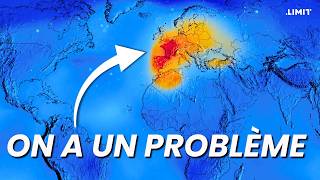
- The Desert Advances Toward EuropeOverviewThe Sahara Desert has been expanding since 1920, and a projection for 2100 shows Spain covered in sand, with France also facing the threat.Key Facts• 300,000 tonnes of sand have already been found in snow-covered regions of the Alps. • Desertification threatens billions of people worldwide.Questions Raised• Can France truly transform into a desert region? • Are there ways to combat the invasion of sand?Video GoalUnderstand the scale of the phenomenon and explore possible solutions.
- What Is a Desert?Ranking• The world's largest desert is Antarctica, followed by the Arctic, then the Sahara in third place. • Only 20% of deserts are composed of sand.Criteria• Aridity index: less than 200 mm of annual precipitation (compared to 500 mm average in France). • Land degradation: erosion, urbanization, overgrazing.ScaleOne third of the planet's emerged land is threatened by desertification.Main Cause• Climate warming linked to fossil fuels dries out soil through evapotranspiration. • Precipitation becomes rarer and concentrated over short periods (down to -20% in southern France at +4°).
- Causes of Desertification in FranceConcrete SprawlIn France, an area equivalent to an entire department disappears under concrete every 7 years, breaking ecological continuities and preventing water infiltration.Intensive Agriculture• Deep ploughing, monoculture, and massive use of fertilizers and pesticides destroy soil life. • This leads to lack of vegetation, increased runoff, and loss of organic matter.Vicious CycleWithout vegetation, soil is exposed to sunlight and no longer retains moisture or nutrients, worsening desertification.Key FiguresDesertification currently affects 3.2 billion people, and France declared for the first time in 2024 that it is affected by this phenomenon.
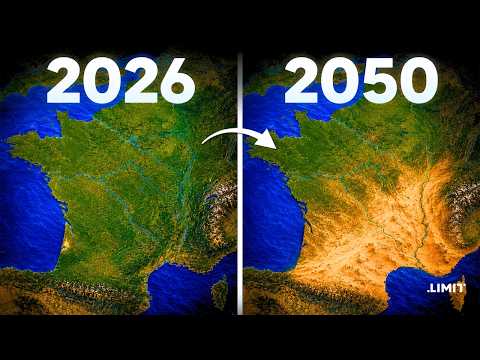
- Spain: A Worrying ExampleClimate ProjectionIn a +4° scenario, most of Spain becomes arid or desert, with 74% of Spanish territory at risk according to the UN (Andalusia, Catalonia).Regional WarmingThe Mediterranean basin warms faster than the rest of the world, with increases reaching 6° by 2100 compared to 4° globally.Agricultural Model• Since the 1960s, Spain has pumped its groundwater for water-intensive and profitable crops. • The Almería region produces 80% of vegetables consumed in the European Union.ConsequencesAquifer levels are dropping drastically, rivers are drying up, and ecosystems lack resources during droughts or heat waves.
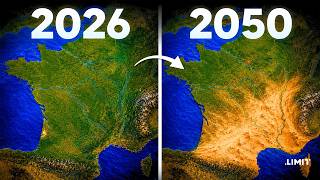
- France Already AffectedCurrent Status1.4% of metropolitan France's area is already considered desertified, despite appearing spared on maps.Affected Regions• The Eastern Pyrenees received only 252 mm of rain in 2023 compared to a normal of 507 mm. • The Massif Central could be affected, with farmers already short of hay in 2019 due to drought.Saharan SandA windy episode already brought Saharan sand to snow-capped mountains in France.Domino EffectSand deposited on snow absorbs more heat, accelerating melting, reducing spring water availability, and gradually drying zones.
- Three Options Against the PhenomenonThe Medicine• In California, a desert zone, rivers are diverted or aquifers are pumped to irrigate and produce fruit and vegetables. • This solution provides temporary relief but worsens the problem, as seen in Spain where excessive irrigation dries out soil.The Bandage• China's Great Green Wall, launched in 1978, planted over 66 billion trees across an area equivalent to France. • Only 15% of planted trees survived due to low-resilience monoculture.The Cure• In the 2000s, China strengthened its program with diverse reforestation and grazing bans in sensitive areas. • By 2024, the 3,000 km vegetation ring around the Taklamakan was closed, raising national forest coverage from 10% to over 25%.Positive ResultsThe zone, once a CO2 emitter, now captures it, and summer precipitation has doubled, creating a virtuous cycle similar to the Great Green Wall project in Senegal.
- Toward Regenerative AgricultureThree Pillars• Permanent vegetation cover of soil. • No-till to let the earth rest. • Crop rotation to diversify nutrients.Soil's RoleHealthy soil provides food and materials, purifies water, and regulates climate by storing carbon.Individual Actions• Support farmers toward an agroecological model. • Choose farmers markets or CSA over greenhouse fruit and vegetables irrigated in Spain.Final MessageFacing this systemic problem, each individual action counts like a grain of sand to halt the destruction of life.