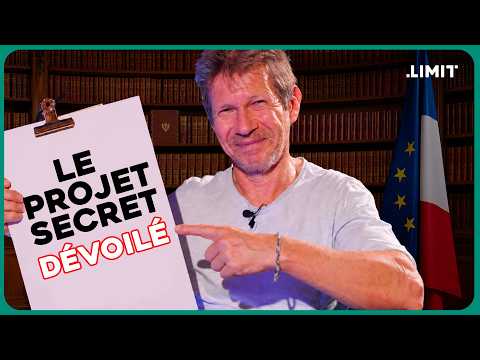
JANCOVICI : IL FAUT SE PRÉPARER !
In a world with limits, you have to make choices, and these choices today are not properly informed by the political world.
13 chapters
- A world without limits facing a world with limitsGeneral assessmentJean-Marc Jancovici explains that in a world without limits, you can have everything at once, but in a world with limits, you have to make choices.Political problemThe political world continues to reason with outdated software from a society of abundance and promises people employment, purchasing power, and environmental protection simultaneously, which amounts to a lie.Identified riskWithout new ways to deliberate calmly and reach consensus, change risks happening through brutality and authoritarianism.IntroductionThe exchange opens with the announcement of a still-secret project that Jean-Marc will reveal, designed to return power to citizens.
- A scorching summer and the acceleration of climate disruptionSummer context• Filming at the Académie du climat on August 20 • Intense drought and heat waves, dried-up rivers across Europe • Discussions on AMOC slowdown and the El Niño phenomenonJancovici's analysisWe are only at the beginning of an evolutionary process: even if we act, the climate will continue to change as long as CO2 is added to the atmosphere.Risk of collective amnesiaAutumn and winter, naturally cooler due to Earth's tilt, risk making people quickly forget the severity of summer, since collective memory is very short.Democracy's limitsDemocracies, though better than other systems according to Churchill, are structurally short-termist because of election cycles, which harms management of long-term issues like climate.
- Why humans are never satisfiedBiological originLike all animal and plant kingdoms, humans seek to obtain as many resources as possible while exerting the least effort, a survival mechanism inherited from the past.Escalation of desires• Apartment, then house with swimming pool, then SUV • Jet ski, helicopter, airplane • Even a commercial flight to the Moon would be desired if it existedOther human drivesCuriosity, present in all young mammals, and the need for social belonging, status, and image within the group are other important drivers of human behavior.Proposed solutionTechnology will not solve this biological and spiritual problem; the antidote lies in values and meaning, not in technical solutions.
- The risk of polarization and scapegoatingTwo human tendenciesHumans are capable both of loving and protecting their group, and of ostracizing those perceived as outsiders, which has led in the past to tragedies like slavery or the Holocaust.Current riskIn a world where resources are becoming scarce due to climate disruption, the temptation to retreat into 'us' versus 'them' increases, in a period already marked by polarization.Mentioned solutionHaving a plan or proposals in which everyone finds their place, understands their role, and which give a realistic collective direction.Balance to findIt is about navigating between realism and hope, without building castles in the air or dreaming of a world that does not exist.
- Project presentation: a citizens' assembly before the presidential electionProject originThe project, distinct from the Shift Project, is aimed at ordinary people and is linked to the next presidential election.How it works• 150 citizens randomly selected via a random phone number generator • Representative group of French society (age, socio-professional category, gender, place of residence) • Access to experts and opportunity to hear from officials • Six weekends of workObjectiveTo submit to the assembly dilemmas that the political world avoids, such as trade-offs between purchasing power and employment, so it can propose findings and decisions.Example dilemmaRelocating manufacturing to France (cars, clothing, paracetamol) for sovereignty means accepting a price increase, a trade-off that no one clearly owns up to in politics.
- A participatory platform to rebuild democratic trustDigital platformA platform will allow everyone to follow the debate, ask questions, work through submitted dilemmas, organize local debates, with possible partnership with regional daily newspapers.Finding on voting• Voting is today experienced as a means of resignation, no one fully embraces any program • More than half of French voters did not vote in the two most recent legislative rounds • 60% of French voters do not see themselves reflected in any candidateIdentified dangerThe growing gap between population and elected institutions is called a 'deadly poison for democracy.'Crowdfunding campaignA participatory fundraiser at 1€ per person is aimed less at money (already three-quarters raised) than at the number of supporters, with the goal of surpassing the previous record of 36,000 supporters (PTEF) and aiming for several hundred thousand.
- An apolitical project led by civil societyStated neutralityJancovici clarifies that this project is neither an electoral springboard nor the embryo of a political party, and he will never run in a national election.Civil society support• Thierry Lhermitte, McFly and Carlito, Laury Thilleman, François Gabart • Alain Aspect (Nobel Prize in Physics), Yasmine Belkaïd (Pasteur Institute) • Caroline Ilher Le Branchu (Breton cannery)Sought diversityThe goal is to obtain very diverse support (athletes, intellectuals, workers) to represent society as a whole.Jancovici's roleHe defines himself as a volunteer and 'logistics coordinator' of the operation, clarifying that the real heroes will be the citizens of the assembly.
- One symptom among others: beyond climateDistrust figures77% of French citizens favor citizens' assemblies, while 78% distrust current politics.Broader visionClimate is only one symptom among others of a general system dysfunction, which worked well in a world without limits but increasingly malfunctions with planetary boundaries.Historical referenceHistorically, the other has always been the scapegoat for difficulties in times of resource scarcity (St. Bartholomew's Day, slavery, Holocaust).Project objectiveIt is a 'happening' to make elected officials better, not to oppose them, in a system where they are often 'hands tied' by larger logics.
- Trust in mayors versus distrust of central powerTwo types of politiciansThere are those who run from TV show to TV show without time to work, and those who work without time to publicize their action.Trust in mayorsThe trust rating for mayors reaches 60%, significantly higher than for national officials, because you can see them work concretely.Biological limit of trustHumans can only trust a few hundred personally known individuals; beyond that, political figures become abstractions.Mechanism's objectiveThe citizens' assembly aims to restore mechanisms of trust and collective building, not against the political world but for citizens.
- What we hope for: a shift in the political balance of powerUncertain outcomeJancovici says he does not know precisely what will emerge from the process, but hopes for a shift in the balance of power between the political world and the electoral base.Politics broadlyThe Shift Project, the Limite channel, associative engagement are all forms of politics when they touch on societal and behavioral changes.Expected effect on candidates• A before and after in how they address voters • Fewer untenable promises • More work on documenting the real world (meters, liters, kWh) rather than only economic and legal indicatorsComplementarity with Shift ProjectThis project focuses on dialogue methods, while the Shift Project proposes concrete plans accounting for planetary limits.
- Avoiding mistakes of the Citizens' Climate ConventionHistorical comparisonThe Citizens' Climate Convention, launched by Macron, promised an unfiltered adoption, which was untenable and led to a feeling of hollow content.Belgian exampleIn Belgium, an assembly launched by a party in power was abandoned as soon as that party lost power, illustrating the risk of political capture.Difference with this projectUnlike these precedents, the initiative comes from citizens themselves ('we weren't asked but we're inviting ourselves into the campaign') and not from those in power.Civic ambitionThe goal is to acknowledge that the world is complicated and you cannot have everything, to define your own order of priorities.
- Timeline, discretion, and program analysisProject timelineThe citizens' assembly work will end in February, before the presidential election scheduled for April, leaving two months to confront candidates with the conclusions.Duty of discretionJancovici refuses to say which party aligns most with his hopes and announces he will not meet any presidential candidates until April to preserve the project's neutrality.Program analysis by Shift ProjectA qualitative analysis of program consistency will be conducted, different from the flawed quantitative approach used in the previous election.European scopeJancovici, Franco-Belgian, emphasizes that French decisions have a ripple effect on Belgium and Europe, with France being a major world power.
- Conclusion and call to actionAppeal for donationsEveryone is invited to support the project through an Ulule crowdfunding page with a symbolic 1€ donation, with the number of supporters being the priority objective.Civic participationThe public is invited to follow and participate in the online debate, in town halls, with family, or in any civic organization.Scheduled follow-upJancovici and the moderator arrange to meet again 'at the results,' meaning at the end of the citizens' assembly process.ClosingThe exchange ends with mutual thanks and a call to share the video as widely as possible.