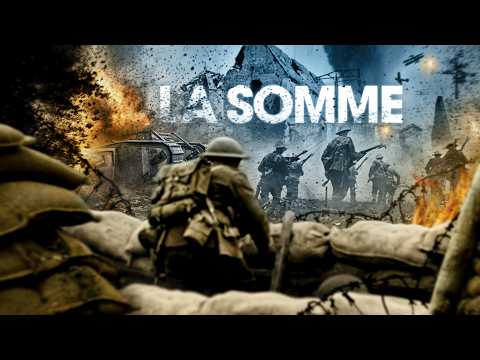
La Somme : un champ de bataille qui n’a jamais disparu
World War I is a global trauma that leaves, more than 100 years after an unprecedented outbreak of violence, deep marks in memory.
11 chapters
- Introduction: The Great War and Its ScarsGlobal ImpactOver 18 million deaths and a billion shells marked World War I, leaving deep marks in memory more than 100 years after the conflict.Massive DestructionEntire villages disappeared from the map, and the conflict had lasting impacts on the environment and landscapes of affected regions.Visible ScarsThe scars of the conflict remain clearly visible to those who know where to look, particularly in the Somme region.ReconstructionThe video focuses on the immediate post-war period, when wounds had to be healed and territory rebuilt directly after the conflict.
- The Battle of the Somme: Context and CourseStrategic ContextIn 1916, the Western Front was bogged down and Germans were attacking Verdun, forcing Franco-British forces to seize the initiative.Launch of Offensive• On July 1, 1916, after a bombardment of nearly 1.5 million shells • British forces and troops from across the empire launch an attack alongside the French • The attack turns into a massacreCatastrophic Losses• 57,000 British are wounded on the first day • 19,000 die, making it the bloodiest day in British military history • The battle lasts several months without breaking through the frontFinal Toll• On the Somme, 600,000 men were wounded and 400,000 died • The battle stops in November 1916 due to lack of results • Massive destruction after months of bombardment and attacks
- Visible Scars of the BattlefieldPermanent Craters• Lochnagar Crater: 90 meters in diameter and over 20 meters deep • Caused by an underground attack with 30 tons of explosives, earth was thrown over one kilometer high • Spectacular example of destruction left by warPreserved TrenchesThe Newfoundland Memorial at Beaumont-Hamel preserves intact trenches where visitors can understand their function and see the lunar landscape marked by shells.Commemorative Choices• Newfoundlanders chose to preserve the scars of the Great War to remember • South Africans chose to replant the disappeared Delville Wood with memorial and museum • Only surviving tree: 'The Last Tree' within the replanted forestPresent Dangers• Millions of shells did not explode during the battle • Farmers discover explosives, grenades, weapons and ammunition while working the land • This 'iron harvest' is collected and destroyed by mine clearers
- First Solutions and Temporary SheltersHousing UrgencyAfter the war, refugees returning to Longueval find almost nothing: the village was completely destroyed.Salvaged Materials• Residents seek shelter with materials found in the trenches • Wood, sheet metal, stones used to build temporary cottages • Adrian and Nissen corrugated metal barracks provided to address housing shortageModernization• Awaiting war damage payments to finance reconstruction • 'Model' houses produced in series to accelerate construction • Introduction of modern comforts like running water in villagesTechnical Innovations• Massive use of concrete and cement for rapid and solid construction • Water towers built to overcome well pollution from warfare • Integration of decorative elements like mosaics and stained glass in reconstructions
- Albert and Art-Deco StyleRecurring ExperienceThe city of Albert had been destroyed seven times before 1914, so the Great War was only its eighth destruction.Stylish Reconstruction• After 1918, Albert rebuilds in pure art-deco style • Nearly 260 houses display art-deco facades preserved today • Architects indulged themselves: railway station shaped like a locomotive, town hall with art-deco chandeliers, frescoes and stained glassArchitectural SymbolThe architecture perfectly embodies the renaissance and modernity desired after the horrors of war.Regional ExpansionThis creative reconstruction approach spreads to other communes in the Somme beyond Albert.
- Reconstruction of Churches: Religious InnovationBasic PrincipleLost churches are valued, then an equivalent sum is released for reconstruction, with no obligation to reproduce them identically.Saint-Pierre de Lamotte-Warfusée• Architect Godefroy Teisseire chooses Byzantine style instead of classical • Greek cross plan instead of Latin, with Christ on the cross in Byzantine style • Unfinished openwork concrete spire due to budget constraints, ultimately becoming a distinctive featureSaint-Jean-Baptiste de Villers-Bretonneux• One of the largest churches in the Somme before destruction • Budget equivalent to nearly 5 million euros today released for reconstruction • Architect Albert Guilbert chooses art-deco style with neo-Byzantine interiorChurch of Chaulnes• Teisseire applies art-deco and neo-Byzantine style • Careful decoration with bricks, paintings and sgraffito • Sgraffito: technique where a layer of plaster is scratched to reveal a pattern
- Péronne and Architectural EclecticismReconstruction Debates• Saint-Jean-Baptiste church almost completely destroyed in 1918 • Initial proposal: leave ruins as a memorial and build new church elsewhere • Final decision: rebuild on the same site from old plansArchitectural Diversity• True architectural eclecticism in the city with regionalism, neo-classical and modern • Monuments rebuilt identically like the Porte de Bretagne • Use of modern construction techniques despite historical reproductionMuseum Heritage• Péronne Castle rebuilt in its Philippian version • Has housed since 1992 the Historial of the Great War dedicated to societies at war • Example of heritage conversion of a rebuilt structureSymbol of CreationReconstruction is not just a period of building, but a period of creating, innovating and moving forward, which is highly symbolic.
- Memory and Tourism: The Commonwealth in the SommeTourism Boom• Even before the conflict ends, memory tourism experiences a new boom • Families visit graves of loved ones fallen at the front, or the curious come to see war damage • After the conflict, genuine expansion of tourism with the will to move forward without forgettingInternational Reach• Commonwealth families come to pay respects in the Somme • Albert and Péronne become meeting points served by train stations • 11 memorial sites of World War I in the Somme inscribed as World HeritageCommemorative Centers• French Memorial Chapel at Rancourt-Bouchavesnes-Bergen dedicated to Lieutenant Jean Du Bos • Becomes a place of pilgrimage with commemorative plaques funded by French families • Overlooks three cemeteries: French, British and GermanMassive Monuments• Thiepval: immense monument in the shape of a triumphal arch, the world's largest British memorial • Inscriptions of over 72,000 British and South African soldiers whose bodies were never found • Symbolizes memory of the missing with no identified grave
- Commonwealth Troops and Military InnovationsAustralian Presence• Sir John Monash Centre opened in 2018 at Villers-Bretonneux dedicated to Australian soldiers • Nearly 300,000 Australian soldiers fought in the Somme • Unknown Australian soldier comes from the Somme Valley and is buried in his countryTactical Innovations• General Sir John Monash innovates by supplying troops by parachute • Improvement of cooperation between infantry and tanks • Use of tricks and bluffs allowing advance with very reduced lossesNew Zealand PresenceNew Zealand and Australian troops introduce modern warfare techniques to the conflict with major impact.Memorial Legacy• The Somme is crucial in collective Commonwealth memory • Schools bear Anglo-Saxon names like Victoria at Villers-Bretonneux • Traffic signs in English and many English speakers in the region
- Memory Tourism and Current EngagementProfessionalized Welcome• The whole world fought on the Somme and comes to remember it • Somme Battlefields Partners network brings together tourism offices, guides and restaurateurs • Local actors become ambassadors of memory tourismPacifist Mission• Somme Battlefields for Peace collects donations from visitors • Principle: if you visit to remember a past conflict, intervene in current conflicts • Donations given to Handicap International via Essentiem endowment fundConcrete Actions• Funding prosthetics for current conflict victims • School kits and wheelchairs financed • Mine clearance operations in war-torn countriesMeaningful Message'Remember to act' is the message carried by the Somme, transforming historical memory into commitment for present peace.
- Conclusion: Discover and Engage in the SommeInvitation to VisitThe Somme offers cities and villages rebuilt after the war, rising from their ashes at the dawn of the roaring twenties.Available ResourcesSomme Tourism offers historical discoveries accessible on foot, by bike or even horseback to explore history-rich locations.Pay Tribute• Better understand World War I • Pay tribute to those who fell • Discover architectural and museum reconstructionMemory TransmissionThe report transmits the memory of the Great War in the Somme with meetings of history enthusiasts and discovery of memorial sites.