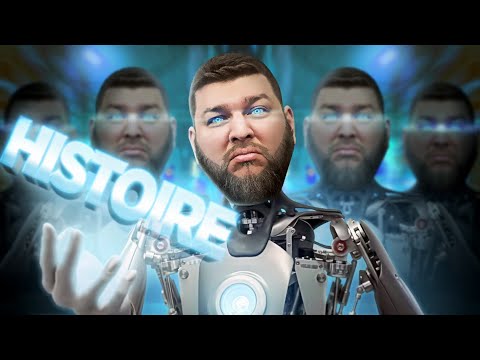
L'IA peut-elle vraiment aider les historiens ?
AI is increasingly entering our lives and developing at an absolutely breakneck pace.
10 chapters
- Introduction and context of AIPopular referencesAI is associated with films like I, Robot, A.I. Artificial Intelligence and Ex Machina where humans coexist or confront AI.Current stateAI is increasingly entering everyday life and developing at a breakneck pace, with tools like MidJourney and ChatGPT.General stakesThese tools raise complicated methodological and ethical questions while constantly improving.Scientific utilityAI is highly useful for historical and scientific research to process large amounts of data, detect and translate ancient texts, reconstruct 3D objects, identify counterfeits, and analyze landscape patterns.
- Translation of Mesopotamian cuneiformThe 2023 challengeIn May 2023, Israeli researchers launched a challenge to an AI capable of directly translating Mesopotamian tablets covered in cuneiform writing into English.Complex writing system• Cuneiform is one of the oldest writing systems, dating back approximately 3400 years before our era. • There are hundreds of thousands of texts in cuneiform, primarily in Sumerian and Akkadian. • Akkadian is particularly challenging: without punctuation, each glyph can be read in different ways depending on context.Translation processAn expert must first recopy the glyphs, retranscribe them into the Latin alphabet, then translate into modern English. AI can skip the intermediate Latin step because it doesn't need to understand what it's translating.Results and limitations• The machine achieves good scores but lets errors slip through, notably with proper nouns. • An expert must correct and refine the artificial translations. • The texts span thousands of years with major changes in syntax, grammar, and vocabulary. • Many texts are brief and incomplete, composed of 90% recurring formulas.
- Reconstruction of Herculaneum papyriImaging techniqueResearcher Brent Seales's team uses 3D computed tomography (CT-scan) to measure X-ray absorption, allowing digitization and 3D reconstruction of internal structures and virtual unrolling of rolled papyrus layers.Ein Gedi discoveryIn 2016, the team successfully read a carbonized scroll from Ein Gedi dating to the 3rd–4th centuries: a copy of the Book of Leviticus whose ink contains metal, making it readable under X-rays.Roman library• The villa of Herculaneum contained a complete Roman library carbonized during the eruption of Vesuvius in 79. • Discovered in the 18th century, the papyri were initially mistaken for charcoal logs. • Many techniques were tested with varying degrees of success, often destroying the analyzed scrolls.Value of non-invasive methodsMedical imaging allows access to texts without destroying their material substrate, which is the main advantage of these approaches.
- Decipherment of the Vesuvius ChallengeMachine learning appliedAI is trained to identify complete characters in other known texts, reducing them to point alignments. Faced with partially erased characters, a few ink spots are enough to draw the complete and probable characters.Competition launched in 2023• In March 2023, Silicon Valley entrepreneurs launched the Vesuvius Challenge. • Objective: decipher at least 140 characters from a provided scroll by year's end. • Prize: $700,000 for winners, funded by investors and enthusiasts on social media.Results and winners• In October 2023, Luke Faritor, a 21-year-old Space X intern, deciphered the first complete word: 'purple'. • In January 2024, the three winners received their $700,000 prize. • The teams managed to decipher approximately 5% of the first scroll.Nature of discovered textThe scroll is an unpublished ancient text still unknown, addressing pleasure, a subject of great importance in Epicurean philosophy.
- Limits and implications of deciphermentLack of validationThe Vesuvius Challenge results have not been validated by the scientific community because no findings were submitted to peer-reviewed scientific journals.Remaining technical challenges• Work was done on the end columns of the scroll, the easiest part to read. • The center of the scroll will be much more complex because it is heavily compressed. • Multiple different hands may have participated in writing, which would require adapting the program for each hand.Reality and fiction boundaryAI can invent words where there are none, proposing probable but uncertain fictions. These pseudo-sources demand great caution from researchers.Critical verificationResearchers must distinguish what is visible in the images from what actually exists on the object. The separation of roles between computer scientists and philologists increases the risk of bias and errors.
- Other AI projects in historical researchCurrent projects• The DECRYPT Project deciphers manuscripts, letters, and European correspondence in archives. • Recently, they deciphered the secret correspondence of Mary, Queen of Scots, while she was imprisoned in England.Ithaca software• Beyond deciphering characters, it assigns temporal and spatial dating to text. • It completed 62% of gaps, dated texts to within 30 years, and achieved 71% geographic accuracy. • The software is free and pools 78,000 inscriptions that improve with each new text.Advanced featuresIthaca also suggests missing words, providing for each blank a list of possible words sorted by probability, serving as a super assistant without replacing the researcher.Ethical questionsAI creates only probable but uncertain pseudo-sources, demanding great caution from researchers handling this material.
- Deep learning and automated analysisDeep learning conceptDeep learning consists of letting a computer program analyze data autonomously. Its convolutional neural network, inspired by the human brain, passes information through different layers of neurons to gain precision.Advantages of autonomyThe computer determines itself the relevant criteria and avoids human analytical bias, making results more neutral and objective.Archaeological applications• The ArchAIDE project, used since 2016, reconstructs the shape of pottery from simple fragments. • From thousands of 3D scanned fragments, the computer forges its own criteria of texture, shape, and weight. • A robot from the University of Rennes automatically detected Neolithic cairns in Morbihan using LIDAR imagery.Comparative reliabilityAI makes fewer mistakes than a human researcher, notably for tasks like determining the sex of a skeleton, because it doesn't overinterpret nuances.
- Impact on historians' workMajor time savingsAI accelerates the least gratifying part of a historian's work, such as paleographic transcription over days and days.Two possible trajectories• Time reduction: a doctoral student no longer needs 3 years for their dissertation. • Increased analysis: in 3 years, the researcher can analyze many more sources.Quality improvementBy increasing the quantity of analyzed sources, the quality of analysis follows. AI could help produce better dissertations or less fatigued researchers accomplishing more work.Conditions for successAI is a specific tool: misused or applied to the wrong objective, it can mislead. It has value only if properly used by specialists.
- Risks of dependence and loss of expertiseProgressive loss of skillsIn philology, doctoral students gradually lose linguistic competence, particularly reading Greek and Latin, as these tasks are entrusted to lemmatizers and machine translation systems.Time-saving paradoxAI saves time, but the question arises of what is lost and the errors these tools can introduce.Need for masteryAI won't wait for research to advance, so researchers must seize it quickly to master its use.New disciplinesNew professions are emerging in historical research with the development of Digital Humanities, requiring ongoing researcher training.
- Public applications and future implicationsAdditional application areas• Heritage transmission and public history. • Communication and historical presentation. • Playful tools for the general public.Public useAI also applies to historical transmission, notably with fictional chatbots like a fake Napoleon chatbot at the Napoleon Museum, which serve as games and playful supports.Separation of worldsArchaeologists, historians, and art historians continue working on actual documents, genuine Napoleon letters, and real excavation sites, independently of public applications.Open questionsThe popular impact of AI on common perception of history represents a distinct problem that could be the subject of another discussion.