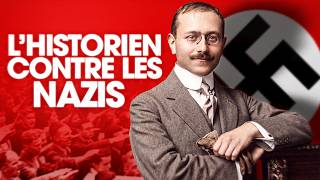
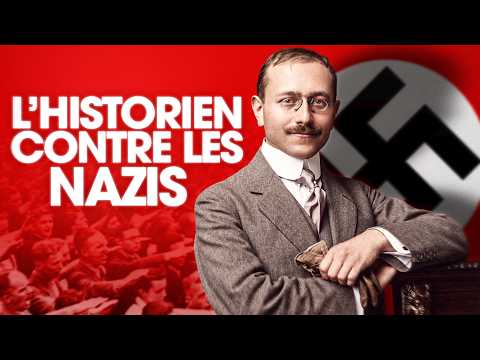
Marc Bloch : l’historien qui combattait les nazis
Marc Bloch, resister, cofounder of the Annales, author of the famous 'Apology for History', revolutionized the discipline by giving it a more global, more human approach, far from mere dates and raw facts.
9 chapters
- Introduction and context of the PanthéonPassion for HistoryFor 12 years, Nota Bene has shared a passion for History by building connections with historians, museums, and institutions. History is not merely a succession of past events, but an essential tool for understanding the present.Historical RevolutionMarc Bloch revolutionized the historical discipline in the twentieth century by giving it a more global and human approach, far from mere dates and raw facts.Entry to the PanthéonIn June 2026, Marc Bloch enters the Panthéon, recognized for his role as a resistant and major historian. He will join figures such as Mirabeau, Voltaire, Jean Moulin, and Simone Veil.Central QuestionsHow did this historian, father of a family and professor, become a figure of danger in the eyes of the Nazi occupier? How can historical science become an act of revolt?
- Family origins and intellectual formationAlsatian HeritageMarc Bloch was born in Lyon on 6 July 1886 into an Alsatian Jewish family. His family was among the 'optants', Alsatians who chose to remain French after the defeat of 1870-1871.Paternal InfluenceHis father Gustave Bloch, professor of ancient history at Lyon and the Sorbonne, transmitted to him the requirement of intellectual rigor and a taste for teaching. He grew up in a republican environment, Dreyfusard and close to socialist circles.Academic Path• Entered the École Normale Supérieure in 1904. • Obtained his agrégation in history and geography in 1908. • Studied in Berlin and Leipzig to discover new historical approaches. • Became a fellow at the Thiers Foundation from 1909 to 1912. • Developed interest in Émile Durkheim's sociology and collective psychology.Medieval SpecializationUnlike his father, Bloch was passionate about the Middle Ages, an era then less explored in academic circles. He began teaching in secondary school in Montpellier in 1913.
- The First World War and its lessonsMilitary ServiceBloch was mobilized in 1914 as an infantry sergeant. A patriot and civil servant, he considered the defense of republican France against the militarism of the Second Reich as a necessity and a duty.War ExperienceWounded and ill but always willing, he returned to the front and advanced through the ranks. He ended the war as a captain in the fuel service, decorated with the Croix de Guerre with four citations and the Légion d'Honneur.Historical Observations• Recorded his war memoirs immediately after his injury. • Explored reflection on memory and forgetting. • Left evocative captions on photographs from the war. • Published in 1921 'Reflections of a historian on the false news of the war'.Anthropological TerrainFor Bloch, war was not merely a military experience but also terrain for anthropological observation. He observed collective beliefs and social reflexes in the face of danger, combining fieldwork and archives, memory and source criticism.
- Strasbourg and the historiographical revolutionStrasbourg InstallationAfter the war, Bloch joined the University of Strasbourg, which had become French again. It was more than an academic post: it was a symbol of rebuilding an excellent republican institution after 48 years of German annexation.Intellectual EnvironmentThe French government sent an exceptional generation of professors to Strasbourg. Alongside Bloch: Lucien Febvre in modern history, André Piganiol in Roman history, Maurice Halbwachs in sociology, and geographers and economists.Methodological InnovationsIn 1920, Bloch defended his thesis 'Kings and serfs, a chapter of Capetian history' on the liberation of serfs in Île-de-France. At a time when political history dominated, he was already interested in social and economic themes.Founding the AnnalesIn 1929, Bloch and Febvre founded the journal 'Annales of economic and social history'. They aimed to free history from old patterns by integrating economics, sociology, geography, and demography to understand societies in depth.
- The collapse of 1940 and The Strange DefeatVoluntary Re-enlistmentDespite being 53 years old in 1939, suffering from debilitating polyarthritis, and having a large family, Bloch re-enlisted to become a military officer again. He declared himself 'the oldest captain in the French army' and was assigned to the Army Fuel Service.Analysis of the CollapseWitnessing firsthand the military and moral collapse of the Third Republic in 1940, Bloch wrote from July to September 1940 'The Strange Defeat: Testimony of 1940', a manuscript that would become very famous.Lucid Critique• The defeat is not only military, but intellectual, moral, and political. • He accuses military leaders frozen in their certainties, unable to understand modern war. • He attacks a part of the French bourgeoisie that preferred to see Hitler prevail. • He identifies the tacit alliance between reaction and cowardice that plunged the country into the abyss.Act of ResistanceThe Strange Defeat is an act of resistance in itself. It is not a book written for honors but a cry of clarity launched in the midst of tempest. For Bloch, to understand is already to resist.
- Persecution, clandestinity, and resistanceExclusion and IsolationWith the arrival of the Vichy government, Bloch was excluded from the civil service under the antisemitic laws of 1940. Refusing to separate from his family, he remained in France despite American authorities' refusal to admit him.Difficult Academic LifeHis Parisian apartment was requisitioned and his library shipped to Germany. Jérôme Carcopino temporarily reintegrated him to the faculty at Strasbourg relocated to Clermont-Ferrand, then he was transferred to Montpellier in 1941.Clandestine Work• Continued publishing anonymously in the Annales under the pseudonym Marc Fougère. • Between 1941 and 1943, wrote 'Apology for History or The historian's craft' under difficult material conditions. • This testament work exposes his vision of historical work with critical rigor and refusal of fatalistic history. • Published in 1949 after his death, became a key work for historians.Resistance EngagementWhen the Germans invaded the free zone in November 1942, Bloch went underground. In 1943, he joined the Resistance in Lyon within the Franc-Tireurs then the United Resistance Movements, becoming regional leader in Rhône-Alpes.
- Martyrdom and historiographical legacyArrest and ExecutionOn 8 March 1944, Bloch was arrested in Lyon by the Gestapo after a Resistance meeting. Tortured at Montluc by Klaus Barbie's men, he revealed none of his comrades. On 16 June 1944, he was shot with 27 other resistants at Saint-Didier-de-Formans, days before the liberation of Lyon. He was 58 years old.Double CommitmentMarc Bloch remains in History as one of the rare intellectuals of his era to die with weapons in hand. He remained faithful to the end to his dual commitment: that of the intellectual and that of the citizen.Major Works• The Thaumaturgic Kings (1924): history of mentalities and royal symbolic power. • Feudal Society (1939-1940): inquiry into medieval social bonds with an interdisciplinary approach. • Apology for History (1949): reflection on the meaning and utility of history, manual for historians in training.Revival and RecognitionAfter the 1970s-80s, with debates on Vichy, Bloch's work experienced a revival. From the 1990s onward, his legacy was fully rehabilitated. He became the 'patron saint' of historians, symbol of the rigorous scholar and engaged resister.
- The Annales revolution and transformation of the disciplineAmbition of the JournalMarc Bloch and Lucien Febvre created the Annales to free history from old patterns. They were fed up with a discipline reduced to battles, kings, and diplomats. Their goal was to understand societies in depth by studying economic structures and collective mentalities.Interdisciplinary Approach• Open history to other social sciences: sociology, economics, geography, anthropology. • The historian can no longer rely solely on chronicles and parchments. • Analyze maps, currency, statistics, objects, and landscapes. • Illuminate the concrete functioning of a society.Contemporary InfluenceThe Annales also addressed economic and political elites, convinced that social and economic history could help understand crises. From the 1930s onward, the journal addressed current issues with historical method: the 1929 crisis, the rise of Nazism, Stalinist USSR.Long DurationBloch and Febvre sought to explain social phenomena and bring to light the invisible structures that condition events. The historian must observe the world in which he lives to better understand the past, remaining attentive to the social and economic realities of his time.
- Intellectual continuity and institutional influenceSurvival of the AnnalesDespite the war and German censorship, the journal survived under the title 'Miscellany of social history'. After Bloch's death, Febvre then Braudel ensured continuity. The Annales became over the decades the most influential history journal in the world.Legacy at EHESS• After the war, Lucien Febvre obtained the creation of the Sixth Section of EPHE, dedicated to interdisciplinarity. • This section became the center of the Annales, gradually imposing their scientific program. • In the 1970s, the Sixth Section became the School for Advanced Studies in the Social Sciences (EHESS). • The Annales are still housed at EHESS, property of the school, staff funded by the institution.Late RecognitionMarc Bloch was not immediately put in the foreground after his death; his legacy gradually shaped institutions. Although he did not know the EHESS during his lifetime, the link remains very strong, going beyond mere tradition to become a claimed intellectual continuity.PanthéonizationIn June 2026, Marc Bloch enters the Panthéon for his historical work and his engagement in the Resistance. He is the dual figure of the discipline's innovator and civic hero, blending thought of the long duration with commitment to the present.