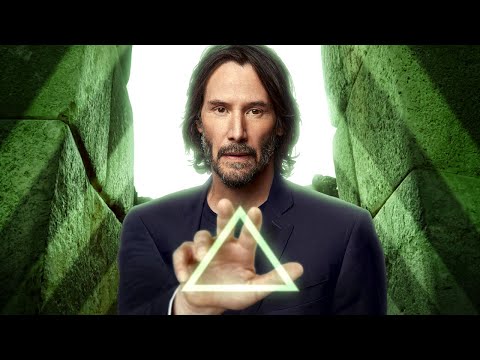
Keanu Reeves et la promotion de la pseudo archéologie (Graham Hancock - A l'aube de notre histoire)
On October 16 on Netflix, the big return of 'Matrix' with its new opus 'Ancient Apocalypse'
11 chapters
- Introduction to Graham Hancock and His Netflix SeriesRelease contextOn October 16, 2024, Netflix launched season 2 of 'Ancient Apocalypse', a documentary series produced by Graham Hancock, a successful journalist and author. Season 1 was already controversial when it debuted in November 2022.Keanu Reeves appearanceSeason 2 generated buzz in September 2024 with the announcement that Keanu Reeves would make an appearance, though this presence is brief and bewildering for viewers.Hancock's background• British journalist who worked for prestigious newspapers in the 1970s–1980s • Career shift starting in 1990 toward writing non-fiction exploring pseudo-archaeology • Publishes a book every three to four years, often becoming bestsellers • Participates in numerous documentaries and podcasts to promote his theoriesAnalysis objectiveExamine who Graham Hancock is, why he is controversial, and how to recognize misinformation in his series, rather than simply refuting it.
- Hancock's Hyperdiffusionist HypothesisCore theoryAn ancient super-civilization living during the ice age disappeared 12,000 years ago in a cataclysm triggered by a meteor shower, causing a global deluge that wiped out everything in its path.Knowledge spreadSurvivors of this super-civilization retreated to all corners of the planet to transmit their technology to primitive humans and warn them of future cataclysmic dangers.Mythological originsThis hypothesis blends the Biblical flood and Plato's myth of Atlantis, revisited by Hancock through his worldwide archaeological research.Key conceptHyperdiffusionism asserts that an unknown civilization, unlike historical civilizations with limited spheres of influence, spread everywhere across the world.
- Debunking Limitations and MisinformationDebunking ineffectivenessA 2023 meta-analysis showed that correcting misinformation is often ineffective, and debunking generally preaches to the converted rather than to those influenced by false information.Misinformation spread• False information spreads better than truth because it is shocking or incredible • Corrections almost never reach those contaminated by misinformation • Rational explanations are less compelling than dramatic narrativesPsychological biases• Continued influence effect: information once implanted continues to influence opinions even after denial • Illusory truth effect: tendency to believe information after repeated exposure • Algorithms amplifying information bubbles by presenting content aligned with our expectationsProposed alternativeRather than debunking, use 'pre-bunking': learn to recognize misinformation and protect yourself by examining manipulative techniques.
- Comparison with BBC's 'Secrets of the Neanderthals'Structural similarities• Two Netflix/BBC productions about extinct civilizations • Each featuring a Hollywood star: Keanu Reeves for Hancock, Patrick Stewart for the BBC • Same distribution platform enabling broad audience reachFundamental differencesOne is a series, the other a film; one is produced by Hancock with a marketing approach, the other by the BBC with a scientific approach.Methodology• Hancock: positions himself as the protagonist, the courageous researcher spurned by the system • BBC: discreet anonymous narration serving researchers who will deliver the facts • Hancock creates seduction, the BBC aims to inform without pleasingScientific approachThe BBC series honestly concludes 'For now, we only have a glimpse', acknowledging complexity and the absence of simple answers, unlike Hancock who proposes one unique and complete answer.
- Hancock's Manipulative StorytellingHero and seductionHancock presents himself as the protagonist, a courageous researcher spurned by the established system, creating an emotional narrative structure similar to tales like Frodo or Harry Potter.Conflict and struggleHancock constructs dramatic conflict where his enemy is the system, the elite and other researchers united against him, creating a struggle to assert his alternative vision of history.Secret and revelationHe plays the mystery card by claiming to have discovered an entire hidden civilization, using the allure of secrecy and hidden identity to captivate the audience.Simplified resolutionA hyper-complex mystery spanning thousands of years is reduced to a single explanation: one civilization and one cataclysm explaining all future historical problems.
- Emotional Mechanisms and FearStorytelling masteryHancock excels at seductive storytelling with a hero, a quest, and a final triumph, creating strong emotions in viewers.Use of fearSeason 1 ends with Hancock warning that our civilization could meet the same fate as the lost super-civilization if it doesn't heed his warnings, creating existential fear.Season 2 backpedalingSeason 2 considerably softens season 1's discourse as Hancock discovered subtlety after backlash against the first season, ending ironically by praising scientific archaeology.Marketing tacticThe series is a superior marketing product: stunning drone footage, Hollywood music, message repetition, and barely veiled promotion of ayahuasca consumption as proof of his theory.
- Keanu Reeves' Limited Role and Marketing BuzzScreen timeAcross 6 episodes of over 40 minutes each, Keanu Reeves appears for only 5 minutes total, disappointing viewers expecting his presence.Nature of participationKeanu Reeves appears in interspersed conversations with Hancock where he seems passively assenting, acting as a 'disembodied puppet' before the 'supreme chief'.Real objectiveThe only interest in his presence is the buzz it generates and the credibility ('street-cred') it brings to the series, an objective largely achieved since viewers noticed it.Reason for interestKeanu Reeves brings Hollywood legitimacy to a pseudo-archaeology project, using celebrity as a marketing tool rather than as a substantive contributor.
- Ayahuasca and Dubious EvidenceDrug promotionThe series contains barely veiled promotion of ayahuasca consumption, a hallucinogenic drug, in a mainstream documentary.Hancock's logicHancock, himself an ayahuasca consumer, claims that this psychotropic beverage is evidence of a lost common civilization that brought the science of hallucinogenic plants to other cultures.Circular argumentHis proof is that ayahuasca's first hallucinations are geometric shapes, and geometric shapes appear in the art of many civilizations, creating a fictional connection.Controversial precedentHancock had already given a controversial TedX talk in 2013 on the same subject, so problematic it was banned from certain platforms.
- Identified Misinformation TechniquesHypothesis becomes factHancock states a hypothesis or 'maybe', then minutes later presents it as indisputable fact, gradually transforming speculation into certainty.Faulty logic arguments• Use of premises that seem logical but are not • Example: observing human–megafauna cohabitation concludes extinction by deluge rather than hunting • The conclusion has no logical connection to the premises presentedConsensus distortion• False claim that all scientists say one thing when multiple theories exist • Inventing scientific claims never made to better refute them • Selectively choosing theories that support his argumentDebunking complexityTo correct 30 seconds of nonsense would require re-explaining the context, different scientific theories and their debates, making debunking impractical.
- Exploitation of Negative Emotions Versus WonderEmotional tacticHancock plays on doubt toward scientists, distrust of conspiracies, and fear of cataclysm and death to sell his series.Critical questionWhen someone plays on your doubts, mistrust, and fears, do they usually want your well-being or are they trying to get you to consume and buy their product? This is classic marketing technique.Research limitationScientific research never offers all the answers; there are always debates, progress, and ongoing efforts, which may seem disappointing at first.Positive alternative• Instead of fear, seek wonder at constant discoveries • Knowledge is built generation after generation, collectively • Everyone can participate in this adventure of understanding the world, not just one 'guy' who figured it all out
- Conclusion and Role of DebunkingBalanced approachDebunking is not presented as the sole solution, but as a tool with limitations, complementary to knowledge production.Recognized limitationWhile debunking is enjoyable and useful, it has limitations, especially when false information is too deeply embedded or too complex to refute.Practical validationSome people have regained reasoned argument through debunking, proving the effort is not entirely futile.Final messageThe proposed analysis aims to give viewers tools to recognize and protect themselves from misinformation rather than simply bombarding them with corrections.