Le Bismarck, l’arme absolue des Allemands
12 chapters
- Introduction and context of the Battle of the AtlanticStrategic contextThe Battle of the Atlantic is one of the major stakes of World War II. Germany uses its submarines to attack Allied convoys supplying England.New weaponBeyond submarines, Germany secretly develops a gigantic steel monster: the Bismarck.Name symbolismThe ship bears the name of Otto von Bismarck, the chancellor who unified Germany in 1871, symbolizing German power.Popular demandThe subject of the Bismarck has been requested for years by viewers who heard about it in popular culture, notably in films, books, songs, and video games like World of Warships.
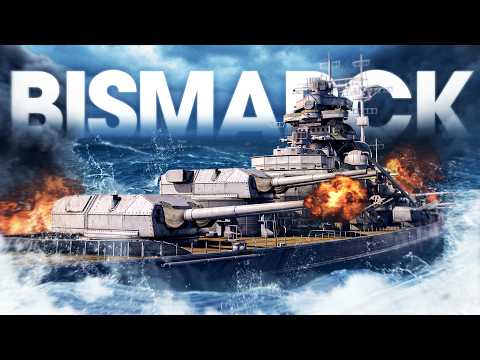
- Technical characteristics and capabilities of the BismarckImpressive dimensionsThe Bismarck measures 250 meters long and 36 meters wide, almost as long as the Titanic but wider.Armor and protectionThe ship is protected by armor up to 320mm thick, equivalent to a genuine floating steel bunker.Formidable armament• 380mm cannons capable of sinking an enemy at nearly 25km • Secondary 150mm batteries able to destroy any adversary approaching too closeSpeed and agilityCan travel at over 30 knots, roughly 55 km/hour, making it as swift as it is deadly at sea.
- Operation Rheinübung and departure to the AtlanticMission objectiveOperation Rheinübung aims to attack convoys bound for England rather than enemy fleets.Fleet compositionThe Bismarck sets sail accompanied by the Prinz Eugen, a heavy cruiser that will join it in harassing British supply lines.Ship commandCommander Ernst Lindemann, a respected officer and naval artillery specialist, is chosen to command the Bismarck. Admiral Lütjens places the entire force under his command.Departure and discovery• On May 19, 1941, the convoy departs from Gotenhafen in Poland • On May 20, the Swedish merchant ship Gotland spots the Bismarck and reports it to the British • On May 21, an English Spitfire photographs the Bismarck in a Norwegian fjord
- The fatal refueling error and beginning of the huntStrategic decisionAdmiral Lütjens orders refueling of the Prinz Eugen but not the Bismarck, judging that time is pressing to reach the Atlantic.Negative consequencesWith the Bismarck's tanks not full, it will lack sufficient fuel to complete its mission.British mobilizationBritain learns of the Bismarck's presence through merchant vessels and reconnaissance aircraft. The nation faces a national crisis over this threat.Organization of pursuitThe Royal Navy sends HMS Norfolk and Suffolk, which use their radars to track the Bismarck and relay its position to the fleet for interception.
- The Denmark Strait battle and destruction of HMS HoodFirst confrontationOn May 24, 1941 at 5:35am, the Bismarck spots approaching British warships. The British send HMS Hood, the pride of the Royal Navy for 20 years, accompanied by HMS Prince of Wales.British commandBoth ships are under the command of Vice-Admiral Lancelot Holland, a talented officer unaware these are his final moments.Combat and destruction• The battle engages in the Denmark Strait between Greenland and Iceland at 25km distance • The Bismarck's fifth salvo strikes the Hood's ammunition magazine, causing a massive explosion • The Hood is pulverized and sinks in three minutes • Of 1418 sailors aboard, only 3 surviveBattle outcomeHMS Prince of Wales is damaged and retreats under cover of smoke, but succeeds in striking the Bismarck, damaging an oil tank and creating a critical fuel problem for the Germans.
- Retreat to Brest and British reactionStrategy shiftFacing fuel damage, the Germans decide to let the Prinz Eugen continue alone to the Atlantic while the Bismarck changes course toward Brest.National impactIn Britain, the loss of HMS Hood creates a national tragedy. The battleship represented British pride, and its swift destruction by the Bismarck symbolizes the German threat.Total mobilizationWinston Churchill orders that all means be put at the Royal Navy's disposal. The Bismarck hunt becomes a symbol and absolute priority.Search operations• British warships converge from all directions • Aircraft are sent to search for the Bismarck • Force H from Gibraltar is tasked with opening hostilities
- The air attack and critical rudder damageSwordfish assaultOn May 26, the Royal Navy launches Swordfish torpedo bombers from HMS Ark Royal, old biplanes attacking in poor weather.Direct hitEnglish pilots manage to release their torpedoes despite difficulties. Two find their mark.Critical stroke of fateThe first torpedo merely grazes the Bismarck, protected by its armor. But the second damages the battleship's rudders, locking them to port.Disastrous consequences• The Bismarck is no longer controllable • It is condemned to circle • Despite German sailors' efforts, the damage cannot be repaired • The ship loses the critical mobility to escape the British fleet
- The final chase and Admiral Lütjens' last messageCritical situationThe Bismarck, wounded and unable to maneuver, must endure attacks from British destroyers harassing the ship throughout the night.Inevitable directionUnable to do anything but circle due to locked rudders, the Bismarck moves inexorably straight toward the pursuing British fleet.Message of resistanceAdmiral Lütjens sends a final message: 'The ship is no longer maneuverable. We will fight to the last shell. Long live the Führer.'Programmed endGermany's pride lives its final hours. It will not surrender without a fight.
- The final battle and sinking of the BismarckAssembled forces• At dawn on May 27, the Bismarck sees the British fleet emerge from the mist • Present: battleships HMS King George V and Rodney, heavy cruisers Norfolk and Dorsetshire • King George V carries 356mm cannons • Rodney carries 406mm cannonsBattle planBritish Admiral John Tovey, aboard King George V, adopts a simple strategy: approach the Bismarck as fast as possible and engage with all guns.Battle progression• At 08:47, Rodney opens fire; the Bismarck retaliates but its shots lose accuracy • A Rodney shell strikes the armored bridge, destroying the fire control center and killing officers • At 09:30, all four main turrets of the Bismarck are disabled • Hundreds of shells are fired but the Bismarck refuses to sinkScuttling and endGerman sailors scuttle the ship by placing explosive charges. At 10:35, before British eyes, the Bismarck capsizes and is engulfed in minutes.
- Rescue of survivors and human tollBismarck's heroismThe Bismarck receives nearly 400 shells during the final battle, testifying to its exceptional construction and resistance.Rescue operationThe British begin recovering survivors but an alarm sounds: a periscope is spotted. The operation is cancelled and the British withdraw for safety.Survivors recoveredThe British recover 109 sailors. 5 others are saved by arriving Germans. In total, of 2200 men aboard, only 114 survive.Emotional impactIn Germany, the loss of the Bismarck has enormous repercussions. It is the loss of a national symbol and a painful reminder that England remains master of the seas.
- Legacy and rediscovery of the BismarckLasting legendEven on the ocean floor, the legend of the Bismarck endures and fascinates explorers.Wreck explorationJames Cameron, a wreck enthusiast, dives on the Bismarck to better understand its final hours and study this giant of the seas.Wreck discovery• The wreck rests at 4800m depth • It was discovered in 1989 by American Robert Ballard • Despite shells, explosive charges, and its full-speed impact on an underwater volcano, the Bismarck did not break apartFinal revelationStudy of the wreck reveals the Bismarck sank due to scuttling by its crew. Shells damaged the superstructure but did not penetrate the inner hull, demonstrating the ship's exceptional construction.