
The Longest-Running Evolution Experiment
9 chapters
- Rapid Bacterial Evolution Under Antibiotic StressObservable ChangeBacteria initially stop growing when exposed to antibiotics, then mutants appear capable of surviving increasing antibiotic concentrations over just 11 days of evolution.Adaptation Progression• Bacteria survive 10 times the original antibiotic concentration • Then survive 100 times the concentration • Finally survive 1,000 times the original lethal doseKey ConceptThis demonstrates evolution in action through natural selection and mutation.ContextThe video introduces the broader topic through a dramatic microbiological example before examining the world's longest-running evolution experiment.
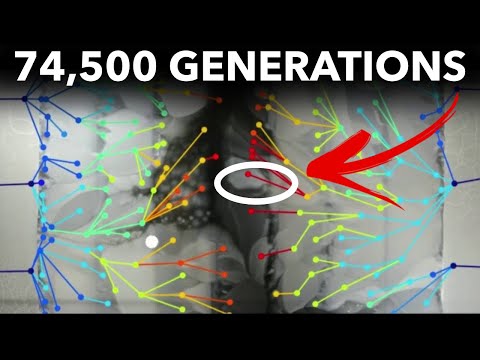
- The Long-Term Evolution Experiment SetupResearch FoundationRichard Lenski started this experiment 33 years ago in Michigan with a team of colleagues maintaining it continuously, even on weekends.Experimental Design• 12 long-term flasks of live E. coli bacteria started from a single common ancestor in 1988 • 12 separate populations have evolved independently • Bacteria have reached generation 74,500 (equivalent to 1.5 million years of hominid evolution)Evolutionary AdvantageBacteria undergo 6-7 generations per day compared to corn evolution experiments which get only one generation per year, enabling faster evolutionary observation.Population ControlEach population started from individual cells, ensuring that identical changes across populations represent independent mutations rather than shared initial variants.
- Daily Maintenance and Environmental ConditionsControlled Environment• Temperature maintained at 37 degrees Celsius • No other organisms present • Bacteria live in the same solution containing glucose, potassium phosphate, citrate, and other elements • Glucose is the only carbon source and is limitedDaily Transfer ProcessEvery day for 33 years, 0.1 milliliters (1%) of solution from each flask is transferred to a sterile new flask containing the same solution, diluting bacteria 100-fold and providing space and resources to grow.Selection PressureBacteria are selected primarily for consuming glucose and converting it to offspring as quickly as possible, replicating as fast as possible.Elimination ProcessEvery day 99% of the E. coli population is eliminated in an autoclave, serving as a bacterial crematorium to keep the experiment manageable.
- Mutation Rates and Natural SelectionMutation FrequencyOnly about 1 in 100 to 1 in 1,000 bacterial cells have a single mutation, making bacteria extremely conservative compared to humans who have 10-50 new mutations per offspring.Mutation VolumeDespite low individual mutation rates, with billions of bacteria in each flask, approximately 1 million new mutations occur daily, providing substantial variation for natural selection.Mutation Effects• About half of mutations have no effect on bacterial growth in the lab environment • About half are deleterious, making bacteria inferior competitors • 10-1,000 mutations daily provide competitive advantage over progenitorsCompetitive AdvantageMutations conferring even 10% faster growth rate lead to exponential spread through the population as the faster-growing variants are more likely to survive the daily 99% elimination.
- Measuring Fitness Through Time TravelFrozen ArchiveEvery 500 generations (roughly 75 days), samples of each population are frozen in suspended animation, creating a frozen fossil record of bacteria from all time points.Comparison Method• Current generation bacteria are competed against ancestral bacteria from different time periods • Bacteria are thawed, mixed in a flask, and incubated for one day • Relative growth rates determine which generation utilizes glucose better and divides fasterVisual IdentificationSix populations produce red colonies and six produce white colonies, allowing researchers to distinguish evolved bacteria from their ancestors on agar plates.Result VerificationAll colonies are counted by hand to determine the winner of the fitness competition between modern and ancestral bacteria.
- The Citrate Breakthrough DiscoveryUnexpected DevelopmentIn 2003, after 33 years, one of the 12 lineages suddenly began consuming citrate, a second carbon source that had been present throughout the experiment.Initial HypothesisScientists initially suspected a contaminant bacterium had entered the flask, as E. coli is definitionally incapable of consuming citrate, but genetic testing confirmed it was E. coli from the original ancestral strain.Research QuestionResearcher Zack investigated why this ability took so long to evolve and why only one population developed it by going into the freezer and selecting bacterial clones from earlier points in that lineage.Competing Hypotheses• One hypothesis: the mutation is extremely rare, requiring precise DNA segment flipping at exact breakpoints, making it a rare event that could occur anytime • Alternative hypothesis: a series of prior mutations made citrate consumption possible, meaning earlier bacteria could not have evolved this trait regardless of chance • Both hypotheses proved true: the trait is difficult because it requires both rare mutations and prior evolutionary changes
- Unexpected Evolutionary PatternsPopulation DynamicsInstead of increasing in number over time, bacteria decreased in total population size while individual bacterial cells grew larger.Mutation Rate Changes• Six of the 12 populations evolved hypermutability with mutation rates 100 times higher than their ancestors • These same populations subsequently acquired mutations that brought mutation rates back down to normal levels • Higher mutation rates help populations evolve faster but create too many deleterious mutations if rates stay too highInitial FindingsThe first major finding confirmed Darwinian adaptation by natural selection, showing bacteria become better competitors over time in their environment.Early ExpectationsInitial observations suggested evolution would slow and plateau over time, as seen in other evolution experiments, prompting consideration of stopping the experiment entirely.
- The Power Law Model and Continuous EvolutionInitial Model FailureLenski's initial rectangular hyperbola model predicted bacteria would reach a fitness plateau asymptote, but actual data showed bacteria continued improving beyond the predicted limit.Superior AlternativeA power law model with only two parameters better describes the data by showing improvement continues indefinitely but at ever-decreasing rates, without an upper bound.Predictive PowerThe power law model can predict future fitness trajectories accurately, projecting 50,000-60,000 generations into the future based on only 1/10 of the actual data.Broader Implications• Evolution never stops even in a constant environment because many opportunities of smaller magnitude continue enabling progress • Life on Earth's continuous evolution may not require environmental change or external pressures • Even without asteroid impacts, viruses, or changing conditions, populations can improve indefinitely through accumulated small genetic improvements
- Household Bacteria Contamination DemonstrationExperimental SetupFluorescent powder was added to a household dishcloth to represent bacteria without telling household members, then later tracked using UV light.Contamination Findings• Significant fluorescent powder appears in the sink • Powder found on the tap, faucet handle, and dishwasher handle • Visible finger marks suggest contamination was spread by hands touching the dishwasherReal-World RelevanceDishcloths effectively spread bacteria throughout the household, demonstrating the importance of hygiene practices in preventing contamination.SolutionUsing paper towels like Bounty is presented as a hygienic alternative for cleaning up messes and spills to prevent bacterial spread.