World's Strongest Magnet!
This is the world's strongest magnet, capable of sucking objects in, generating electric current, and levitating non-magnetic objects.
9 chapters
- Introduction to the 45 Tesla MagnetMagnet Capabilities• Sucks in magnetic objects and materials • Generates electric current • Levitates non-magnetic objects • Wreaks havoc on camera equipment by disrupting electron pathwaysLocation & RecordLocated at the National High Magnetic Field Laboratory in Tallahassee, Florida, which has held the Guinness World Record for the strongest continuous magnetic field since 2000.Field Strength• Earth's magnetic field: 0.00005 Tesla • Refrigerator magnet: 0.01 Tesla • MRI machines: up to 3 Tesla • This electromagnet: 45 Tesla (nearly a million times Earth's field)Physical StructureThe apparatus is two stories tall with an outer superconducting magnet and an inner resistive magnet. The maximum field only occurs in a narrow cylindrical bore, with the strongest region being approximately one centimeter tall.
- Magnet Construction and SafetyComponent Design• Outer superconducting magnet produces 11.5 Tesla • Inner resistive magnet produces 33.5 Tesla • Combined fields add to reach 45 Tesla totalFringe Field DangersThe magnetic field extends beyond the magnet's center as the fringe field. Objects within the 100 Gauss line will orient themselves to the field and potentially accelerate toward it. Ferromagnetic implants like pacemakers are strictly prohibited in this area.Power RequirementsThe magnet requires 47,000 amps of current at 500 volts to operate. Ramping up to full power takes approximately one and a half hours.Research ApplicationsThe magnet's narrow bore is suitable for small samples like computer chips and cell phones, making it valuable for material science and kinetic matter research.
- Magnetic Materials and PropertiesFerromagnetic Behavior• Electrons are tiny magnets that pair up in most atoms, canceling their fields • Elements with half-full electron shells cannot pair, creating magnetic atoms • Domains are regions where atoms align in the same direction • A strong external field can align all domains to create permanent magnetsDemonstration with WashersA Nerf football containing steel washers was used to show magnetic attraction. The ball with washers was strongly pulled toward the magnet while an unmodified ball was unaffected.Ferrofluid BehaviorFerrofluid contains nanoscale magnetite particles suspended in solution. In the magnetic field, particles develop parallel ridges, form spikes aligned with field lines, and climb the vessel walls as proximity increases.Historical DiscoveryMagnetite is the mineral that led to the discovery of magnetism over 3000 years ago in Magnesia, Greece. By the 11th century in China, magnets were used in compass needles to indicate direction.
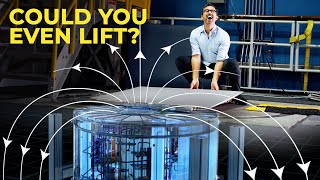
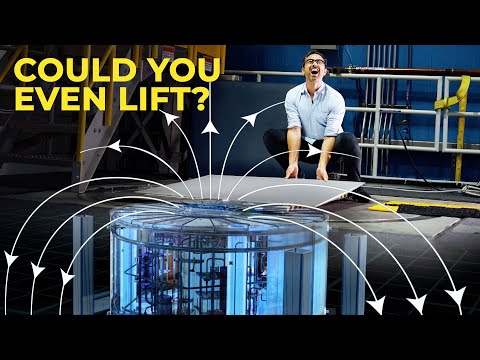
- Eddy Currents and Electromagnetic InductionLenz's Law ExplanationAs objects move through a magnetic field, changing magnetic flux induces eddy currents in conductive materials. These currents create their own magnetic field that opposes the change, following Lenz's Law or the 'No You Don't' Law.Falling Metal Plates• Conductive plates fall much slower through the field due to induced opposing currents • Eddy currents dissipate energy as heat, warming the plate • The plate is repelled by the field it induces, causing decelerationResistance DemonstrationsObjects cannot be easily pushed down through the field (gravity opposed) or lifted away (magnetic attraction induced). Even with significant effort, the induced magnetic field resists both directions of motion.Projectile ExperimentsProjectiles fired through the field rotate to align with magnetic field lines, minimizing flux changes. Projectiles with LED-connected coils light up different colors as induced currents change direction.
- Superconductors and Magnetic LevitationSuperconductor Properties• Below critical temperature, superconductors have zero electrical resistance • Induced currents can persist indefinitely without dissipating • Engineered defects trap magnetic field lines, preventing movement • This allows objects to be locked in magnetic configurationsHuman LevitationA 90-pound (40 kg) magnet hovers above a ring of superconductors. When a person stands on the magnet, the increased magnetic flux is opposed by superconductor currents, allowing the person to levitate while maintaining angular momentum.Levitation Experiments• Strawberries can be levitated due to their high water content • Raspberries and plastic pieces are also diamagnetic and can levitate • Frogs and grasshoppers have been levitated in experiments • Mice can be levitated to study weightlessness effects without space travelBiological EffectsNo lasting or long-term effects from strong magnetic fields have been observed. However, rodents show temporary effects of polarized inner ear stones, causing them to spin in circles for a few minutes after exposure.
- Diamagnetism and Non-Magnetic LevitationMaterial Properties• Paramagnetism: Some materials like oxygen are always attracted to magnetic fields • Diamagnetism: Most materials are repelled by strong magnetic fields • Water is diamagnetic and creates an indent when a magnet approaches its surfaceMagnetic Field EffectsExternal magnetic fields cause water molecules to become opposing magnets, resulting in repulsion. This diamagnetic effect can be strong enough in a 31 Tesla magnet to levitate objects that aren't traditionally magnetic.Observation SetupA 31 Tesla magnet with a periscope setup allows observation into the bore. This weaker magnet lets researchers place objects inside and observe diamagnetic levitation visually through the optical pathway.Levitating ObjectsStrawberries levitate due to their high water content. Living organisms containing enough water can also be levitated, including frogs, grasshoppers, and mice.
- Engineering the World's Strongest MagnetSuperconductor LimitationsSuperconducting magnets alone can only generate up to 20 Tesla due to physical limits of superconductors. When magnetic field strength exceeds superconductor tolerances, they cease to be superconducting.Hybrid SolutionAn outer superconducting electromagnet (11.5 Tesla) is combined with an inner resistive magnet (33.5 Tesla). Maxwell's equations dictate that fields add together to reach 45 Tesla total strength.Resistive Magnet Technology• Francis Bitter at MIT in the 1950s realized that conductor shape doesn't matter • Round wire is flattened into thin plates and stacked with insulators • Cooling water is pushed axially through the stacked plates to remove heat • This allows currents up to 57,000 amps instead of traditional limitsCoil Assembly• Stacked plates are aligned using a stacking jig • Approximately 20 tons of force holds the coil together • Tie rods are locked down to provide electrical connections • Several thousand gallons per minute of deionized water cool the coils to prevent melting
- Magnet Maintenance and FailuresMaterial Failure MechanismMaterial failure occurs when metal goes beyond its plastic limit and permanently deforms instead of returning to original shape. Flexing coils can short circuit to adjacent coils or ground.Cascade EffectsA single coil failure can damage multiple adjacent coils. When the B coil failed plastically, the insulator burned through and metal vaporized, subsequently killing the A coil and C coil.Cost of FailuresCoil failures are extremely expensive due to the complex nature of the magnet and the difficulty of replacement. The cascade failure described destroyed multiple high-value components.Global CompetitionChina recently commissioned a similar 45 Tesla hybrid magnet, making it the second such facility in the world. Both systems represent the current pinnacle of continuous magnetic field generation technology.
- Energy Consumption and Research ApplicationsElectricity Budget• The Mag Lab uses approximately 8% of Tallahassee's total generating capacity at full operation • Monthly electricity costs range from $250,000 to $300,000 • The facility operates within the city's federally mandated power reservePower ArrangementThe Mag Lab has a deal with the city of Tallahassee to use their reserve power, which they cannot normally sell. In return, the city generates revenue from this power that would otherwise go unused. When needed, the Mag Lab can power down faster than the utility can activate backup generators.Research Drivers• Growing new materials in extreme magnetic field environments • Creating high electric field and high pressure conditions alongside magnetic fields • Operating at ultra-low temperatures while applying strong fields • Improving material cleanliness by removing impurities to enhance propertiesFuture ImpactScientists believe this five-year period represents an inflection point in magnet research. In 25 years, this technology will be viewed as a pivotal moment for material discovery and new applications.