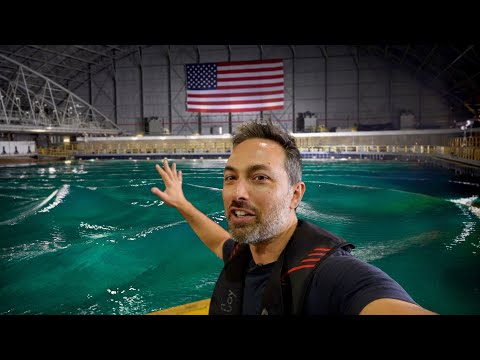
Inside The Navy's Indoor Ocean
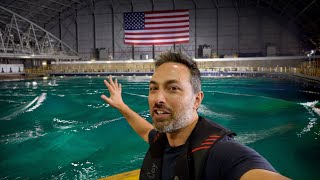
The biggest wave pool in the world where they can test scale ships and make them better before they go out on the open ocean.
5 chapters
- Understanding Wave PropertiesBasic Wave Concepts• Wavelength is the distance from one wave crest to the next • Waves transmit energy rather than material from one place to another • Water molecules move in circular paths as waves pass, with deeper water showing smaller motion • All motion stops at the wave base, a depth equal to half the wavelengthFrequency EffectsHigher frequency waves have steeper slopes and travel slower than low frequency waves. Wave speed is inversely proportional to frequency when water is deeper than the wave base.Wave InteractionsThe principle of superposition states that when waves meet, they add together. The height of water equals the sum of individual wave heights at that point.Practical Demonstrations• Multiple frequency waves are timed to meet at the same point, causing them to break • Standing waves are created when two regular waves meet from opposite directions, forming a quilt-like pattern • Bullseye waves are created when circular wave fronts converge at a single point, demonstrating wave coalescing
- Ship Testing and ScalingReal-World ApplicationThe primary purpose of the facility is to replicate on a small scale the types of waves Navy ships encounter in actual ocean conditions. Engineers place scale models of billion-dollar vessels in the water to test how different designs behave.Scaling Challenges• The pool uses fresh water instead of salt water, requiring adjustments to ballast calculations to account for buoyancy differences • Testing uses the Froude number rather than Reynolds number to maintain accurate wave dynamics • A model ship 46 times smaller must travel at 1/√46 of its real-world speed to achieve accurate physicsMeasurement ToolsUltrasonic sensors are used to measure wave height, period, and direction in the basin, ensuring that test conditions match expected specifications.Testing Procedures• Models run in race tracks (circles or figure-eights) to correlate model behavior with full-scale vessel behavior • Tethered models on a carriage system allow for power and instrumentation that models cannot carry themselves • Testing includes checking water wash-on-deck conditions, critical for helicopter landing pad safety
- Ocean Wave Formation and TypesWave Generation Process• Wind blows across still water, creating regions of pressure differences that form tiny ripples • Wind acts on ripples, creating larger pressure differences and pulling them into bigger waves • Wave interaction creates a range of different wavelength waves • Breaking waves dissipate energy as heat, eventually reaching a fully developed sea when energy dissipation matches wind energy inputOcean SwellHigh frequency waves dissipate energy quickly as they travel from storms. Low frequency waves (swell) travel long distances and eventually reach open ocean hundreds of miles away with long wavelengths and low frequency.Wave Spectra Differences• North Sea and small bodies of water have peaky spectra due to limited storm fetch • Mid-Atlantic has broader spectra from developing or decaying open ocean waves • North Atlantic has the broadest spectrum from steady wind across open ocean • Different oceans require different wave condition testing based on their geography and storm typesRogue Waves ExplainedRogue waves are not spontaneous phenomena but rather multiple waves meeting and creating amplitude much larger than individual waves would produce. When waves merge to create insufficient wave base depth relative to amplitude, they break.
- Ship Design Innovation and ImpactHull Design Evolution• Traditional designs flare outward to provide reaction force when rolling • Tumble home designs curve inward, reducing restoring force when rolling but offering stealth advantages • Hull design innovations balance multiple priorities: radar signature reduction, speed, power, and stabilityTesting BenefitsModel testing at the facility reduces costs significantly by identifying design flaws before building full-scale ships. Testing validates innovative ideas that may contradict traditional naval design.Facility ImpactEvery ship in the Navy's fleet has been tested in this facility or peripherally through it. All Navy-owned ships have undergone testing here.Legacy and AwarenessMost sailors are unaware of the background work supporting their operations. Personnel with decades of Navy service were surprised by the magnitude of testing and innovation happening at the facility.