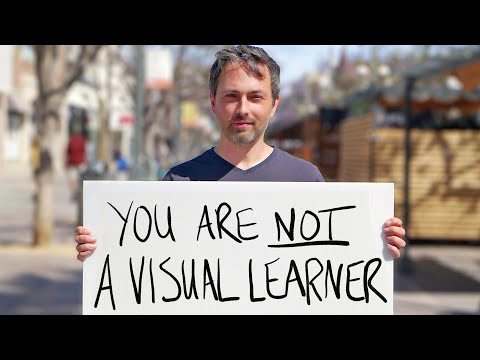
The Biggest Myth In Education
7 chapters
- Introduction to Learning StylesCommon BeliefsPeople commonly identify themselves as visual, auditory, reading-writing, or kinesthetic learners based on perceived preferences for how they receive information.VARK Framework• Visual learners learn best from images, demonstrations, and pictures • Auditory learners learn best from listening to explanations • Reading-writing learners learn best from reading and writing • Kinesthetic learners learn best by physically doing and interactingWhy It Seems TrueLearning styles make intuitive sense because people have different strengths—some have better spatial reasoning, listening comprehension, reading ability, or manual skills.Teacher AdoptionA survey of nearly 400 teachers from the UK and Netherlands found that over 90% believed individuals learn better when receiving information in their preferred learning style.
- Testing the Learning Styles HypothesisExperimental DesignA randomized controlled trial identifies learners with different learning styles, randomly assigns them to mismatched or matched presentations, then tests whether matching improves performance.Street ExperimentWhen visual learners were shown pictures of items, they remembered about five or six items. When shown items auditorily instead, the results were similar, suggesting presentation format did not determine memory performance.Success Strategy• High performers employed memory strategies like organizing items in order, repeating lists mentally, or creating stories to link items together • Success correlated with active strategy use, not with matching presentation to learning styleKey FindingMemory performance improvements came from employing deliberate learning strategies, not from matching the presentation format to a supposed learning style preference.
- Rigorous Scientific EvidenceVisualizer StudyResearchers categorized students as visualizers or verbalizers based on questionnaires, then randomly assigned them to text-based or picture-based lessons on electronics.Test Results• Students whose preferred learning style matched their instruction performed no better than those whose instruction was mismatched • The same result was found when the test was repeated with 61 non-college-educated adultsStudy Behavior AnalysisIn a 2018 study of 400+ university students, an overwhelming majority used study strategies supposedly incompatible with their learning style, yet showed no performance difference.Consistent ConclusionReview articles of learning styles consistently conclude there is no credible evidence that learning styles exist or improve learning outcomes.
- Origins and Limitations of VARKCreation StoryNeil Fleming, a New Zealand school inspector, created VARK after observing that some excellent teachers did not reach certain learners while some poor teachers did, leading him to explore preferred modes of learning as an explanation.Lack of EvidenceThere was no empirical study showing students naturally cluster into four distinct groups; VARK was created based on intuition rather than scientific evidence.Why Preferences Don't Determine LearningWhat we want people to recall is not the precise nature of images or sounds, but the meaning behind presentations. Task-specific aptitudes exist, but preferences are not consistent across learning domains.Domain-Specific Skills• Someone with perfect pitch will better recall certain tones in music • Someone with excellent visual-spatial reasoning will better learn country locations on a map • But these specific skills do not generalize across all learning domains
- Cognitive Biases and ConfirmationConfirmation BiasPeople find learning styles convincing because they already believe it to be true, and then interpret experiences through that lens—when a good diagram helps them understand something, they attribute it to their visual learning style rather than the diagram's quality.Belief ReinforcementWhen people already believe learning styles are correct, they interpret new experiences to fit with those beliefs whether they actually support them or not.Alternative ExplanationA diagram that helps someone understand a concept would likely help anyone learn it, not just self-identified visual learners. Good instructional design benefits all learners.Impact on Education• Learning styles misconception gives teachers unnecessary worries • Makes some students reluctant to engage with certain types of instruction • Resources spent on learning styles training could be better spent on evidence-based interventions
- What Actually Improves LearningMultimodal ApproachA large body of research supports that everyone learns better with multimodal approaches where words and pictures are presented together rather than either alone.Multimedia EffectVideos are powerful learning tools when narration complements visuals. The combination of auditory and visual information is more effective than either modality alone.Active ThinkingThe most important factor for learning is not how information is presented but what happens inside the learner's head. People learn best when actively thinking about material, solving problems, or imagining what happens if variables change.Universal Benefits• The best learning experiences involve multiple different ways of understanding the same thing • Multimodal strategies work not just for one subset of people but for everyone • People are all visual, auditory, and kinesthetic learners combined
- Critical Thinking and Information SearchingSearch Bias ProblemA common trap people fall into is only searching for information that confirms what they already believe, often by putting the answer they're looking for directly in the search query.Better Search Strategy• Try alternative searches by adding words like 'debunked' or 'false' at the end to find opposing viewpoints • Search for both sides of controversial topics to get complete information • Click on source information to judge trustworthiness yourselfSource EvaluationGoogle Search makes it easy to get details about source information—click the three dots next to any result to judge whether the information is trustworthy before visiting the site.User ResponsibilityGoogle Search surfaces relevant information, but it is up to you to formulate queries, try different searches, and assess whether information is reliable.