The Surprising Genius of Sewing Machines
Every piece of clothing you've ever put on virtually was made by a sewing machine.
9 chapters
- The Mystery of Sewing Machine OperationThe ChallengeHand sewing requires passing a needle up and down through fabric and releasing it on one side to grab it on the other. Machines cannot easily replicate this motion, so a completely new sewing method had to be invented.Why It MattersVirtually every piece of clothing ever worn was made by a sewing machine. Understanding how they work reveals tiny mechanical miracles happening every second.The ProblemThe needle in a sewing machine never actually passes fully through the fabric like a hand-sewn needle does, yet it still creates complete stitches.What's ComingThe solution involved three major breakthroughs that fundamentally changed how sewing could be mechanized.
- Ancient Sewing and the Double-Sided Needle InnovationHistorical Origins• Humans have been sewing for tens of thousands of years • A needle found in a Siberian cave dates back 50,000 years, made by Denisovans (now extinct early humans) • Sewing is a uniquely human activity, not just limited to Homo sapiensAncient DesignNeedles from ancient caves in France, Egypt, Greece, India, China, and Japan all looked remarkably similar—a sharp end to pierce fabric and an eye for thread. This design remained unchanged for tens of thousands of years.The 1755 BreakthroughCharles Frederick Wiesenthal, a German inventor living in England, created a needle sharp on both sides. This allowed sewers to pass the needle back and forth through fabric without flipping it over, speeding up hand sewing.Unexpected ConsequenceThe two-sided needle design moved the eye of the needle next to the sharp tip, an unexpected benefit that all modern sewing machines still use today.
- The Chain Stitch: First Mechanical SolutionThe ProblemWhen a needle with thread goes through fabric, the thread gets pulled out when the needle is removed. A way was needed to tangle the thread at the bottom of the stitch to prevent it from pulling out.The SolutionBy keeping a loop of thread underneath the fabric and passing the needle through that loop, each stitch links to the previous one, forming a chain of stitches.Early Inventors• Thomas Saint drew detailed patent drawings in 1790 but never built a prototype • Joseph Madersperger patented a design in 1814 in Vienna but never commercialized it • Barthélemy Thimonnier built a working chain stitch machine in 1830 and set up a factory with 80 machines for French army uniformsPerfected Designs• James Gibbs and Charles Raymond each patented reliable chain stitch machines in 1857 • Raymond's design used a hook that catches thread loops as the needle moves • Gibbs used a rotating hook design that required 37 wooden prototypes to perfect the looper shape
- The Lock Stitch: Superior Mechanical InnovationGenius ConceptInstead of using one thread, the lock stitch uses two separate spools of thread. The needle passes completely through the fabric, and the bobbin thread interlocks with the top thread, creating a secure lock stitch.Early Development• Elias Howe patented the lock stitch in 1846 and staged a live demonstration of his machine versus five seamstresses • Howe's machine used a curved needle, vertical fabric, and could only make straight-line stitches • Allen B. Wilson dramatically improved the design and received two patents in 1850 and 1851Vibrating Shuttle DesignWilson's 1850 patent introduced the vibrating shuttle machine. The shuttle oscillates back and forth carrying a small bobbin of thread. As it moves through the needle's thread loop, it creates a lock stitch by intertwining both threads.Rotating Hook DesignWilson's 1851 patent replaced the shuttle with a rotating hook around the bobbin. This design became the basis for how most modern sewing machines work today, allowing for faster operation and more reliable stitching.
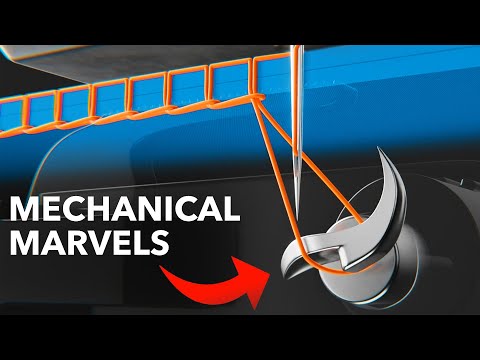
- Modern Sewing Machine MechanicsHow Rotating Hook Works• The needle pulls the top thread down, creating a bulge when it pops back up slightly • The rotating hook catches this bulge and pulls thread entirely around the bobbin • The needle passes through the loop as it moves up, repeating the cycle for each stitchThread BalanceAlthough it appears more thread comes from the top spool because a full loop must be pulled around the bobbin, the thread is drawn back up. The same amount of thread is used from both the top and bottom spools.Critical TensionThe tension must be identical on both top and bottom threads so equal amounts are used in each stitch. If tension is off, the stitch won't meet perfectly in the middle of the fabrics, resulting in a much weaker stitch.Needle InnovationA groove was developed on one side of modern sewing needles to reduce friction as thread gets pulled down and back up around the bobbin. This reduces fraying of both thread and fabric, resulting in a cleaner stitch.
- Fabric Advancement and Feed DogsEarly LimitationIn the earliest sewing machines, fabric had to be moved by hand after every stitch. This was slow, inefficient, and stitches were not identically spaced.The SolutionAllen B. Wilson invented the feed dog—a small metal foot that presses down on fabric. When the needle is not in the fabric, grooved metal underneath pushes up and grabs the fabric, advancing it a fraction of an inch to where the next stitch should be.Universal DesignThis feed dog design is used in practically all sewing machines today. Modified versions exist, like the universal feed machine used for chain stitch embroidery that can advance fabric in 360 degrees.Factory Operation• Historically, sewing machines in factories were powered by cables connected to one large steam or coal-powered generator • Factories would engage machines by pulling a pin when the continuous spinning motor was ready • Unlike modern machines that can be feathered slowly, historical machines jumped to about 10,000 rpm immediately, requiring exceptional skill from operators
- Isaac Singer and the Sewing Machine RevolutionWho Was SingerIsaac Singer did not invent the sewing machine. He was a shrewd businessman who bought up patents for various parts and built his company on optimized production rather than innovation.Price Revolution• Singer optimized the production process inspired by interchangeable parts used in firearms manufacturing • He dropped sewing machine prices from $100 to around $10 (just over $300 in 2023 terms) • This lower price allowed him to sell machines to families instead of only corporationsBusiness InnovationSinger's company was one of the earliest in the world to offer installment payment plans, allowing buyers to pay off machines over several months rather than paying the entire cost upfront.Global Impact• Singer became one of the largest corporations in the world • Singer was the first American multinational company • This business model made sewing machines accessible to ordinary families, transforming the textile industry
- Impact on Clothing Production and SocietyProduction SpeedBefore sewing machines, it took over 12 hours to sew a single shirt. With sewing machines, a shirt now takes less than 30 minutes to make.Cost of Clothing• In 1900, the average American family spent about 15% of total income on clothing • By 2003, this dropped to less than 4% • Despite spending less, people own more clothes than everConsumption TrendsIn 2019, the worldwide average number of garments owned was over 130 per person. Each year, a hundred billion garments are produced globally.Environmental CostIn the US alone, 11.3 million tons of clothing ends up in landfill each year—nearly 35 kilograms of clothing per person that is thrown away annually.
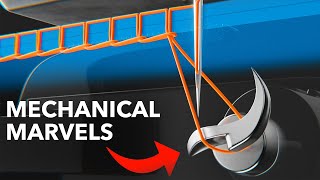
- The Genius of Sewing Machine DesignCollective InnovationThe sewing machine was invented, iterated upon, and improved by dozens of people over centuries, not by a single inventor.Key Breakthroughs• Double-sided needle design that moved the eye next to the sharp tip • Chain stitch mechanism using hooks and loopers • Lock stitch using two threads that interlock • Feed dog mechanism for automatic fabric advancementMechanical MarvelThese machines represent tiny mechanical miracles, performing complex synchronized operations every second to create precise, durable stitches.World RevolutionThe sewing machine revolutionized the world by introducing a completely new way to sew that could be mechanized, transforming textile production and making clothing accessible to everyone.