The Insane Math Of Knot Theory
Most of us tie our shoe laces wrong.
18 chapters
- Introduction to Knot TheoryThe ProblemMost people tie their shoelaces incorrectly. One method uses counterclockwise motion around the loop, while the other uses clockwise motion, but one is far superior and doesn't loosen as easily.What Is Knot TheoryA branch of mathematics that aims to identify, categorize and understand every possible knot that could ever exist. So far, 352,152,252 knots have been discovered.Real World Applications• Core to the structure of proteins and DNA • Leading to new materials stronger than Kevlar • Used to develop medicines that save millions of livesWhy It MattersKnot theory is not pure math. Understanding these humble knots has become remarkably useful in chemistry, biology, and medicine.
- Defining Mathematical KnotsThe ChallengeEveryday knots are held together only by tension and friction. For rigorous study, mathematicians needed a way to prevent knots from falling apart when pulled.The SolutionMathematicians connected the two ends of the rope to create closed loops. Now knots can be studied and rearranged without fundamentally changing their structure.Basic Types• Unknot: A simple circle, the simplest knot possible • Trefoil: The simplest knot after the unknot, cannot be untangled without breaking the loopFundamental RuleTwo knots are only different if you cannot make one into the other without breaking the loop. All knots exist on closed loops.
- The Knot Equivalence ProblemThe Core QuestionHow do you tell two knots apart? The knot equivalence problem has propelled the entire field of knot theory for over 150 years.Historical Context• Alan Turing called it potentially undecidable in his final publication • Previously, the Gordian knot was the most famous knot problem, solved by Alexander the Great by cutting it (invalid in knot theory)Historical Knots• Endless knot: appeared in Indus Valley clay tablets and Medieval Celtic designs • Quipu: Incan knots on cords used to track taxes and calendars • Borromeon rings: featured in the coat of arms of the Italian House of BorromeoProblem SignificanceThis single question is so famously difficult that it has driven an entire mathematical field, with some of the greatest minds unable to solve it for centuries.
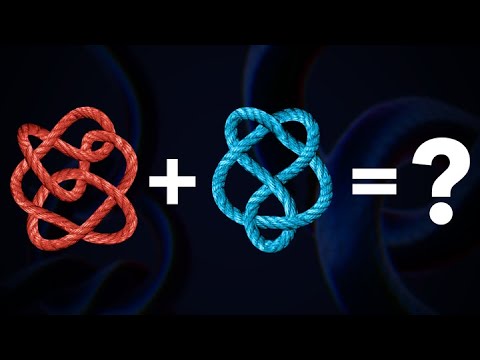
- Tait's Pioneering WorkThe DiscoveryIn 1867, Scottish physicist Peter Guthrie Tait demonstrated a smoke machine to William Thomson (Lord Kelvin), leading to a revolutionary theory about atoms.Kelvin's VisionKelvin theorized that atoms were made of vortex rings of ether in different knot configurations. Different knots would make different elements, creating a periodic table of knots.Tait's Contribution• Began investigating knots systematically to support Kelvin's atomic theory • Discovered knots by crossing number: trefoil (3), figure eight (4), and progressively more complex knots • Introduced composite knots (multiple knots combined) and prime knots (non-decomposable)Scientific ContextAlthough Kelvin's vortex theory was later disproved by the discoveries of the electron and periodic table, Tait was already committed to understanding knots mathematically.
- Building the Knot TablesInitial AccomplishmentTait published his list of knots up to seven crossings in 1877, the first math paper with 'knots' in its title. He then paused for seven years.Collaborative EffortThomas Kirkman and Charles Little answered Tait's call for help. Together they found all 21 eight-crossing knots, 49 nine-crossing knots, and 166 ten-crossing knots by 1899.Hand CalculationsAll work was done painstakingly by hand. Tait admitted uncertainty about whether all groups were truly different, and the task grew exponentially harder with each crossing number.Remarkable AccuracyTheir knot tables stood for 75 years without change until a single correction in 1973, demonstrating exceptional care and accuracy in their manual tabulation.
- Reidemeister Moves and Proving KnotsThe BreakthroughIn 1927, German mathematician Kurt Reidemeister proved that only three types of moves are needed to transform any two identical knots into each other.The Three Moves• Twist: creating or removing a simple loop • Poke: adjusting the configuration at a crossing • Slide: moving a string from one side of a crossing to the otherProving SamenessIf you can show that two knots are connected by Reidemeister moves, you've proven they must be identical. This solved half of the equivalence problem.Remaining ChallengeYou still cannot prove two knots are different, because you could perform Reidemeister moves for centuries without making the right ones to show equivalence.
- Computing SolutionsEarly AlgorithmIn 1961, mathematician Wolfgang Haken created a computer algorithm that definitively distinguished any knot from the unknot, but his paper was over 130 pages long.Computational Barriers• Haken's algorithm would take longer than the age of the universe to run for large knots • 2001: mathematicians found an upper bound of 2 to the 100 billion n moves needed • Today: improved to 236 n to the power of 11, still unfathomably largeScale of ComplexityFor a single crossing knot, the number of required moves is larger than the number of stars in the observable universe.Complete SolutionIn 2011, mathematicians solved the entire knot equivalence problem with an upper bound using tetration operations repeated 10 to the million n times, an unimaginably large number.
- Knot InvariantsThe ConceptInvariants are properties of a knot that never change no matter how much you twist or tangle it. Different knots have different invariants, allowing identification.How They Work• If two knots have different invariants, they are definitely different knots • If two knots share invariants, they might still be different • Invariants are not perfectly discriminating but serve as identifying hallmarksCrossing NumberThe simplest invariant: two knots cannot be identical if they have different crossing numbers. However, calculating it requires finding the knot's reduced form.Practical ApplicationKnots are identified by combining dozens of invariants together, similar to identifying a person by first name, last name, birthday, and other characteristics.
- Tricolorability and p-colorabilityTricolorability DefinedA knot invariant where each segment is colored with one of three colors. Rules: use at least two colors, and at crossings, the three intersecting strands must be all the same color or all different colors.Key PropertyTricolorability is preserved through all Reidemeister moves. The unknot is not tricolorable, while the trefoil is easily tricolorable with three different colored segments.LimitationsTricolorability only provides two categories across all knots. The figure eight knot, for example, is not tricolorable, same as the unknot, so they need further distinction.Extended Version• p-colorability uses prime numbers instead of three colors • Numbers 0 to p minus one are assigned to strands • The unknot is completely uncolorable, so any knot with any colorability cannot be the unknot
- Polynomial InvariantsAlexander PolynomialDiscovered in 1923, before even Reidemeister moves. It assigns a polynomial to each knot based on a recursive relationship derived from varying single crossings.How It Works• The unknot has a polynomial equal to one • For any crossing, you can vary it in three positions: forward, backward, and separate • This creates a relationship between the polynomials of the three resulting knotsJones PolynomialDiscovered in 1984 when mathematician Vaughan Jones realized his work on statistical mechanics resembled knot theory equations. With Joan Birman's help, he created a more powerful polynomial invariant.Further Discoveries• Jones' discovery sparked a fervor in knot theory • Six mathematicians independently found the HOMFLY polynomial with two variables • Later refined to the HOMFLY-PT polynomial by Polish mathematicians
- The Perko Pair CorrectionThe DiscoveryKenneth Perko, a lawyer who studied knot theory, noticed two knots in Little's table of 10 crossing knots that seemed suspiciously similar despite being listed as different.The BreakthroughUsing a yellow legal pad to sketch Reidemeister moves, Perko quickly found a way to connect the two knots, proving they were actually the same knot.The ImpactThe Perko pair became famous as the two projections that exposed an error in Tait and Little's 75-year-old tables, resulting in a single correction: 166 ten crossing knots became 165.Lesson LearnedThe Perko pair demonstrated that even the most carefully constructed knot tables could miss subtle equivalences, highlighting the difficulty of proving knots identical through Reidemeister moves alone.
- Modern Knot TabulationComputational MethodsIn the 1980s, Dowker and Thistlethwaite built computer algorithms to tabulate knots. The method lists all possible knots and uses invariants to eliminate duplicates.Historical Progress• John Conway found all 552 eleven crossing knots in a single afternoon (last hand tabulation) • Dowker and Thistlethwaite found 12 and 13 crossing knots • Hoste, Weeks, and Thistlethwaite tabulated 14, 15, and 16 crossing knots in 'The First 1,701,936 Knots'Recent RecordsIn 2020, mathematician Ben Burton single-handedly tabulated all 17, 18, and 19 crossing knots, bringing the total known prime knots to 352,152,252.Computational Scale• Burton's project required hundreds of computers running for months • Alternating knots were computed up to 24 crossings in 2007 • Including alternating knots, total knots known: 159,965,097,353
- Molecular Knots in ChemistryThe First DiscoveryIn 1989, chemist Jean-Pierre Sauvage tied molecules around copper ions to create the first ever synthetic knotted molecule, a trefoil knot that restricted atoms in higher energy states.Molecular Properties• Any type of knot tied in a molecule changes its properties • Over 159 billion different molecular knots are theoretically possible • Only six molecular knots have been created to dateCreation ChallengeChemists cannot nudge individual ions into place. Molecules must be designed to self-assemble into knots. Knot theory helps identify which knots match molecular templates.Record AchievementThe 819 knot with 192 atoms around a central chloride ion holds the Guinness World Record for tightest knot, with eight crossings in 20 nanometers, making it one of the strongest chloride binders in existence.
- DNA and Bacterial KnotsThe ProblemBacterial DNA consists of a single loop of the double helix molecule. When DNA replicates, it forms a knotted link, preventing bacteria from separating into two cells.The Enzyme SolutionBacteria use type two topoisomerase enzyme to snip and reconnect DNA, turning linked DNA back into an unlink so replication can proceed cleanly.Antibiotic Application• Inhibiting type two topoisomerase prevents bacteria from replicating properly and causes them to die • Quinolones are common antibiotics that work through this mechanism • These are among the most common antibiotics in the worldDiscovery ProcessBiologists needed knot theory to understand that topoisomerase decreases the crossing number of DNA knots by two at a time, revealing it cuts and rejoins entire double strands of DNA.
- Cancer Treatment and Protein KnotsHuman DNA TanglesHuman DNA is not circular but long enough to tangle. Each cell contains two meters of DNA, equivalent to stuffing 200 kilometers of fishing line into a basketball.Human TopoisomerasesHuman type two topoisomerases manage DNA tangles through crossing changes. They are different enough from bacterial versions to be unaffected by antibiotics.Cancer Treatment• Human topoisomerases are intentionally inhibited in chemotherapy • Inhibition stops cell replication and kills cells • Rapidly dividing cancer cells are predominantly affected • This is one of the most common forms of chemotherapyProtein Structure• 1% of all proteins have various knots in their fundamental structure • Misknotted proteins malfunction • Knot theory helps understand protein mechanisms and potential repair methods
- Shoelace Knots ExplainedThe Two MethodsBoth common shoelace tying methods create two trefoils on top of each other. Counterclockwise motion creates identical trefoils (granny knot), while clockwise creates mirror-imaged trefoils (square knot).The DifferenceThe square knot created by clockwise motion is superior and doesn't loosen as easily as the granny knot created by counterclockwise motion.Other Common Knots• Simple overhand knot is just the trefoil • Bowline knot (common for boating) is the six two knot • Any knot tied without using the ends (in the bite) is an unknotRecommendationEveryone should tie their shoelaces by going clockwise around the loop to create the more stable square knot instead of the looser granny knot.
- Real-World Knot FormationThe StudyIn 2007, researchers Dorian Raymer and Douglas Smith conducted 3,415 trials of spinning string in boxes to study how knots form naturally, creating 120 different types of knots.Key Findings• Longer agitation time leads to higher chance of knotting • Longer string increases knotting probability • Smaller box restraint decreases probability, overriding string length effectsFormation ModelA series of loops first form when string is placed in a container. During agitation, a free end gets woven up and down through the loops, braiding itself into knots.Practical Prevention• Coiling wires sets you up for failure by creating loops for loose ends to braid into • Restrict movement using small boxes or increase string stiffness • DNA uses supercoiling to increase stiffness; twisted wires achieve the same effect
- Legacy and ApplicationsHistorical ArcKnot theory began as a failed theory of everything but became a standalone field of math propelled purely by intellectual curiosity for over a century.Modern Recognition• Raymer and Smith's study won an Ig Nobel Prize • Their work was cited in studies of knots in surgical catheters • Linked to an Apple patent for stiffer earbud wiresReclaimed PotentialKnot theory is now a theory of everything from headphone tangles to material science to chemotherapy, reclaiming its original potential as a universal framework.Knowledge TransferKnot theory exemplifies how knowledge in one area becomes a tool to understand countless others. Learning to distinguish a trefoil from an unknot led to discovering brand new proteins and molecules.