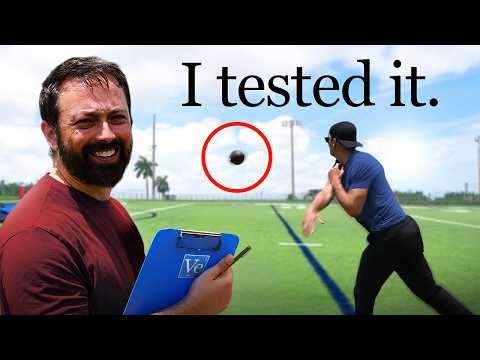
The Biggest Misconception in Football (ft. Tom Brady)
Even Tom Brady can't throw a perfect spiral
11 chapters
- Introduction to Tom Brady and the Spiral MythBrady's AchievementTom Brady is the greatest American football quarterback of all time, having won seven Super Bowls and thrown the most touchdown passes in history.The DiscoveryThrough detailed analysis of Brady's throw, researchers discovered that even Tom Brady cannot throw a perfect spiral—his deep passes exhibit a slight wobble and drift to the right.Key FindingThese imperfections are not mistakes but are actually fundamental to the physics of throwing a football accurately.Research Methods• Computational fluid dynamics analysis • Wind tunnel testing with spinning balls • Sensors embedded in real footballs
- Brady's Throwing Technique ExplainedGrip and PostureThe key to throwing a tight spiral involves very light grip pressure on the football and a relaxed, efficient throwing posture with all energy directed toward the target.Spin GenerationSpin is imparted by popping the wrist at the end of the throw, creating a snap that releases from the fingertips and gives the ball its rotation.Mechanical EfficiencyBrady emphasizes having a smooth, efficient throwing motion developed over time to be really efficient with mechanics.Why It MattersThe snap and spin created are the key to Brady's record-breaking throws, enabling accuracy and distance.
- Why Spin Matters: The Physics FoundationKnuckleball ProblemA ball thrown without spin becomes unstable and tumbles unpredictably, with drag force increasing up to 10 times greater than when aligned with the throw.Spin BenefitSpin helps the ball maintain its orientation and orientation, allowing it to cut through air with a smaller frontal area and lower drag coefficient.Wind ResistanceA spinning ball maintains orientation so the wind has less effect on it, which is especially important when playing in windy conditions.Historical ContextThe benefits of spin became clear in the 1854 Crimean War when rifled muskets with spinning bullets proved far more accurate than smooth-bore muskets.
- Angular Momentum and Gyroscopic StabilizationConservation PrincipleAll spinning objects conserve angular momentum, which helps them resist changes in their orientation, similar to how a spinning top stays upright.Practical ApplicationFor spinning bullets and footballs, angular momentum resists changes to the axis of rotation, so even if wind applies an unbalanced force, the object maintains its orientation.Drag ReductionThis orientation stability reduces drag and helps the projectile fly further, faster, and more accurately through the air.Wind EffectA quarterback can throw a tight spiral that resists wind effects much better than a wobbling ball, which is critical in windy playing conditions.
- The Turnover ParadoxThe PuzzleDespite angular momentum making the ball hard to pivot, in long passes the ball pitches from positive 30 degrees at release to negative 30 degrees at catch—a phenomenon called turnover.Alignment ImportanceTurnover is essential because it keeps the ball's orientation closely aligned with its direction of motion, minimizing drag throughout the flight.Why It's Strange• Footballs lack feathers or fins like arrows or birds • Weight is evenly distributed along the axis • They cannot use the same self-aligning mechanisms as other projectilesScientific ExplanationIn 2020, the editor-in-chief of the American Journal of Physics developed a theoretical model to explain how the football's turnover actually works through complex aerodynamic interactions.
- Wind Tunnel Testing and Data CollectionMeasurement ResultsSensors embedded in real footballs showed that Tom Brady's maximum spin rate on the test day was 628 revolutions per minute.Throw Speeds• Regular passes: approximately 46-49 mph (80 km/h) • Long throws: over 60 mph (almost 100 km/h) • These speeds are typical for game conditionsWind Tunnel SetupThe low-speed wind tunnel at the university can reach up to Mach 0.2 (20% of the speed of sound) and uses a six-component load cell to measure forces and torque.EquipmentThe facility includes a Sting mount on a turntable and an electric motor that can spin to simulate the football's spiral during testing.
- Gyroscopic Precession and Ball WobbleInitial BehaviorWhen a ball travels straight into airflow with a perfect spiral, no significant forces or torques develop and it behaves as expected.Parabolic Path EffectDuring actual throws, the ball follows a parabolic trajectory, causing more air to hit the underside than the top, which would normally tilt the ball back if it were not spinning.Spinning Ball ResponseWhen spinning, the ball responds differently through gyroscopic precession—forces applied at one point cause the ball to pivot 90 degrees further along its rotation, resulting in a wobble.Wobble Function• The wobble traces the nose in a circle around the airflow direction • Creates a slow wobble pattern essential to keep the ball aligned with its path • Wobble is impossible to avoid and actually essential for proper flight
- The Rightward Drift and Lift EffectTilt and LiftWhen the ball is tilted to the right, it generates lift in that direction; the more it's tilted, the larger this lift force.Why Drift OccursThe rightward tilt required for the ball to turn over during its parabolic path causes right-handed throws to drift right and left-handed throws to drift left.Real-World ExampleIn 1991, receiver Jerry Rice switched from right-handed Joe Montana to left-handed Steve Young and noticed throws coming up short, not realizing the drift difference between their opposite throws.Effect on PerformanceThe drift is subtle but essential—it's part of the precession that minimizes drag and lets the ball fly farther, faster, and more accurately.
- Indoor vs Outdoor Playing ConditionsWind ImpactIn winds gusting over 15 mph, weather plays a major role in throw accuracy since the ball is thrown at 50-60 mph with most airflow from its own motion.Accuracy ComparisonNFL data analysis shows that throws in indoor stadiums are consistently more accurate than outdoor stadiums at any distance due to wind elimination.Brady's PreferenceBrady preferred outdoor conditions at 70 degrees with humidity and a tiny breeze, stating his depth perception was better outside rather than in a dome environment.Weather Adaptation• Over 23 seasons, Brady practiced 100-120 times per year • He knew exactly what clothing to wear for every temperature • He adjusted hand muffs and heat packs based on specific conditions • Familiarity with field conditions gave him an edge over other quarterbacks
- Brady's Intuitive Physics MasteryScientific UnderstandingOver 383 career games, more than 7,700 completed passes, and tens of thousands of hours on the field, Brady intuitively understands all the complex physics of football throwing.Mastery Elements• Deep understanding of physics and aerodynamics • Internalized kinematics and complex calculations • Ability to harness aerodynamic effects with only seconds to throw • Makes impossibly complex physics look simplePrecision AnalogyBrady compares his preparation to an F1 car, where everything requires fractions of adjustments to feel the most comfortable.Impossible PerfectionIn a game where perfection is impossible, Brady has internalized all the complex physics and kinematics while still making it look effortlessly simple.
- Advanced Football Design and Future ResearchDesign OptimizationIn other sports, surfaces are engineered down to the smallest detail to control airflow, but footballs have hardly changed in decades despite potential improvements.Custom Ball TestingResearchers tested whether a football's design is really optimal by having Tom Brady throw a series of custom balls, including one designed to eliminate spin entirely.Hidden TechniquesDuring investigation, researchers uncovered secret techniques that teams are using to modify their balls and give their players an advantage in the game.Future ExplorationAdditional findings about ball modification techniques and design optimization will be covered in a future video to complete the investigation into football physics and performance.