
How Imaginary Numbers Were Invented
Only by abandoning math's connection to reality could we discover reality's true nature.
10 chapters
- The Origins of Mathematics and the Cubic ProblemHistorical FoundationMathematics began as a way to quantify the world: measuring land, predicting planetary motions, and tracking commerce.The Impossible ProblemThe cubic equation (ax³ + bx² + cx + d = 0) had stumped mathematicians from the Babylonians, Greeks, Chinese, Indians, Egyptians, and Persians for at least 4,000 years. Luca Pacioli, Leonardo da Vinci's math teacher, concluded in 1494 that solving cubics was impossible.Quadratic FoundationWhile cubics seemed unsolvable, ancient civilizations had solved quadratic equations thousands of years earlier using geometric methods of completing the square.Barrier to Negatives• Mathematicians avoided negative numbers because they were tied to real-world quantities like lengths and areas • There were six different versions of quadratic equations arranged to keep coefficients positive • Omar Khayyam identified 19 different cubic equations in the 11th century, all with positive coefficients
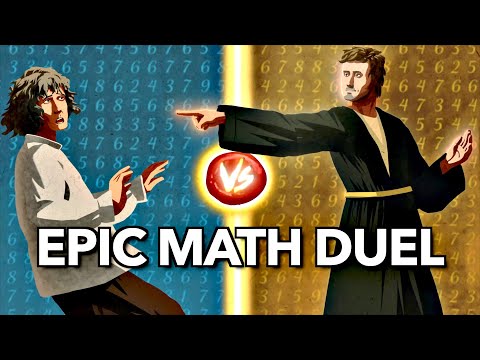
- Scipione del Ferro and the Secret SolutionThe BreakthroughAround 1510, Scipione del Ferro, a mathematics professor at the University of Bologna, found a method to reliably solve depressed cubics (cubic equations with no x² term).Competitive StakesMathematicians in the 1500s faced constant threats from rivals who could challenge them for their positions through math duels. Winners solved more problems correctly and kept their jobs; losers faced public humiliation.Secrecy StrategyDel Ferro kept his solution completely secret for nearly two decades to guarantee his own job security, revealing it only to his student Antonio Fior on his deathbed in 1526.The ChallengeOn February 12, 1535, Fior challenged mathematician Niccolo Fontana Tartaglia, who had recently moved to Venice. Tartaglia solved all 30 of Fior's depressed cubic problems in just two hours, while Fior could not solve a single one of Tartaglia's problems.
- Tartaglia's Geometric Method and Extension to 3DPersonal BackgroundNiccolo Fontana Tartaglia (meaning 'stutterer' in Italian) was largely self-taught, grew up in poverty, and had his face cut open by a French soldier as a child, leaving him with a stutter.3D Completion MethodTartaglia extended the completing-the-square technique into three dimensions by padding a cube with rectangular prisms and smaller cubes, transforming the cubic equation into a solvable form.Key TransformationBy introducing a new variable y, Tartaglia converted the final equation into a quadratic in terms of y³, which could then be solved using the familiar completing-the-square method from two dimensions.Preservation MethodRather than repeat the geometric derivation for each cubic, Tartaglia summarized his method as an algorithm and recorded it in the form of a poem, since modern algebraic notation would not exist for another hundred years.
- Cardano's Publication and the Oath BreakingThe PersuasionGerolamo Cardano, a polymath based in Milan, persistently pursued Tartaglia's secret through alternating flattery and aggressive attacks in letters until he lured Tartaglia to Milan with the promise of an introduction to his wealthy benefactor.The OathOn March 25, 1539, Tartaglia revealed his method only after forcing Cardano to swear a solemn oath never to tell anyone, publish it, or write it except in cipher, so it would be incomprehensible after his death.Full Solution DiscoveryCardano discovered that substituting x minus (b/3a) into any general cubic equation cancels out the x² term, converting it into a depressed cubic solvable by Tartaglia's method.The Loophole• In 1542, Cardano visited Bologna and found Scipione del Ferro's original solution in a notebook, which predated Tartaglia's by decades • This discovery allowed Cardano to rationalize publishing the full solution to the cubic without technically violating his oath to Tartaglia • In 1545, Cardano published 'Ars Magna' (The Great Art), an updated compendium with geometric proofs for all 13 arrangements of the cubic equation
- The Crisis: Square Roots of Negative NumbersThe Problem EmergesSome cubic equations like x³ = 15x + 4 produced solutions containing square roots of negative numbers when plugged into Cardano's algorithm, despite having real solutions.Geometric ParadoxWhen working through the geometric derivation, Cardano encountered a geometric impossibility: a square with an area of 30 but sides of length 5 (which would give area 25), requiring negative area to complete the square.Cardano's EvasionUnable to resolve the paradox, Cardano avoided this case in Ars Magna, calling the idea of square roots of negatives 'as subtle as it is useless.' Tartaglia had no better explanation when asked about it.The Verification PuzzleThe equation x³ = 15x + 4 has x = 4 as a clear solution that can be verified by substitution, yet the standard approach failed to find it, raising a fundamental problem with the method.
- Bombelli's Breakthrough: Treating Imaginary Numbers as RealNew PerspectiveAround 10 years after Ars Magna, Italian engineer Rafael Bombelli refused to dismiss square roots of negatives and instead sought a way forward through the mathematical mess.Novel ConceptBombelli observed that square roots of negative numbers 'cannot be called either positive or negative,' allowing them to exist as their own new type of number, involving the square root of negative one.Mathematical TrickBombelli assumed the two terms in Cardano's solution could be represented as combinations of ordinary numbers and this new type of number. He found that the two cube roots are equivalent to 2 ± √(-1).The MiracleWhen Bombelli added the two cube roots together, the square roots of negative one canceled out perfectly, leaving the correct answer of 4. Cardano's method actually worked, but required abandoning geometric proof and accepting negative areas as intermediate steps.
- The Evolution of Algebraic Notation and Complex NumbersSymbolic RevolutionIn the 1600s, Francois Viete introduced modern symbolic notation for algebra, ending the millennia-long tradition of expressing math problems as drawings and wordy descriptions.Acceptance and Naming• Rene Descartes made heavy use of square roots of negatives, popularizing them throughout mathematics • He called them 'imaginary numbers,' a name that stuck despite their mathematical validity • Leonhard Euler later introduced the letter i to represent the square root of negative oneComplex Number SystemWhen imaginary numbers are combined with regular numbers, they form complex numbers, with imaginary numbers existing on a dimension perpendicular to the real number line, together forming the complex plane.Liberation from GeometryThe cubic led to the invention of imaginary numbers and liberated algebra from geometry. By letting go of what seemed like the best description of reality, mathematics became much more powerful and complete.
- The Rotational Properties of Imaginary NumbersRotation PropertyMultiplying by i repeatedly rotates a point by 90 degrees around the complex plane: 1 × i = i, i × i = -1, -1 × i = -i, -i × i = 1 (returning to start).Exponential FormThe function e^(ix) creates a spiral by spreading out rotations along the x-axis, combining the fundamental wave functions: the real part is cosine and the imaginary part is sine.Wave RepresentationBoth cosine and sine waves—the two quintessential functions describing oscillations—are contained within e^(ix), making this exponential form essential for wave equations.Derivative AdvantageThe exponential form e^(ikx - ωt) has a crucial property: taking the derivative with respect to position or time yields a result proportional to the original function, unlike sine functions where the derivative is cosine.
- The Schrödinger Equation and Quantum MechanicsThe DiscoveryIn 1925, Erwin Schrödinger developed one of the most important equations in physics to describe the behavior of quantum particles, building on de Broglie's insight that matter consists of waves.Unexpected AppearanceThe Schrödinger equation features i (the square root of negative one) prominently, surprising and troubling physicists who were uncomfortable with imaginary numbers appearing in fundamental theory.Schrödinger's ObjectionSchrödinger himself wrote that the use of complex numbers was 'unpleasant' and 'directly to be objected to,' believing the wave function should be fundamentally real, not imaginary.Why Imaginary Numbers Work• Schrödinger naturally chose solutions of the form e^(ikx - ωt) because exponentials have useful derivative properties needed for the wave equation • Since the equation is linear, arbitrary numbers of solutions can be combined to create any wave shape • This formulation naturally produces the quantized orbits matching the Bohr model of the atom
- Imaginary Numbers as Fundamental to RealityThe RevelationFreeman Dyson wrote that by putting the square root of minus one into the equation, 'suddenly it made sense' and became a proper wave equation instead of a heat conduction equation.Predictive Success• The Schrödinger equation describes correctly everything known about atomic behavior • It forms the basis of all chemistry and most of physics • It reveals that nature works with complex numbers, not real numbersHistorical IronyImaginary numbers were discovered as a quirky intermediate step on the way to solving the cubic equation in the 1500s, yet turned out to be fundamental to our description of reality.Deeper TruthBy giving up mathematics' connection to reality—abandoning geometric proof and accepting imaginary intermediate steps—mathematics guided us to a deeper understanding of how the universe actually works.