
Why Super Glue Is Perfect For Gluing Skin
Once it sets, you can literally hang from that one drop of adhesive.
10 chapters
- The Accidental Discovery of Super GlueHistorical ContextIn 1942, Eastman Kodak Company was trying to develop a clear plastic for gun sights to accelerate military production. Chemist Harry Coover was working with cyanoacrylate compound, which showed promise but had the unfortunate tendency to stick to everything.The Key MistakeIn 1951, Coover's coworker Fred Joyner accidentally applied cyanoacrylate between two prisms of a refractometer after testing 909 other compounds. He could not pull the prisms apart, seemingly ruining the expensive equipment worth nearly $10,000.The BreakthroughInstead of getting angry, Coover had a flash of insight. He began gluing together everything within reach: glass plates, rubber stoppers, metal spatulas, wood, and paper. He discovered that everything stuck to everything almost instantly with bonds he could not break apart.Commercial LaunchCoover dubbed the compound Eastman 910 Adhesive, as it was the 910th substance tested in the company's search. Today, everyone calls this product super glue.
- How Super Glue Works at the Molecular LevelBasic MechanismSuper glue in the tube is a liquid of identical monomer molecules called ethyl cyanoacrylate. When placed between two surfaces, the liquid flows into all the pores and crevices, then the monomers start reacting with each other, joining to form long polymer chains.Chemical Reactivity• Ethyl cyanoacrylate has two double bonds and one triple bond close together, with a double bond attached to a nitrile group and an ester group • The nitrogen and oxygen atoms attract electrons more than carbons, leaving one carbon slightly positively charged and hungry for electrons • Any slightly electronegative source, even a negative ion, can trigger the carbon double bond to break and four single bonds to formChain ReactionOnce one monomer reacts, the nitrile and ester groups pull the extra electron across the molecule, making that carbon negative. This invites another slightly positive carbon on a separate monomer to attack, creating chemically linked pairs. This starts a chain reaction where more and more monomers bond together, forming longer and longer polymer chains.Setting SpeedSuper glue normally takes between 10 and 30 seconds to set, much faster than other adhesives available in the 1950s like white glue and glue sticks, which work by drying out and require water evaporation.
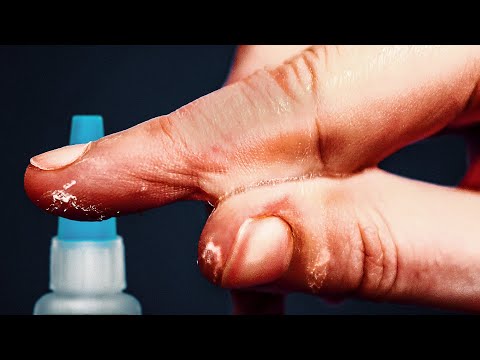
- Water Triggers the Polymerization ReactionWater's RoleThe polymerization of super glue is triggered by water. It's the slightly negative oxygen atoms in the polar water molecule and the negative hydroxide ions in water that break open the carbon double bond, initiating the formation of chains.Why It's Everywhere• Water is everywhere: there's moisture in the air • Little bits of water exist on most surfaces • Water is absorbed into materials like fabrics • This is why super glue sets rapidly on almost every surfaceForensic ApplicationA forensic technique uses super glue fumes to pull fingerprints from non-porous surfaces. When you grab something, your hand leaves behind moisture and oils that are perfect for super glue to bind with.Why Skin Is IdealSkin is the perfect surface for super glue to stick to because there are a lot of wrinkles and pores for super glue to seep into. Additionally, the protein collagen has negative regions that can initiate the polymerization reaction and bond directly with a monomer. Some skin molecules literally become part of the polymer chain, making it extremely hard to get off.
- Super Glue and Medical EmergenciesCase StudyA medical case study documented someone who got cyanoacrylate all over his hands. He tried to wash it off with soap and water, but this accelerated the polymerization reaction and his hands became stuck together.Incorrect TreatmentsHe consulted multiple medical professionals who gave terrible advice. They tried alcohol, water, soap, and attempted physical separation. He even went to consult a cosmetic surgeon before finding the correct solution.The SolutionAcetone, or nail polish remover, successfully dissolved the glue and released his hands.Eye Safety WarningThe bottles for some types of super glue look incredibly similar to eyedrops, resulting in hundreds of cases of people putting super glue directly into their eyes. In that case, acetone is not the solution—do not try to separate your eyelids; seek medical attention immediately.
- Understanding Super Glue's Strength and WeaknessesImpressive Strength• With only a single drop of glue, super glue can support something like 15,000 pounds after 24 hours • The tensile strength of super glue can be upwards of 25 megapascals, similar to other polymers • A square patch just five centimeters on a side could suspend a fully grown African elephantPolymer StructureSuper glue polymers are almost all single chains running linearly between the surfaces with directionality, kind of like wood grain. The chains are densely packed with some cross-linking between them, making the polymer fairly rigid, about as hard as a hard hat.Brittleness ProblemSuper glue is brittle and falls apart easily if there's a sudden impact. The very thing that makes it a great adhesive—forming short chains with built-in stress—is its Achilles heel. Any stress point becomes a potential failure point.Shear and Peel Failures• Super glue is weak in shear when force is applied perpendicular to the polymer chains • Shear is a combination of compression and friction that breaks super glue bonds • Peeling is even worse: all force concentrates on a few polymers, causing chains to break one by one like a zipper unzipping
- Materials Super Glue Cannot Bond ToChemically InertMaterials that super glue does not bond to fall into the category of chemically inert materials, meaning they don't have reactive sites. Examples include polyethylene, polypropylene, nylon, and Teflon.Why They ResistSuper glue is reactive because it's electron deficient and looking for any source of electrons. But with polypropylene, polyethylene, or Teflon, carbon loves carbon and doesn't share its electrons. There's nothing on the surface willing to donate reactivity.Hydrophobic PropertiesThese materials are hydrophobic and non-porous. If you spray a polypropylene sheet with water, it just falls off. If you pour super glue on top of water, you just get a clump that can be peeled off.Practical AdvantageMost super glue bottles specifically warn against using it on polyethylene and polypropylene because it won't stick. This is actually a good thing because you need something super glue won't stick to, so it can be contained and stored without setting.
- Industrial Applications and ModificationsFirst Commercial UseSuper glue's first sale was to Mason and Hanger in 1956, who used it to assemble atomic bombs. Its industrial applications expanded rapidly thereafter.Chemical Modifications• Companies added thickening agents like fumed silica to turn the runny monomers into a gel • Some acid is often added to inhibit polymerization in the tube • Different additives were devised to change the properties of pure ethyl cyanoacrylateAcceleratorsTo speed up the setting of super glue, more negative ions can be added as initiators. DIYers use baking soda (sodium bicarbonate), which reacts with moisture in the air to produce hydroxide ions, causing super glue to set even faster and form a really hard composite substance.Underwater ApplicationTo glue things underwater with super glue, the key is to slow the polymerization down. Gel cyanoacrylate with thickeners slows the reaction, giving enough time to apply and detach objects before it sets.
- Medical Super Glue DevelopmentInitial DiscoveryOne day, Coover's eldest son accidentally cut his finger while making a model. As a quick-thinking father, Coover applied some super glue from the lab to the cut, and it instantly sealed shut. He immediately saw its potential in medicine.Key Problems• As super glue sets, all the bonds forming release heat, which can irritate a wound • Super glue breaks down over time in the body, releasing toxic chemicals like formaldehyde • Super glue is hard and brittle, unlike living tissue which is squishy and flexibleSolution StrategyCoover and his team found that all these problems could be solved by simply increasing the number of carbons in the alkyl chain. Longer carbon chains mean monomers take more time to bind together, slowing the reaction rate, heat release, and allowing longer polymers to form that can flex without breaking.Medical Approval• Coover submitted an FDA application in 1964 for medical super glue • The US military developed a medical super glue spray for use in the Vietnam War • The spray saved lives, including a 24-year-old soldier whose liver bleeding was stopped by spraying super glue directly on it • Medical approval was finally granted in 1998 with 2-octyl cyanoacrylate called Dermabond • Medical super glue has grown to be a $900-million-a-year industry
- Super Glue as a Sustainable Plastic SolutionThe ProblemManufacturers can shred, melt, and reform other plastics, but the polymers degrade, the quality becomes worse, and the process generates microplastics. Plastic can only be recycled mechanically and thermally a certain number of times before becoming useless.Super Glue's AdvantageSuper glue is unique: if you heat it up to 210 degrees Celsius, it breaks back down into pure monomers. These can be distilled and then reactivated back into fresh polymer, achieving 93% recovery—excellent compared to traditional plastics.Technical Challenges• How do you cast something that sticks to basically everything? • How do you stop super glue from breaking since it's brittle on its own?Solutions Found• Modern inert plastics like polypropylene, polyethylene, and Teflon don't activate super glue, making them perfect for handling monomers • Using a very weak base like DMSO (dimethyl sulfoxide) as an initiator allows long polymer chains to form instead of short ones • Using acetone as a solvent provides additional mobility, allowing polymers to form even longer, more stable chains • After the glue sets and acetone evaporates, the new plastic can be reheated and distilled to get back pure super glue monomers
- The Power of Open-Minded ThinkingCoover's Journey• First encounter: thinking only about gun sights, cyanoacrylate's sticky qualities were a frustration • Second encounter: when the refractometer incident occurred, his colleagues fixated on the broken equipment, but Coover saw the stickiness as a benefit • Third encounter: after decades of researchers viewing it only as an adhesive, it took another flash of inspiration to see its potential as a plastic once moreKey InsightCoover's ability to look beyond roadblocks and see breakthroughs on the other side is a skill that every great innovator shares. This should serve as a reminder to be open-minded and curious enough to pursue unexplained events and unexpected results.Learnable SkillThe capacity for breakthrough thinking is not some kind of rare genius. It just takes strong critical thinking and problem-solving skills, which anyone can learn.Unexpected ResultsPursuing unexplained events and unexpected results may unlock new secrets and lead to new and exciting discoveries of the future.