What Everyone Gets Wrong About Gravity
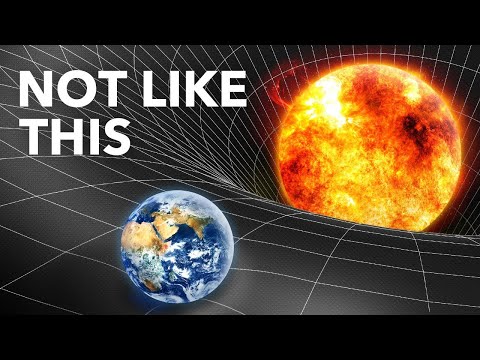
According to the general theory of relativity, gravity is not a force.
6 chapters
- Einstein's Happiest Thought and the Equivalence PrincipleThe InsightEinstein's happiest thought was imagining a man falling off a roof and realizing he would feel weightless, just like objects in deep space at rest or moving at constant velocity.Key RealizationThe falling man and an astronaut in deep space are in equivalent situations—both are inertial observers where no experiment could distinguish their reference frames from any other.The PrincipleEinstein's equivalence principle states that these two scenarios are physically identical, meaning the man is not in a gravitational field and not accelerating—he is an inertial observer.Counterintuition• The falling man appears to be in a gravitational field and accelerating at 9.8 meters per second squared • But the equivalence principle focuses on the observer's experience of weightlessness, not external appearances
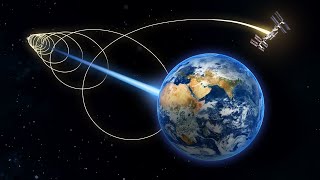
- Curved Spacetime Instead of Gravitational ForcesThe ProblemA rocket ship coasting toward a planet follows a curved path, but the occupant feels no force or acceleration—so how can curved motion exist without gravitational forces?The SolutionSpacetime around massive objects like planets is curved. The rocket travels in a straight line through spacetime, but that straight line appears curved to external observers because spacetime itself is curved.Geodesics Analogy• Airplanes fly the shortest route between cities by going in a straight line, but Earth's curved surface makes this appear curved • Two people walking due north from 1000 kilometers apart on the equator will meet at the North Pole on straight paths (geodesics) on a curved surface, appearing as if a force pushed them togetherSpace Station ExampleAstronauts on the space station are weightless inertial observers traveling on geodesics. Earth curves spacetime around it, making their straight-line path appear as a helix or circular orbit when ignoring the time dimension.
- Why You're Actually Accelerating Right NowThe ComparisonBeing at rest on Earth's surface is physically identical to accelerating at 9.8 meters per second squared in a rocket in deep space—it is the exact same thing, not just similar.Newtonian MisconceptionIn Newtonian physics, weight (gravitational force) and normal force balance out with no net force, so you appear not to accelerate. But in general relativity, gravity is not a force.Relativistic RealityIn general relativity, there is no gravitational field pushing you down. The only force on you is the normal force pushing upward, so you are actually accelerating upward at 9.8 meters per second squared relative to inertial observers like a falling person.The Explanation• Acceleration is deviation from a geodesic—the floor prevents you from following a straight line through spacetime • In curved spacetime, you need to accelerate just to stand still because your spatial coordinates don't change but spacetime is curved
- The Mystery of Universal Free FallThe Newtonian MysteryWhy do all objects fall at the same rate regardless of mass? Newtonian physics requires canceling gravitational mass and inertial mass in the equation, but these are conceptually different properties that scientists have verified are identical to one part in 10 trillion.Why It Was MysteriousGravitational mass creates and experiences gravitational fields, while inertial mass resists acceleration. The question was why these two completely different properties should be numerically identical.General Relativity's AnswerIn general relativity, there is no mystery because all objects are not accelerating. They follow straight-line paths through spacetime until encountering something that stops them, like the floor or ground.The ResolutionObjects appear to fall at the same rate not because they have identical masses, but because they're all following geodesics in curved spacetime—none of them are truly accelerating until they hit an obstacle.
- Einstein's Light Deflection Prediction and Eddington's ProofThe PredictionEinstein reasoned that if light bends in an accelerating reference frame, it must also bend when passing near a massive object like the sun, providing a measurable test for general relativity.The Experiment DesignIn a rocket accelerating at 9.8 meters per second squared, light appears to bend downward during its travel across the cabin. This deflection would be on the order of a proton's width even at extreme acceleration.The TestArthur Eddington photographed stars near the sun during the 1919 total solar eclipse to measure light deflection. He found positions deflected by precisely the amount predicted by general relativity—twice the deflection from Newtonian calculations.The LegacyGeneral relativity has passed virtually every test over the past hundred years, validating Einstein's geometric description of gravity.
- Testing Gravity with Accelerating ChargesThe SetupA conceptually simple test would compare the behavior of a stationary charge in a gravitational field to a free-falling charge, using the known fact that accelerating charges radiate electromagnetic radiation.Newtonian PredictionIn classical gravity, the stationary charge should not radiate (not accelerating), but the free-falling charge is accelerating and therefore should radiate electromagnetic radiation.General Relativity PredictionGeneral relativity predicts the opposite: the free-falling charge is not accelerating (following a geodesic through curved spacetime) and should not radiate, while the stationary charge is accelerating upward and should radiate.Current StatusLogistical challenges have prevented anyone from carrying out this experiment, but what one believes will happen reveals their true understanding of gravity's nature.