

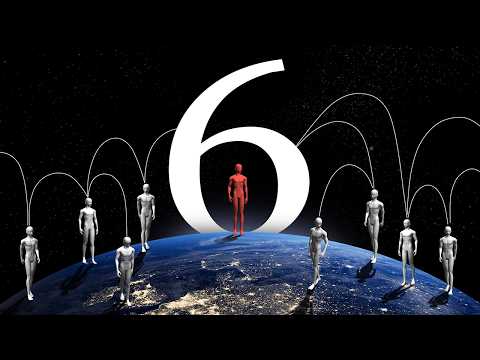
Can you really reach anyone in 6 steps?
11 chapters
- The Six Degrees ExperimentThe Original TestIn 1999, Die Zeit newspaper conducted an experiment asking Salah ben Ghaly, a falafel salesman and former theater director, who he would most like to be connected to. He chose actor Marlon Brando.The ChainReporters found a connection through ben Ghaly's friend in California, who worked with the boyfriend of a sorority sister of the daughter of the producer of 'Don Juan DeMarco,' starring Marlon Brando.Key FindingThe connection took exactly six steps, leading to the concept of six degrees of separation—the idea that any two people can be connected in six steps or less.Central QuestionThe core inquiry: Is this phenomenon truly universal, and how does it affect disease spread, information travel, and other aspects of our interconnected world?
- The Math Behind Small WorldsRandom Connection ModelIf each person knows 100 people out of 8 billion, and each of those knows 100 more, then six degrees of multiplication (100 to the fifth power) exceeds Earth's population, mathematically explaining six degrees of separation.The Reality ProblemIn reality, people don't connect randomly. Most people you know live close to you geographically and know each other, creating high clustering in networks rather than random distribution.Geographic ClusteringA theoretical model with 8 billion people arranged in a circle, each knowing 100 nearest neighbors, would require 80 million steps to reach the other side—demonstrating how clustering prevents small-world connectivity.The ParadoxDespite living in local clusters of friends and acquaintances, we can still connect anyone anywhere in just six steps—this contradiction is known as the small-world problem.
- Watts and Strogatz's Breakthrough ModelThe Problem SetupMathematicians Duncan Watts and Steve Strogatz set out in the mid-1990s to solve the small-world problem, exploring the middle ground between ordered networks (like crystal lattices) and totally random networks.The Shortcut Concept• Watts and Strogatz introduced 'shortcuts'—connections outside your normal circle that make the world smaller • Example: Joining an online chess club and befriending someone in Holland creates a shortcut that puts your friends one step closer to that personThe SimulationThey took a regular network arranged in a circle with each person connected to nearest neighbors, then randomly rewired some connections to different nodes at random to model shortcuts.The DiscoveryBy adding just 1% shortcuts, average degrees of separation dropped from 50 to 10, while clustering remained high—solving the paradox by combining real-world clustering with small-world connectivity.
- Real-World Network TestingNetwork Examples• C. elegans worm: 282 neurons with average degrees of separation of 2.65 (compared to 14 if randomly connected) • Hollywood actors: Over 200,000 actors with average degree of separation less than four • US power grids: Confirmed to be small-world networksVerification ResultsTesting the Watts-Strogatz model on real networks confirmed that nature exhibits small-world properties across diverse systems from biological to technological.Academic ImpactThe 1998 Nature paper had approximately 58,000 citations by the video's time, exceeding citations for the Higgs boson paper and nearly three times Watson and Crick's DNA paper.Interdisciplinary ReachThe research influenced fields from neuroscience and sociology to graph theory, computer science, and even English literature studies.
- Disease Spread in Small-World NetworksClustered Network InfectionIn a fully ordered network where people only know their nearest neighbors, an infection would take 73 days to spread worldwide.Small-World AccelerationAdding just 10% shortcuts reduced infection spread time to 26 days—demonstrating how shortcuts dramatically accelerate disease transmission.Random Network ComparisonA completely random network achieved infection spread in 25 days, nearly identical to the small-world case despite having all random links rather than just 10% shortcuts.Scaling ImplicationsIn a population of 8 billion people, less than 1% of all links need to be shortcuts to achieve near-random network disease spread characteristics.
- Hub Networks and Scale-Free TopologyBarabasi's DiscoveryAlbert-Laszlo Barabasi studied the internet's 800 million webpages in 1998 and found any two sites could connect in 19 clicks, but the network didn't resemble the Watts-Strogatz model.Distribution PatternInstead of a bell curve like population heights, the web showed a steep curve with many sites having few links and a long tail with super-connectors like Yahoo having 100 times more links than average.Hubs Emerge• Barabasi identified 'hubs'—websites with thousands of connections that resemble wheel hubs with spokes • These hubs, not shortcuts, made the web a small world • Hubs fundamentally change how networks behave and what we understand about themNetwork Growth Laws• All large networks grow one node at a time through a growth process • New nodes preferentially connect to already well-connected nodes (preferential attachment) • These two mechanisms naturally lead to hub emergence
- Hub Formation and Preferential AttachmentSimulation ResultsBarabasi and Albert's simulation starting with a small network and adding nodes one at a time with preferential connection showed hubs naturally emerging without explicit design.Airport Example• Chicago O'Hare opened in 1955 with long runways and space, attracting airlines • As more airlines connected flights there, it became increasingly attractive to passengers and other airlines • After 1970s deregulation, this feedback loop accelerated, making O'Hare the most connected US airport with flights to over 200 destinationsNatural Hubs• Food webs: Keystone species like Atlantic cod connecting hundreds of predators and prey • Cell metabolism: Molecules like ATP governing hundreds of chemical reactions • Brain networks: Prefrontal cortex linking hundreds of different functionsInevitable OutcomeAll it takes is a tiny bias when growing a network, and hubs become inevitable—this mechanism operates across biological, technological, and social systems.
- Consequences of Hub NetworksConnectivity BenefitsHubs enable reaching almost anywhere in the world in just a few steps, dramatically increasing accessibility and connection efficiency.Vulnerability ExampleIn August 2025, thunderstorms shut down Chicago O'Hare, canceling 280 flights and diverting 80 others, with overflow affecting six other US airports and planes stuck in Chicago never reaching Europe or Asia.Ecosystem VulnerabilityKnocking out one keystone species like Atlantic cod can destabilize an entire ecosystem, demonstrating that hubs represent an 'Achilles' heel' for networks.Medical Applications• Understanding hub importance led to network medicine field • Researchers develop drugs targeting crucial metabolic network parts • Thailand's 1991 HIV prevention policy targeted brothel hubs, resulting in 50% infection drop among young military recruits and preventing over five million infections by 2013
- Networks and CooperationThe Prisoner's DilemmaA foundational game theory problem where two players can cooperate or defect, illustrating conflicts in real-world scenarios. Rational defection leads to suboptimal outcomes for both players.Axelrod's Finding• In repeated games, cooperation wins out over defection • Tournament among leading game theorists showed successful strategies were 'nice' • Tit-for-tat strategy (cooperate first, then reciprocate) won, proving small clusters of cooperators can overcome defectorsNetwork Structure EffectWatts and Strogatz's simulation showed that adding shortcuts to a regular network destroyed cooperation—cooperators were crushed and defectors dominated, with a critical threshold beyond which cooperation dropped to zero.The Mechanism• In clustered networks: Cooperation emerges from familiarity and repeated interactions • With shortcuts: Each interaction becomes unique and less predictable, discouraging cooperation • Internet example: Anonymous social media platforms with shortcuts allow toxicity and malevolence to spread that might have been shielded in small towns
- Human Behavior in Network StructuresHuman Experiment ResultsWatts tested network structure effects with actual human subjects playing a public goods game and found no significant difference between clustered and random networks—results contradicted his simulations.The Resolution• In clustered networks: People copy each other, all cooperate if anyone starts cooperating, all defect if anyone starts defecting • These opposing effects canceled out statistically • Network structure did matter, but in a different way than the simulations suggestedInstability FindingNetworks are 'on a knife edge'—results depend critically on initial conditions. One person's selfishness can cause collective defection, while cooperation requires everyone to hold together.Choice as Solution• When players could choose who to interact with, cooperation increased significantly • Ability to identify and avoid defectors was crucial • Real-world implication: Avoiding negative interactions and toxic people improves overall cooperation
- Networks Shape Us, But We Shape NetworksIndividual PowerNetworks are always poised on an edge of instability, giving individuals more power than expected. One person can start movements that grow to thousands, ultimately creating change.Historical PatternAll major historical changes start with one stubborn person doing something that leads to 10 people, then 1,000 people, until things fundamentally change.Belief in PowerThe Steve Jobs quote: people crazy enough to believe they can change the world are the ones who do. This belief itself is part of what enables individual agency.Dual ResponsibilityNetworks shape us through their structure and connections, but our individual actions shape the networks themselves. The key is choosing both wisely.