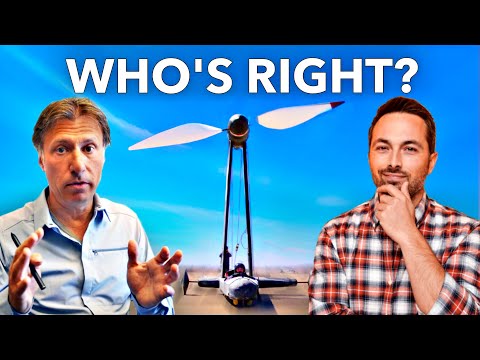
A Physics Prof Bet Me $10,000 I'm Wrong
8 chapters
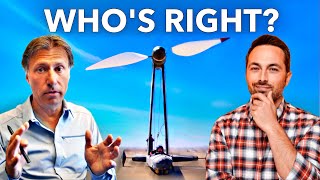
- The $10,000 Bet and Its StakesThe WagerDerek is signing a document betting $10,000 that his previous video claiming a car can go faster than the wind pushing it is correct.The ChallengePhysics Professor Alex Kusenko from UCLA disputes the claim and accepts the bet, believing the explanation is wrong.The Witnesses• Neil deGrasse Tyson, Bill Nye, and Sean Carroll agreed to witness the bet signing • Professor Kusenko requested the wager and discourse be made public • The three scientists praised Derek's generally high accuracy on YouTubeThe PurposeDerek views this as an opportunity to pursue truth through evidence, which he states is the core purpose of his channel.
- Professor Kusenko's Main ObjectionsThe Gust TheoryAlex proposes that a wind gust pushes the car to high speed, and when the wind dies, the car appears faster than wind momentarily but must be decelerating.Wind Gradient Effect• Wind speed is measured at about 1-1.5 meters high but the propeller is at approximately 3 meters • Due to ground interactions, wind travels slower near the ground and faster higher up • Alex estimates the wind speed at the propeller might be 10-15% higher than at the measurement pointTheoretical ProblemsAlex found issues with MIT professor Mark Drela's theoretical analysis, particularly concerning an equation that appears to produce infinite force when car speed equals wind speed.Alex's ConclusionWhen traveling faster than the wind, the acceleration is negative, meaning the car cannot maintain constant speed above wind velocity.
- Testing the Treadmill ExperimentsExperiment DesignTreadmill tests are conducted in still air by moving the ground backwards, simulating a perfectly steady tailwind. If the car moves forward on a stationary treadmill, it shows acceleration faster than wind.Alex's Skepticism• Fluctuating treadmill speed could introduce unconscious bias toward desired results • Human steering with a spork could induce model drift in preferred directions • The experimenter may unconsciously expect and encourage forward movementReplication AttemptsXyla Foxlin, a YouTube maker, attempted to replicate the treadmill experiments. Her first version failed, but she returned with version two, demonstrating determination to solve the problem.Evidence GapNeither Alex nor others had seen Derek's attempts to replicate the treadmill experiments before the debate.
- Derek's Historical and Evidence DefenseHistorical Precedent• Andrew Bauer successfully built the first downwind cart in 1969 to settle a friendly wager • The concept was inspired by a student paper claim from 20 years earlier • Rick Cavallaro, who built Blackbird, was unaware of this history until after his own constructionWind Gradient Refutation• Tell-tales were mounted on fishing poles to the sides and above the propeller • All tell-tales eventually flip backwards, showing the entire vehicle goes faster than wind • Tell-tales consistently point straight back over 30+ seconds until Derek braked to avoid parked vehiclesAcceleration Evidence• Wheel rotation analysis from video footage shows the car continues accelerating after the tell-tale flips backwards • At record speed of 27.7 mph in 10 mph tail wind, multiple GPS units and height-measured wind data confirmed sustained acceleration • The highlighted 10-second measurement period shows the car was still accelerating during the recordAcademic RecognitionThe 2013 U.S. Physics Olympiad Semifinal Exam asked about Blackbird, with the official solution confirming both downwind and upwind faster-than-wind modes are possible with low energy loss.
- The Mechanics of Blackbird ExplainedThe Propeller• The propeller does not work like a windmill • It turns opposite to the direction the wind pushes it • It works like a fan pushing air backwards, powered by the wheels via a bike chainPower ConversionAt the wheels, power is input by the ground moving underneath the car. At the propeller, work is done on the air. The key equation is power equals force times velocity.Force Mechanics• The wheels move much faster over the ground than the propeller moves through the air • This speed difference allows the propeller thrust to be larger than the backward force on wheels • The propeller applies larger force over smaller distance, like a lever or pulley, while wheels apply smaller force over larger distanceThe Lever PrincipleThe car operates like a bicycle going uphill, where pedals move fast with small force to make wheels move slower with bigger force. This same principle allows Blackbird to accelerate faster than the wind.
- Solving the Divide-by-Zero ProblemThe Apparent ParadoxWhen car speed equals wind speed, the propeller equation appears to produce infinite force, suggesting a flaw in the analysis.Why It's Not a Problem• With any lever or pulley, if one arm has zero displacement, infinite weight can be lifted with any force on the other side • The catch is that displacement will be zero, so no actual work is done • This is theoretically expected and not a flawPropeller EfficiencyA propeller efficiency term becomes ill-defined when the propeller is not moving through the air, but a better formula for propeller efficiency is well-defined in the zero speed limit.Practical DemonstrationDerek demonstrates with a simple cart having a big wheel rolling on two smaller spools. When the board is pushed, the cart moves faster than the board itself, showing it can exceed relative velocity when contacting two different media.
- Xyla's Successful Model and ResolutionBuilding Success• Xyla's fourth version of the downwind cart worked spectacularly • It was designed to be replicated by anyone using a 3D printer and simple materials • More building details are available on Xyla's channelThe Professor ConcedesProfessor Kusenko conceded the bet after seeing the evidence and transferred $10,000 to Derek.Derek's Honor and Charity• Derek thanks Kusenko for being a man of honor and changing his mind publicly, which he notes is not easy • Derek does not keep the money • He invests it in science communication through a one-minute video competitionLessons Learned• Scientific disagreements are opportunities to learn, not problems • Derek learned more about Blackbird aerodynamics and gear ratios • He learned he should provide more depth, overwhelmingly convincing evidence, and equations for interested viewers
- Credits and Brilliant SponsorshipKey Contributors• Neil deGrasse Tyson, Bill Nye, Sean Carroll - witnesses • Mark Drela - MIT Aero Professor • Rick Cavallaro - inventor and creator of Blackbird, 15-year advocate for this physics conceptBrilliant's Problem SeriesBrilliant offers daily problems to solve, such as gear ratio calculations. Regular problem-solving builds understanding and insight into physics and engineering concepts.Brilliant's Courses• Computer science courses • Neural networks • Classical physics • Lagrangian mechanics - an elegant way of solving physics problemsSpecial OfferBrilliant is offering 20% off an annual subscription to the first 200 Veritasium viewers who sign up at Brilliant.org/Veritasium.