These are the asteroids to worry about
9 chapters
- The Chelyabinsk Impact and Detection ProblemThe EventOn February 15, 2013, an asteroid heavier than the Eiffel Tower slammed into the atmosphere over Chelyabinsk, Russia, and exploded 30 kilometers above the ground, releasing energy brighter than the sun.The Damage• The shockwave arrived 90 seconds after the blast, damaging thousands of buildings and injuring 1500 people • About 1000 people were injured by glass fragments from windows blown out by the shockwaveDetection FailureScientists successfully predicted that an asteroid called Duende would make a close flyby on the same day, but completely missed the unrelated asteroid that exploded over Russia.The Larger Problem• Since 1988, over 1200 asteroids bigger than a meter have collided with Earth, with only 5 detected before impact • We lack the technology to detect dangerous asteroids before they strike with adequate warning time
- Asteroid Origins and ClassificationFormation HistoryAsteroids are leftover debris from when the solar system formed 4.5 billion years ago, when rocks and dust clumped together into molten protoplanets that eventually broke into pieces.Composition Types• Rocky asteroids are loose conglomerations of gravel-sized rocks called rubble piles • Metal asteroids are pieces from the cores of planetesimals, mostly composed of iron and similar materialsLocation and OrbitsMost asteroids have stable orbits between Mars and Jupiter in the main asteroid belt, but some have migrated closer to Earth and are known as near-Earth objects.Threat AssessmentNear-Earth objects are of greatest interest because of the threat they pose, with Stephen Hawking considering asteroid impacts the greatest threat to life on Earth.
- Why Detecting Asteroids Is DifficultDetection MethodsAsteroids are spotted using ground-based telescopes that take sequences of pictures to identify moving dots orbiting the sun, distinguishing them from stationary stars and galaxies.Physical Obstacles• Asteroids are small, ranging from meters to kilometers in size, and don't stand out in the vast expanse of space • Most asteroids are dark and rough, reflecting only around 15% of the light that hits themThe Opposition EffectOver 85% of detected near-Earth asteroids were found in the 45 degrees of sky directly opposite the sun, where they're best illuminated. Any asteroid approaching from the direction of the sun cannot be seen, which is exactly what happened with Chelyabinsk.Current Catalog StatusScientists have detected and cataloged a million asteroids, though the vast majority are in the main asteroid belt. About 24,000 are near-Earth objects that require close monitoring.
- Prediction Challenges and LimitationsObservation RequirementsDiscovering an asteroid with only a few days of data makes it impossible to predict where it will go. Scientists need observations over years and years to accurately track an asteroid's trajectory.Dynamical ChaosAll planets have gravity and pull on near-Earth asteroids, significantly changing their orbits. This dynamical chaos means that after a certain amount of time, scientists cannot determine where an asteroid will be.Prediction HorizonThe maximum time scientists can predict with any accuracy where a body will be is about 100 years in the future. Beyond that, predictions become unreliable.ImplicationsIf a 10-kilometer or larger asteroid hits Earth, the results will be dramatic and catastrophic, making accurate long-term detection crucial.
- The Barringer Crater and Impact PhysicsDiscovery StoryBarringer Crater in Arizona is named after mining engineer Daniel Barringer, who was the first to suggest it was formed by meteorite impact. The prevailing view until the 1950s was that it was created by volcanic activity.The Search• Barringer staked a mining claim in 1903 and drilled for the metallic meteorite, believing it was worth more than a billion 1903 dollars • He spent 27 years mining the crater, drilling to depths over 400 meters, but found nothingImpact PhysicsAt impact speeds of 30 kilometers per second, the kinetic energy is so enormous that the projectile completely vaporizes into gas. The gas is superheated and super-pressurized, exploding outward to create the crater, leaving no meteorite fragments.The Impact EnergyThe 50-meter asteroid that created Barringer Crater released energy equivalent to 10 megatons of TNT, over 600 times the energy of the Hiroshima bomb, similar to a very large nuclear explosion.
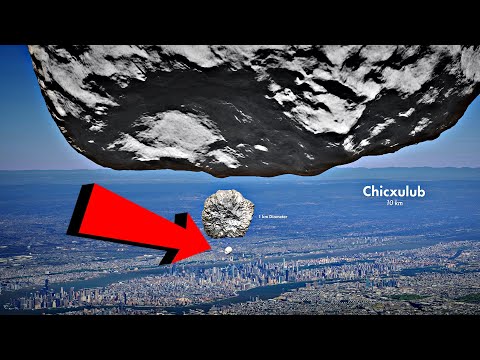
- Extinction-Level Impacts and Global EffectsThe Dinosaur ExtinctionDinosaurs were wiped out by a 10-kilometer asteroid that hit Earth about 65 million years ago, demonstrating the devastating power of large impacts.Global Impact Mechanism• Above a critical size of a couple kilometers, an impacter delivers enough energy to have a global effect • The impact launches debris into sub-orbital trajectory that circulates around Earth and falls back everywhere, even on the opposite side of the planetEnvironmental DevastationThe ejected material lights up the entire sky with meteors, turning day into a red-hot glow like being inside a toaster oven. This radiant heat cooks everything on the ground to death.Survival and RecoveryOnly animals living in tunnels underground or in water had a chance to survive. These survivors later repopulated Earth without having to compete with dinosaurs as a major obstacle.
- Impact Probabilities and Risk AssessmentExtinction-Level Risk• A 10-kilometer impacter like the K-T extinction event occurs roughly every 100 million years • The probability of dying from a 10-kilometer impact in your lifetime is approximately 1 in a million, but astronomers have already identified all large asteroids on collision paths for the next 100 years, making this risk effectively zeroGood NewsThere will be no dinosaur-style extinction event in our lifetimes based on current knowledge of asteroid trajectories.Smaller Threats• There are exponentially more asteroids of smaller sizes—roughly a thousand 1-kilometer asteroids for every 10-kilometer asteroid • These smaller impacts can still cause catastrophic regional damageRegional Damage ScenariosA 1-2 kilometer asteroid could obliterate an entire country the size of France or Germany. Smaller 100-300 meter asteroids can destroy a city and create a 100-kilometer zone of high-speed ejecta, but many remain undetected.
- Deflection Strategies and Their LimitationsFailed Approaches• Bombing the asteroid doesn't work because fragments expand outward briefly but gravity pulls them back together, reforming as a rubble pile • Attaching rockets to push the asteroid gently aside requires keeping rockets attached for centuries, which we don't know how to do • Ablating the surface with lasers would require taking powerful lasers to the object itself, which is even more difficultUnsuccessful Ideas• Wrapping an asteroid in aluminum cooking foil to change its radiative properties—we don't have the capability to launch enough foil to effectively wrap an asteroid • None of these grand ideas worked when analyzed in detailCurrent Reality• We do not have any way to deflect a 1-kilometer asteroid • For 10-kilometer asteroids, deflection is considered 'a thousand times more hopeless'Possible Alternatives• Evacuating the target city is theoretically possible but practically extremely difficult due to traffic gridlock when millions of people try to flee simultaneously • The best current approach is detection and monitoring rather than deflection
- Best Path Forward and RecommendationsPractical PriorityRather than pursuing failed deflection strategies, the most reasonable approach is to focus on what we can actually do: look for asteroids and do the surveys.Detection Investment• Build better telescopes on the ground • Deploy a major space-based telescope to significantly improve asteroid detection capabilitiesStrategic ApproachWhen we find a particular object that looks especially dangerous, we can focus everything we have on it and begin seriously thinking about deflection methods with real motivation.Risk ReassuranceWhile asteroid impacts are a potential global catastrophe, they are just one of many possible existential risks facing humanity in the long term.