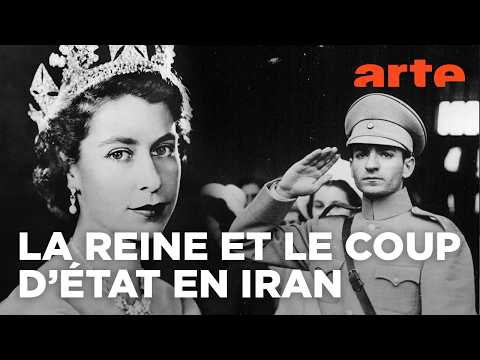
Elizabeth II, les services secrets et le Chah | Documentaire | ARTE
9 chapters
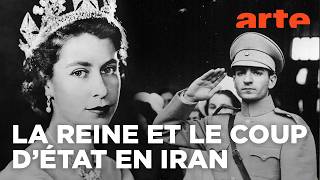
- Secret Messages and Royal InterventionThe RevelationA secret message from Queen Elizabeth expressing concern about the Shah's situation and urging him to stay put. This represents a remarkable case of covert meddling by the British monarchy in the internal affairs of another country.Documentary Sources• American diplomatic material and CIA documents are available to historians • Foreign Office documents were initially denied by Britain • MI6 has never publicly admitted to involvement • Intelligence and monarchy are the two most secretive institutions in the countryHistorical ContextWhen secret worlds of intelligence and monarchy collide, unredacted papers are rarely made public, making such documents extraordinarily difficult to access.SignificanceThis covert intervention demonstrates how the British queen directly influenced geopolitical events during a critical moment in Iranian history.
- Iran's Oil Nationalization and British InterestsAlliance RejectionThe Shah proposed an Anglo-Iranian alliance while staying at Buckingham Palace, but the British government deemed it extremely undesirable due to potential Soviet tensions during the early Cold War.Mosaddegh's Rise• Muhammad Mosaddegh became a national hero through oil industry nationalization • This symbolized Iranian resistance to foreign domination and external dictates • Parliament rallied behind the nationalist movement led by the historic enemy of the British • Mosaddegh became the voice of the nation saying no to foreign superpowersBritish Economic CrisisOil revenue from Iran brought millions to the British Treasury. Post-war Britain needed this money desperately to recover from wartime spending, making oil nationalization an existential threat.Propaganda CampaignBritish media smeared Mosaddegh, portraying him as corrupt, unpatriotic, economically incompetent, and pro-Soviet in a crucial propaganda effort to undermine his credibility.
- Operation Boot: Planning the CoupKey Figures• Dr. Zaharoff: An Oxford lecturer and expert in covert propaganda who had successfully destabilized positions in Iran since 1944 • Sam Fowler: Oriental secretary in the British embassy, representing hard-line military officers with old-school views on British Empire • Monty Woodhouse: Upper-class gentleman spy, former Special Operations Executive officer, future Conservative MPStrategic ObjectiveDestabilize Mosaddegh and encourage remaining Persian allies to show their faces by providing covert support, creating a climate necessary to change the regime and put the Shah into complete control.Operation NameOperation Boot was the British code name for plans to undermine, destabilize, and ultimately overthrow Prime Minister Mosaddegh.American Hesitation• President Truman was reluctant to support what appeared as British conspiracy to perpetuate empire • Americans questioned why they should expend resources for Britain to recover its oil company • The Truman administration believed Britain created its own problem through earlier inaction • Americans had successfully negotiated 50-50 oil agreements with Arab nations, questioning British inflexibility
- Churchill's Persuasion and American ApprovalRhetoric StrategyChurchill used Midwest cowboy language to appeal to Truman from Independence, Missouri, framing joint action against Mosaddegh as two good men dealing with wrongdoing.American Shift• Eisenhower's election brought advisers with a 'can-do' mentality for covert operations • The new administration viewed the Mosaddegh government as unstable and weak • They believed communists would fill any power vacuum, creating a Cold War front line with the Soviets • This ideological framework convinced Americans to join the operationOil Deal TermsThe Americans negotiated a hard bargain: Britain retains 40% of oil revenues, America retains 40%, while America gains political leverage and profits, ensuring Britain can never act independently over Iran again.Power DynamicsThe Shah, having witnessed his father's deposition, remained paranoid about British and American power to depose him at will, making him vulnerable to manipulation and vulnerable to the coup.
- The Shah's Crisis and Royal InterventionThe Breaking PointIn February 1953, Mosaddegh threatened to resign and told the Shah he had enough of British scheming against him, causing the Shah to panic and consider leaving the country.Queen Elizabeth's MessageA telegram indicates Queen Elizabeth expressed concern about the Shah's departure and hoped to dissuade him from leaving, with the message relayed through diplomatic channels as a remarkable example of royal intervention in foreign affairs.Henderson's Telephone Diplomacy• US Ambassador Loy Henderson carefully conveyed that the Shah should not leave the country for the nation's interest • Henderson mentioned receiving a message from a very important personage with whom the Shah had friendly feelings • Henderson was discreet to avoid exposure, knowing Mosaddegh might have tapped palace phone lines • This intervention proved crucial in convincing the Shah to remain and proceed with the coupPsychological ImpactThe Shah, impressed by the apparent message from the world's most important monarch, received a psychological boost that kept him in place, described as a 'be a man' message from Queen Elizabeth urging him to stand firm.
- The Misunderstood Message and CorrectionThe ClarificationA correction telegram reveals the previous message referring to Queen Elizabeth was actually garbled and meant to reference a message from Anthony Eden sailing on the RMS Queen Elizabeth vessel to Canada for a conference.The DeceptionThe Shah believed he received a direct message from Queen Elizabeth urging him to stay, when he actually received a message from a boat with the same name, fundamentally different in origin and authority.Damage Control• Britain would have been livid if the Queen's name had been used in vain • The Americans decided not to inform the British of the incident to avoid diplomatic fallout • Neither power wanted the Shah to know he had been misinformed and potentially dupedUnintended ConsequencesThe Shah, persuaded by what he believed was a royal message, took greater risks and stuck his neck out based on a false premise, making him more complicit in plans against Mosaddegh.
- Covert Action ImplementationOperational Methods• CIA and MI6 leveraged pre-existing opposition to Mosaddegh that already existed and was vocal • The covert operation bolstered existing movements through funding and coordination rather than creating opposition from scratch • A network of established agents and collaborators, developed over many years, were activated at the crucial moment • Bribery became the main mechanism as the coup approachedEscalation PlansThe British discussed possibilities of invasion, sabotaging oil refineries, and even mentioned using nuclear weapons, representing an extraordinary moment when Britain rediscovered old-fashioned gunboat diplomacy.Collateral DamageDuring the operation, MI6 agents abducted the chief of police, a Mosaddegh loyalist, intending to boost opposition morale, but the operation escalated to murder when his body was discovered six days later.The OperativeKermit Roosevelt, the CIA operative, had deep knowledge of Iran and the region, and was confident he could pull off the operation with sufficient money and contacts.
- The Coup's Execution and AftermathBloody VictoryAfter nine hours of bloodshed and three days of riots, the Shah's forces took command and Mosaddegh's reign as virtual dictator of Iran ended, with the former leader fleeing for his life.Royal AcknowledgmentQueen Elizabeth and Churchill sent oral congratulations to the Shah through top secret channels following the successful coup, solidifying the monarchy's support for the outcome.Personal TraumaIranians experienced deep fear and witnessed destruction in the aftermath, with families burning papers and documents as evidence of the upheaval, leaving lasting psychological scars.Trial and ExileMosaddegh faced trial on the government's terms, with the aged defendant constantly challenging the court's authority, ultimately being removed from power permanently.
- Long-Term Consequences and the Islamic RevolutionThe Shah's DeclineThe Shah became a broken man whose life's work and dreams were in tatters, unable to find refuge in countries that had preached loyalty and friendship to him for over 37 years of his reign.Revolutionary Response• Revolutionary guards with Khomeini's tacit support took the fight to the Shah's armed forces • Street demonstrations declared to the world that there could be no turning back • The Iranian people's psychology changed dramatically after the coupAnti-American SentimentThe Islamic Revolution of Iran is a direct response to the 1953 coup, with Khomeini branding the United States the Great Satan. Both religious and political layers blamed America for involvement, fundamentally altering Iranian-American relations.Historical LessonThe 1953 coup exemplifies covert operations carried out for short-term gains but causing immense long-term damage. In Iran, Afghanistan, and many places where the West has meddled, the results have been fairly disastrous.