De Gengis Khan à aujourd'hui | De la Perse à l'Iran : 3 000 ans de civilisations (3/3) | ARTE
De Gengis Khan à aujourd'hui | De la Perse à l'Iran : 3 000 ans de civilisations (3/3)
20 capitulos
- The Mongol Invasion and Conquest of PersiaTwo IdentitiesThe country carries two names: Persia, an ancient and mysterious land of temples and palaces built by powerful kings, and Iran, isolated and fiercely guarding itself against foreign interference since becoming an Islamic Republic in 1979.The Threat Arrives• In the early 13th century, rumors spread of a great warlord advancing from conquered China toward Persia • Genghis Khan's army is disciplined, fearless, and merciless • In February 1221, the Persian city of Merv refuses to open its gates to the MongolsDestruction and Collapse• The city's solid ramparts cannot withstand the destructive assault • On the seventh day, Merv surrenders, but it is too late • The population is evacuated into surrounding countryside and each Mongol warrior is given 400 people to put to the sword • Approximately one million men, women, and children are massacred according to historical accountsAftermath and DominanceBy 1258, Persia is under Mongol domination. The economy collapses, the population is enslaved or exiled, vast regions return to nomadism, and the golden age of Muslim dominance seems to have ended as Islam itself is threatened by pagan Mongols.
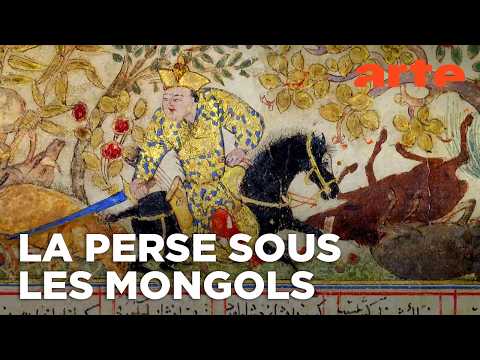
- The Ilkhanids: Cultural Transformation and the ShahnamehPolitical EmergenceFor the first time since the Muslim conquest, Iran becomes a distinct political entity separate from the rest of the Muslim world. The Mongols discover they cannot administer their empire without Persian officials.Religious ConversionIn 1295, the Mongol elites convert to Islam and subsequently become more Persian than the Persians themselves. The Ilkhanids discover and become enthusiastic about the Shahnameh, the Book of Kings written in the early 11th century, which contains the DNA of Persia.Architectural Patronage• The Ilkhanids use the site of Taq-e Soleyman, which housed an important Zoroastrian fire temple, to consolidate their authority • They use pre-Islamic stones and bricks to connect their dynasty to ancient Sassanid sovereigns • Archaeological excavations reveal glazed ceramic tiles illustrating passages from the Shahnameh that once decorated the palace wallsLiterary AdaptationThe Ilkhanids commission special editions of the Shahnameh. In a 14th-century copy, the heroes increasingly resemble Mongols rather than Persians, wearing Mongol clothing and depicted in garden scenes with wine-drinking and horses, representing a fusion of Persian and Mongol cultures.
- The Ilkhanid Golden Age: Architecture and PowerCapital Construction320 kilometers to the east, the Ilkhanids build their imperial capital, which they name Soltaniye. At the heart of this city stands the second-largest mausoleum in the Islamic world.Architectural Marvel• The dome rises 51 meters in height with walls 7 meters thick • The building represents a magnificent jewel of Persian architecture • It tells the story of a sovereign who ordered its construction after converting to Shia IslamReligious SymbolismSultan Öljeitü had planned to house the ashes of the Prophet's son-in-law and cousin, Imam Ali, which would have made the mausoleum the second-greatest pilgrimage site in Shia Islam, though this never occurred.Cultural AbsorptionThe refined calligraphies, geometric ceramic motifs, and majestic dome demonstrate that the Mongol invaders were literally absorbed by Persian culture, transforming from brutal conquerors into sophisticated patrons of the arts.
- Shiraz Spared: Poetry and Humanist PhilosophyCity SalvationThe city of Shiraz is spared from Mongol destruction thanks to the quick thinking of its governor, Atabak. When Mongols appear on the horizon, he wisely opens the gates and prepares a grand banquet for the general. The tactic works, and Atabak even retains his position under Ilkhanid rule.Poetic InspirationRoses are the symbol of Shiraz and inspire the vocation of one of Iran's greatest poets, Saadi, born in 1210. He pursues the work of Ferdowsi and inaugurates a new golden age of Persian poetry.Life and Travels• Saadi has a reputation as a great traveler, journeying west to Anatolia and east to India • His poetry is nourished by wandering through lands devastated by the Mongol invasion • He spends late nights in tea houses talking with ordinary people who survived the massacres: merchants, peasants, religious mystics, and SufisLegacy and ImpactWhen Saadi returns to Shiraz in 1256, he transforms these encounters into poems. His masterwork, the Golestan (Garden of Roses), is a scholarly blend of historical narratives, legends, and wisdom sayings that have become universally familiar and continue to guide people toward justice and happiness.
- Saadi's Humanist Vision and Universal BrotherhoodPractical Wisdom• The Golestan is more than a compendium of popular wisdom • Like the Shahnameh, it is filled with advice on good governance • Saadi addresses how to govern, the relationships between sovereign and subjects, religion, morality, and governmentGuiding PhilosophyWith the Golestan, Saadi attempts to write a book that guides the powerful toward justice and the people toward greater happiness and wisdom.Universal DeclarationSaadi's travels through Mongol-devastated Persia instill in him a modern idea of human rights. His words are now inscribed in the United Nations General Assembly hall in New York: 'The members are one another's limbs and all are created of one matter. If one member is afflicted, the others feel it. Whoever is not touched by the pain of others does not deserve to be called human.'Eternal InfluenceFor Saadi, all human beings are equal regardless of race, religion, gender, or skin color. This faith in humanity makes Saadi renowned throughout the world and eternally cherished in the hearts of Iranians, with verses from his poems adorning his mausoleum walls.
- Timurid Renaissance: Art, Miniatures, and LegitimacyNew ConquerorToward the end of the 14th century, another great warrior emerges on the horizon: Timur, also known in the West as Tamerlane. He turns his ambitions toward Persia, leaving behind mountains of severed enemy heads as his armies sweep through Central Asia toward the south.Dynasty ShiftIn the early 15th century, Persia falls under a new foreign dynasty, the Timurids. Timur's brutal reign is short-lived; he dies of fever in 1405. Like previous conquering dynasties, the Timurids soon fall under the spell of Persian culture.Cultural Transformation• The next generation of Timurids renounce large-scale conquest • While Timur amused himself by piling skulls everywhere, his children and grandchildren become aesthetes and patrons of the arts • The Timurid renaissance represents one of the golden ages of Persian historyArtistic PatronageTimur's successors are friends of Persian arts and literature, attracting numerous artists to their new capital in present-day Afghanistan. The royal court becomes a new cultural epicenter where miniature art reaches new heights of refinement and sophistication.
- The Shahnameh Illuminated: Timur's Descendants Commission MasterpiecesRare ManuscriptA six-century-old Shahnameh from the Timurid period is preserved under lock at the Golestan Palace Museum. This is one of the most beautiful manuscripts in the world and certainly the most important.Princely CommissionThis manuscript is commissioned by Prince Baysunghur, a grandson of Timur. In its pages, like the Mongol sovereigns before them, the Timurids give themselves heroic roles in their new version of the Shahnameh.Artistic Excellence• In Baysunghur's royal workshop, approximately forty calligraphers and painters work exclusively to illustrate Ferdowsi's poetry • The manuscript concentrates the essence of Persian miniature art • Major love scenes of the Shahnameh are depicted, including Rostam and Roudabeh, with illustrations so vibrant they appear to leap from the page • Trees overflow their frames and the illustrations are concentrated and punchy despite their small sizeLegitimacy Through ArtThese rulers wanted to connect themselves to the past, to the kings who preceded them, particularly those who left good memories. It was a way to tell the people: 'See, I am the legitimate sovereign.'
- Weak Successors and Foreign InvasionsDecline of PowerIf the descendants of Timur are friends of the arts, they are poor sovereigns. For nearly a century, Iran becomes increasingly fragile and at the mercy of yet another invader.Resilience MeasuredThroughout travels across the country, the resilience of the Persian people facing repeated invasions by nomadic warriors from east and west becomes evident. Religions, sovereigns, and dynasties have succeeded one another, but whether Persian spirit can resist eternally remains uncertain.New ThreatAt the end of the 15th century, a band of nomadic cavalry arrives from the northwest to draw Iran into a new radical direction: a revolutionary militant movement devoted to converting all Muslims to Shia Islam.Ismail's RiseTheir leader is Ismail, a remarkable warlord who conquers the city of Tabriz at age twelve, beginning his conquest early in preadolescence. His disciples believe he possesses divine qualities, not simply chosen by God but truly divine.
- Ismail and Shia Conversion: The Birth of the Safavid DynastyCharismatic LeaderIsmail is tall, beautiful, and strong with broad shoulders, a long mustache, and excels at archery. He plays the card of Shia extremism by demanding that his followers curse the three caliphs who preceded Ali, the Prophet's only legitimate successor.Militant Campaign• Ismail's crusade not only forcibly converts Muslims to Shia Islam but opens hostilities with neighboring Sunni Ottomans • Military campaigns are immortalized on massive frescoes in the Chehel Sotoun palace • The frescoes contain emotionally moving details: an elderly man held by a young soldier with incredible sadness, a small boy clearly an hostage with bound hands, and a man lying face down with a severed headReligious IdentityDeliberately, Ismail wants to make Shia Islam the state religion so that Iran distinguishes itself from its Ottoman rivals. As Shia Islam becomes established, arts and crafts become means to promote this branch of Islam, present on all objects from carpets to jewelry.Dynasty EstablishmentIsmail becomes the hero of the Shia cause and becomes the first sovereign of a new dynasty, the Safavids. Shia Islam has shaped a new national identity in Iran that remains very strong today, with Iranians and Shia Islam walking hand in hand for the last 500 years.
- Abbas I: Master of Powder and Builder of IsfahanMilitary GeniusIsmail's grandson, Abbas, pacifies the country using a recent weapon: gunpowder. Like artillery, Abbas proves to be decisive for the future of the Safavid dynasty. He is one of three gunpowder empire sovereigns of the 16th century alongside the Ottomans and Mughals.Visionary Ruler• Abbas is adventurous, a true pirate who drinks like no other • He possesses overflowing energy with grand ideas and projects for his country • His vision will give birth to one of the greatest architectural marvelsIsfahan FoundedAbbas decides to build from nothing. His reign must mark the beginning of a new Persian renaissance. To accomplish this, he needs a blank canvas that he will construct in brick and cement: Isfahan, a masterpiece of urban planning and architectural achievement.Global Influence• Abbas chooses such vast dimensions and magnificence that Europeans who flock to discover this court are astonished • They return home and recount what they have seen: extraordinary palaces and dazzling gardens • As a result, Louis XIV constructs Versailles, the Ottomans build the Topkapi Palace, and the Mughal sovereigns construct their garden city at Agra
- Isfahan: The Magnificent City and Its Sacred MonumentsNaqsh-e Jahan SquareThe Persians call this vast square Naqsh-e Jahan, the image of the world, meaning the entire world is reflected within it. This represents the pinnacle of Abbas's vision.Royal Mosque• The jewel of the crown is the Royal Mosque covered with turquoise ceramics, the color of paradise • The dome rises over 30 meters high and doubles with a second exterior dome • The space between the two creates the echo heard resonating throughout the mosque • Abbas commanded his architect to create a structure full of echoes that repeat a sound seven times for the call to prayerSacred ArchitectureThe muezzin stands at the center of a platform made of seven black tiles, like the days of the week and the levels of paradise. Seven is a sacred number, the number of God.Three Centers of Power• At Isfahan, Abbas unites three components of power in Persia • The power of Shia Islam embodied by mosques • The power of the Shah himself with the Ali Qapu Palace • The power of merchants with the Imperial Bazaar that becomes a royal workshop complex
- The Imperial Bazaar: Commerce and CraftsmanshipMarket TransformationThe bazaar entrance is marked by the Qaisariye Portico. Though over 1000 years old, it is under Abbas that this local market transforms into a complex of royal workshops.Economic HeartWithin a few years, Isfahan becomes the economic heart of a reshaped Persian nation. The bazaar attracts crowds as one of the world's largest, a true fairy tale for the senses.Artisanal Excellence• Under Abbas's reign, artists and artisans reach heights of perfection • Their techniques persist in the bazaar today • Craftspeople still spend twenty days producing a single ceramic vase • The bazaar represents centuries of craftsmanship and merchant traditionModern CommerceDespite being a centuries-old bazaar location, it operates with the times. Visitors can pay by card for all transactions, blending medieval commerce traditions with contemporary payment methods.
- The Safavid Golden Age and Its DeclineArchitectural GloryIsfahan is a visionary city that fascinates Western visitors of the era. Today it offers an extraordinary catalog of Islamic architecture. The bridges, mosques, palaces, and bazaars brilliantly reflect the power of the Safavid dynasty and its identification with Shia Islam.Abbas's DeathAbbas dies in 1629. His heirs lack his superb leadership and above all fail to repel another threat: nomadic warlords from Afghanistan.Nader Shah's Rise• A mercenary soldier from Mashhad distinguishes himself in the Persian army ranks • Nader Shah becomes more than an opportunistic mercenary: he is a military genius • He not only fights for the Safavid sovereign but eventually overthrows him to reconquer the country for himself like a true Iranian NapoleonMilitary ConquestWhen Nader Shah proclaims himself king in 1736, he turns his ambitions to India and the Mughal Empire. He crushes the Mughal army in three hours near Delhi, and the Persian Empire reaches its greatest territorial extent since pre-Islamic kings.
- Nader Shah: Triumph, Plunder, and Violent EndColossal PlunderNader Shah brings back enormous booty from his Indian campaign. He sits on the legendary Peacock Throne of the Mughals, encrusted with precious stones including the famous Koh-i-Noor diamond, later recovered by the British and integrated into the Crown Jewels.Contested Legacy• In India, Nader Shah is still considered a plunderer • However, some historians argue that Nader Shah at his beginning came close to creating a unified modern state that could have rivaled British, French, or American empires • The face of the Middle East would have been changedImperial AmbitionsDespite the booty from India, Nader Shah's warrior appetite seems insatiable. He bleeds the country white, and some of his actions could have guaranteed a better future for the nation.Brutal Decline• He becomes increasingly bloodthirsty and eventually is assassinated by his people • His reign is like a fireworks display: a gigantic explosion followed by nothing, no legacy, only darkness • Modern Iranians remember only his glory and prefer to forget the extreme violence of his regime
- Colonial Era: Persia Under Western DominationPolitical CollapseAfter Nader Shah's assassination in 1747, his generals dispute the remains and Persia slowly descends into civil war, opening the way to European colonial penetration.Imperial Interference• Once confident in its ability to benefit from multiple conquerors, Persia becomes the plaything of imperial powers like Great Britain and Russia • From a proud, independent nation, Iran becomes a buffer state caught between British Crown and Russian Tsarist interestsUrban DeclineOnce the dazzling capital, Isfahan declines. Its bazaars and streets fall back into silence, a stark contrast to its golden age.Cultural PreservationWhat remains of ancient Persia after civil war chaos and colonial intervention is the language itself and the literature it created. The narratives of poets and writers like Saadi, Hafez, and Ferdowsi continue to live in tea house salons across Iran through storytellers, becoming a refuge where Persian culture perpetuates itself.
- Tea House Traditions: Living LiteratureOral TraditionBy sipping tea while smoking a water pipe, Iranians recall better times when their sovereigns reigned over much of the ancient world. This tradition of storytelling persists today in tea houses throughout Iran.Shahnameh StoriesIn a Tehran tea house, people gather to listen to a story from the Shahnameh: the story of Bijan and his unfortunate love affair with the daughter of an enemy sovereign. This is one of many origin myths comprising the Shahnameh.Moral Narratives• The Shahnameh contains moral accounts whose characters are responsible for their own downfall and that of their kingdom • These stories serve as cautionary tales and wisdom literature • They represent timeless themes of human nature and political powerCultural ContinuityLiterature continues to be a vital connection between Iranians and their heritage, allowing contemporary society to maintain links with their ancient past through shared narratives and values.
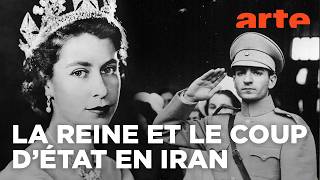
- Mohammad Reza Shah: Emulating Cyrus and Political HubrisImperial PretensionsThe last Pahlavi Shah is called Mohammad Reza Shah. His reign echoes the sad destiny of bad kings in Ferdowsi's book: a history of excessive pride and ambition.Divine Connection• In 1967, Mohammad Reza proclaims himself King of Kings, a gesture meant to convince his subjects that he too is invested with the divine light that all great Persian kings must possess • He sees himself as the product of 2500 years of uninterrupted Persian monarchy • He genuinely believes his mission on earth is to be a new CyrusPersepolis CelebrationMohammad Reza wants the world to know about the sovereign buried at Persepolis: Cyrus the Great, who forged the first Persian Empire in 559 BC. He celebrates the anniversary of the Persian Empire to associate his own reign with that of Cyrus.Cautionary TaleMohammad Reza would have greatly benefited from following the wise counsel contained in the Shahnameh, which is truly a manual of good governance. Instead, he ignores the lessons that Persian kings have always held this book as an ally of their power.
- The Persepolis Celebration: Grotesque Excess and Political FailureGrandiose Event• Mohammad Reza prefers to stage a grotesque parade doubled by a grand festival to impress the gallery • Among guests are kings, queens, heads of state, and even an emperor • They consume 5000 bottles of champagne and one ton of caviar • Over 160 French chefs are brought in to feed everyoneDisconnection from Reality• Very few Iranians are invited to the grand party • All food is imported from France, as is the tableware • It is not at all an Iranian event • Guests are housed in luxury tents evoking the itinerant court of ancient Achaemenid sovereignsTragic IronyLike Oedipus in Sophocles' play, one wants to tell him: 'No, do not do this, it is a mistake.' But he continues, he does it anyway, demonstrating that he understood nothing of Persian history.Catastrophic Impact• The event has a disastrous effect with a pharaonic budget equivalent to 150 million euros • It becomes glaring proof of excessive extravagance at the end of the dynasty • By trying to impress foreign powers with an artificial link to ancient kings, he chooses to ignore the powerful bonds linking Iranians to each other
- The Islamic Revolution: Downfall of the Pahlavi MonarchyKhomeini's Opposition• This distorted vision of royal power serves the interests of Mohammad Reza's sworn enemy: Ayatollah Khomeini • Khomeini denounces from his Iraqi exile the veneration of Persia's pagan past that he considers anti-Islamic and even anti-IranianCatalyst for RevolutionWhile the Shah does everything to position himself as Cyrus the Great's successor, Khomeini protests. The 1971 Persepolis celebrations likely do not originate the Iranian Revolution but definitely play against the Shah.Popular Uprising• His power is increasingly contested • In December 1978, millions of demonstrators take to the streets demanding his abdication • The following month, Mohammad Reza leaves the country and never returnsHistorical ParallelHis fall resembles that of the sovereigns in the Shahnameh, fallen from grace by excessive pride and ambition. Mohammad Reza would surely have benefited from following the wise advice contained in its pages, for this book is truly a manual of good governance.
- Modern Iran: Cultural Resilience Through Art and LiteratureContemporary Challenges• In the following decades, Iran must face numerous ordeals • The Islamic Revolution • A murderous eight-year conflict with Iraq • Economic sanctions imposed by the WestCultural RefugeEven today, Iranians need to escape their present by taking refuge in art, poetry, literature, and their culture. This force unites all Iranians and has shaped the world.Enduring SpiritThroughout travels across the country, the resilience of the Persian people in facing repeated invasions remains evident. Religions, sovereigns, and dynasties have succeeded one another, yet the spirit of Persia persists.Historical ContinuityFrom Genghis Khan to the present day, from ancient Persia to modern Iran, the narrative arc spans 3000 years of civilizations. Despite conquests, collapses, and revolutions, the cultural and spiritual essence of the Persian people endures through literature, art, and shared memory.